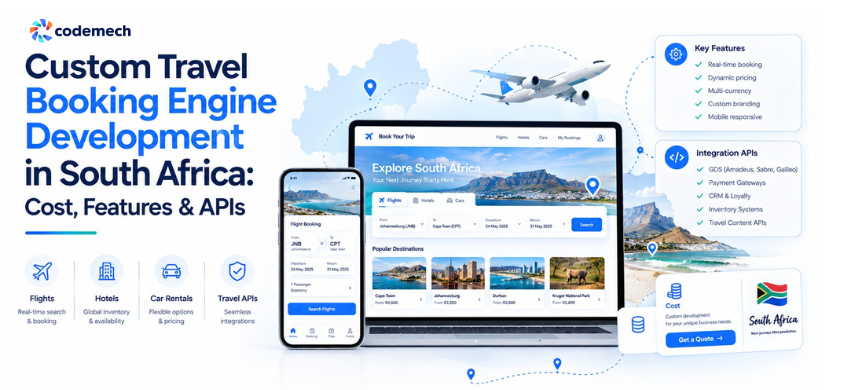
For a South African travel agency, tour operator, OTA, or corporate travel business, custom travel booking engine development in South Africa can provide a tailored way to manage flight, hotel, tour, and other travel bookings from a single platform. A modern booking engine can connect GDS providers, airline and hotel APIs, payment gateways, PNR systems, customer accounts, and internal business tools while supporting requirements such as ZAR payments, multi-currency pricing, B2B workflows, and B2C bookings.
What Is a Travel Booking Engine?
A travel booking engine is the technology layer that allows travellers or travel agents to search, compare, book and manage travel products through a digital platform.
Depending on the business model, the engine may handle:
- Flights
- Hotels
- Car rentals
- Transfers
- Tours and activities
- Packages
- Corporate travel
- Agent bookings
- B2B reservations
- B2C online bookings
A booking engine can operate as part of a travel website, mobile application, B2B travel portal, corporate travel platform, or a larger travel management system.
For example, a South African tour operator could use a custom booking engine to combine accommodation, airport transfers, activities, and safari packages into one customer journey.
A corporate travel company may require a completely different workflow in which employees search for flights, managers approve bookings, and travel consultants manage changes.
This is why a custom travel booking engine should be designed around the business workflow, rather than simply around the available APIs.
For a deeper explanation of the underlying technology, see What Is a Travel Booking Engine and How Does It Work?.
Why Build a Custom Travel Booking Engine in South Africa?
There are already many ready-made travel booking platforms available.
So why would a South African business consider custom development?
The answer usually comes down to business-specific workflows and integrations.
A standard platform may provide basic flight or hotel booking capabilities, but a growing travel company may need its booking engine to work with existing systems and commercial processes.
A custom solution may be considered when a business needs:
- Multiple GDS connections
- Direct airline API integrations
- NDC content
- Hotel supplier APIs
- Custom package booking
- South African payment options
- ZAR pricing
- Multi-currency support
- B2B agent management
- Corporate travel approval
- Custom commissions
- Supplier-specific business rules
- Existing CRM or ERP integration
- Custom reporting
- Different pricing for different customer groups
However, custom does not automatically mean better.
If an existing travel platform already supports the required business model, using it may be more practical than developing everything from scratch.
Custom development becomes more relevant when the business has unique workflows, integrations, pricing rules, supplier requirements, or scalability needs that an off-the-shelf solution cannot efficiently accommodate.
Businesses evaluating this decision can also explore Custom Software Development: What It Is, Benefits, Types, and More.
How a Travel Booking Engine Works
A typical architecture may look like this:
Customer / Travel Agent ↓ Website / Mobile App / B2B Portal ↓ Travel Booking Engine ↓ API & Integration Layer ↓ GDS | NDC | Airline APIs | Hotel APIs | Other Suppliers ↓ Pricing & Availability ↓ Booking / PNR ↓ Payment Gateway ↓ Confirmation & Booking Management ↓ CRM / Back Office / Reporting
The booking engine acts as the central business layer between the customer-facing application, external travel suppliers, payment systems, and internal business applications.
It does not necessarily need to store every supplier's complete inventory. Instead, it can orchestrate requests between suppliers and the customer-facing application.
This architecture becomes especially useful when a travel company works with multiple suppliers.
For example, the same search interface can potentially retrieve content from different approved distribution sources while presenting customers with a consistent booking experience.
For businesses considering architecture choices, the article How Travel Software Companies Build Scalable Booking & Reservation Platforms provides additional context.
Core Travel Booking Engine Features
The exact feature set should depend on the business model, but most serious travel platforms need more than basic search and checkout.
1. Flight Search
The engine should allow users to search based on the requirements of the business.
Common search options include:
- One-way
- Return
- Multi-city
- Departure and arrival airports
- Travel dates
- Number of passengers
- Cabin class
- Flexible dates
- Traveller type
The search interface should be simple for customers but flexible enough to support the underlying supplier requirements.
2. Real-Time Availability
Travel availability changes constantly.
The booking engine should therefore retrieve relevant availability from connected suppliers rather than relying only on static information.
This can involve GDS, NDC and direct airline API connections depending on the distribution strategy.
3. Fare and Price Display
Users need to understand what they are actually paying.
The platform may need to display:
- Base fare
- Taxes
- Service fees
- Markups
- Discounts
- Total price
- Currency
For South African businesses, ZAR may be an important display and transaction currency, while international customers may require additional currency options.
4. Multi-Currency Support
A travel business serving international travellers may need to display prices in multiple currencies.
A multi-currency architecture should define:
- Supported currencies
- Exchange-rate source
- Rounding rules
- Price validity
- Currency conversion
- Payment currency
- Refund currency
The booking engine should also make it clear to customers which currency will actually be charged.
5. Traveller Information
The system may need to capture:
- Passenger name
- Date of birth
- Contact details
- Passport information where required
- Nationality
- Special requests
- Loyalty information
The exact information should depend on the product and booking workflow.
6. PNR Management
For flight bookings, the PNR becomes an important part of the reservation lifecycle.
The platform may need to store or reference:
- PNR number
- Supplier reference
- Passenger details
- Itinerary
- Ticket information
- Booking status
- Payment status
The system should also define how changes received from suppliers are synchronized.
7. Booking Management
Customers and agents may need to access existing bookings.
A booking management area can include:
- View booking
- Download itinerary
- Payment status
- Booking status
- Cancellation request
- Change request
- Traveller details
- Invoice or receipt
- Support request
For a B2B platform, agents may need additional controls such as customer management, commission tracking and booking history.
GDS Integration South Africa: Where Does It Fit?
For many travel businesses, GDS integration South Africa is an important part of the booking-engine architecture.
Depending on the business requirements and commercial arrangements, a platform may integrate with providers such as:
- Amadeus
- Sabre
- Travelport
The technical work is not limited to flight search.
A complete integration may involve:
- Availability search
- Fare information
- Pricing
- Traveller data
- Booking creation
- PNR management
- Ticketing
- Cancellation
- Exchange or reissue workflows
- Post-booking servicing
Therefore, successful search integration does not necessarily mean the platform is ready for production bookings.
For example, Amadeus API Integration Guide: How to Access GDS Travel Content explains the role of Amadeus APIs in accessing travel content.
NDC Integration and Direct Airline APIs
The modern travel distribution environment can involve more than traditional GDS connections.
NDC integration and direct airline APIs can provide additional distribution options depending on the airline, content requirements and commercial relationship.
NDC should not simply be treated as a replacement for every GDS workflow.
Instead, a travel business should ask:
- Which airline content do we need?
- Where is that content available?
- Which booking workflows are supported?
- Can we service the booking after purchase?
- What happens when the airline changes the itinerary?
- How will the content be normalized within our booking engine?
A custom architecture can potentially connect different distribution sources through a common integration layer while keeping supplier-specific business rules where they are required.
Travel API Integration in South Africa
A modern travel platform may need several types of APIs.
Flight APIs
Used for airline availability, fares, booking and related workflows.
Hotel APIs
Used to access hotel availability, room information, rates and reservations.
Transfer APIs
Useful for airport transfers, private transportation and other ground services.
Activity APIs
Can support attractions, tours and experiences.
Payment APIs
Used to process customer payments and communicate payment status to the booking system.
CRM APIs
Can synchronize customer information and booking activity with the company's CRM.
Accounting or ERP APIs
Useful when bookings need to connect with invoicing, financial reporting or internal accounting systems.
The challenge is making these APIs work together.
A well-designed Travel API Integration in South Africa project should therefore focus on orchestration, data mapping, error handling and the booking lifecycle, not simply the number of APIs connected.
Payment Gateway Integration for South African Travel Businesses
Payment is one of the most important parts of a travel booking engine.
A customer may spend significantly more on a flight, holiday package or safari booking than on a normal ecommerce purchase. A failed or unclear payment process can therefore create a serious operational problem.
A South African booking platform may need to consider:
- Credit and debit cards
- Instant EFT
- Digital wallets
- Local payment methods
- International cards
- ZAR payments
- Multi-currency pricing
- Refunds
- Payment verification
- Transaction reconciliation
The right payment setup depends on the business model and merchant arrangement.
For example, South African payment providers offer card and Instant EFT capabilities, and some provide APIs and integrations designed for custom applications.
The booking engine should also have a clear payment-state workflow.
For example:
Search → Select → Passenger Details → Price Confirmation → Payment → Payment Verification → Booking Confirmation
The system should not treat a payment attempt and a confirmed booking as the same event.
B2C vs B2B Travel Booking Engine
One of the first decisions during development is understanding who will use the platform.
B2C Travel Booking Engine
A B2C platform is designed for direct travellers.
The user experience usually focuses on:
- Fast search
- Simple comparison
- Transparent pricing
- Mobile-friendly checkout
- Online payment
- Booking confirmation
- Self-service booking management
For South African consumers, the platform should make pricing, currency and payment information clear before checkout.
B2B Travel Portal
A B2B platform serves travel agents, corporate clients or other travel businesses.
It may require:
- Agent login
- Sub-agent accounts
- Credit limits
- Markups
- Commission rules
- Agent-specific pricing
- Booking history
- Customer management
- Invoices
- Reports
- Role-based access
The interface can therefore be very different from a consumer booking website.
Corporate Travel Platform
Corporate travel introduces another layer.
The system may need:
- Employee profiles
- Company travel policies
- Approval workflows
- Travel budgets
- Preferred suppliers
- Manager approval
- Cost centres
- Traveller profiles
- Reporting
This is why identifying the target user before development is essential.
Businesses interested in corporate travel technology can also explore Corporate Travel Technology Stack: GDS, NDC, APIs & Travel Booking Engine Guide.
Travel Portal Development South Africa: What Should Be Included?
A travel portal is broader than a booking engine.
A travel portal development South Africa project may combine the booking engine with customer accounts, supplier management, agent management, content, payments and administration.
A typical portal may contain:
Customer Area
- Registration
- Login
- Profile
- Booking history
- Saved travellers
- Upcoming trips
Agent Area
- Agent dashboard
- Customer management
- Booking management
- Markups
- Commission
- Reports
Admin Area
- Supplier management
- User management
- Booking management
- Pricing rules
- Content management
- Reports
- Payment monitoring
The exact structure should depend on whether the business operates as an OTA, travel agency, tour operator, DMC, or corporate travel provider.
For the broader distinction between these systems, see Travel Booking Engine vs Travel Portal: What's the Difference?.
Travel Booking Engine Development Cost in South Africa
There is no single price for travel booking engine development cost.
Two projects can both be called “travel booking engines” while having completely different technical scopes.
For example:
Basic Platform
- Single travel product
- Basic search
- Single supplier
- Standard checkout
- Basic admin panel
This is significantly different from:
Advanced Travel Platform
- Multiple GDS integrations
- NDC
- Direct airline APIs
- Hotel APIs
- B2B and B2C portals
- Multi-currency
- ZAR payments
- Corporate travel workflows
- PNR management
- Advanced reporting
- CRM integration
- Mobile application
- Automated servicing
The development cost can therefore be affected by:
| Cost Factor | Why It Matters |
|---|---|
| Number of APIs | Each integration adds development and testing requirements |
| GDS connections | Different providers can have different workflows |
| NDC | May require additional airline-specific distribution workflows |
| Hotel integration | Adds supplier, availability and reservation logic |
| Payment gateway | Requires secure payment and transaction handling |
| B2B portal | Adds agent, commission and account management |
| B2C portal | Requires customer-focused booking and self-service |
| Multi-currency | Adds exchange-rate and pricing logic |
| PNR management | Adds post-booking complexity |
| Admin system | Adds operational management features |
| CRM/ERP integration | Adds data synchronization requirements |
| Mobile app | Adds another application layer |
| Testing | Travel workflows require extensive integration testing |
| Maintenance | APIs and supplier requirements change over time |
For a South African business, development estimates should therefore be based on a documented scope rather than a generic “booking engine price”.
A Practical Development Process
A custom travel booking engine should normally be developed in stages.
Step 1: Define the Business Model
First determine whether the platform is for:
- Travel agency
- OTA
- Tour operator
- Corporate travel company
- Travel management company
- B2B supplier
- B2C consumers
This determines much of the later architecture.
Step 2: Map the Booking Journey
Document the complete journey:
Search → Results → Selection → Passenger Details → Pricing → Payment → Booking → Confirmation → Servicing
Identify what happens at every step.
Step 3: Identify Suppliers
List the required:
- GDS
- Airline APIs
- NDC sources
- Hotel APIs
- Activity providers
- Transfer suppliers
- Payment providers
Do not integrate suppliers simply because they are available. Each integration should solve a business requirement.
Step 4: Design the Integration Layer
The integration layer should handle:
- Authentication
- API requests
- Data mapping
- Supplier responses
- Error handling
- Logging
- Monitoring
This can reduce direct coupling between the front-end booking experience and individual suppliers.
Step 5: Build the Booking Engine
The core engine can then manage:
- Search
- Pricing
- Traveller data
- Booking
- PNR
- Payment
- Confirmation
- Booking management
Step 6: Add Business Rules
This is particularly important for B2B and corporate travel.
Examples include:
- Markups
- Discounts
- Commission
- Approval rules
- Customer-specific pricing
- Supplier preferences
- Travel policies
Step 7: Test Real Booking Scenarios
Testing should go beyond checking whether a search works.
Test scenarios should include:
- Successful booking
- Failed payment
- Payment success but booking failure
- Fare change
- Supplier timeout
- Duplicate booking prevention
- Cancellation
- Reissue
- Refund workflow
- Schedule change
- Currency conversion
Step 8: Monitor After Launch
A travel booking engine needs ongoing monitoring.
The development team should be able to identify:
- API failures
- Slow responses
- Payment failures
- Booking errors
- Supplier issues
- Data synchronization problems
Common Mistakes to Avoid
Building Only the Search Experience
A booking engine is not complete because the search page looks good.
The post-booking workflow is equally important.
Integrating Too Many Suppliers Too Early
Every additional integration increases technical and maintenance requirements.
Start with the suppliers that support the actual business model.
Ignoring Payment Failure Scenarios
A payment can fail, timeout or succeed without the booking being completed.
The system needs a clear reconciliation process.
Treating GDS and NDC as the Same Thing
Different distribution approaches can have different content and workflows.
The architecture should preserve the requirements of each source.
Forgetting Agent Workflows
A B2B travel platform needs more than customer-facing search and checkout.
Agents may need pricing controls, commissions, customer management and reports.
Ignoring Post-Booking Servicing
Changes and cancellations are part of real travel operations.
They should be considered during the initial architecture stage.
What Should You Ask a Travel Software Development Company?
Before selecting a travel software development company South Africa, ask practical technical questions.
- Which travel APIs have you integrated?
- Can you work with GDS providers?
- Can the platform support NDC?
- Can you integrate airline and hotel APIs?
- How will PNR data be managed?
- How will payment failures be handled?
- Can the system support ZAR and multiple currencies?
- Can you build both B2B and B2C workflows?
- How will agent commissions and markups work?
- Can the booking engine connect with our CRM?
- How will post-booking changes be handled?
- What monitoring will be available after launch?
- How will API changes be maintained?
- What testing will be performed before production?
A good technical discussion should focus on the complete business workflow rather than only the number of integrations a provider can advertise.
How CodeMech Solutions Can Help
CodeMech Solutions provides custom software development and travel technology development for businesses that need tailored booking, integration and business-management workflows.
For a South African travel business, the technology requirements may include:
- Custom travel booking engine development
- GDS integration
- NDC integration
- Airline API integration
- Hotel API integration
- Travel portal development
- B2B travel portals
- B2C booking platforms
- Payment gateway integration
- PNR and booking management
- CRM integration
- Custom reporting
The starting point should be the business workflow.
For example, an OTA may need a different architecture from a corporate travel management company, while a tour operator selling safari packages may require a combination of accommodation, transfers, activities and payment workflows.
CodeMech Solutions can help map those requirements into a scalable travel software architecture rather than forcing every travel business into the same booking-engine structure.
Conclusion
Building a custom travel booking engine in South Africa is not simply a matter of creating a flight-search page and connecting an API.
A production-ready platform may need to coordinate GDS, NDC, airline, hotel, transfer, activity, and payment systems with pricing, PNR management, booking confirmation, customer management, and post-booking servicing.
For South African travel businesses, additional considerations such as ZAR pricing, multi-currency support, local payment requirements, B2B agent workflows, corporate travel policies, and international travellers can influence the architecture.
The most useful starting point is therefore not choosing a technology stack or asking for a generic development price.
Start by documenting:
- What travel products you sell
- Who books them
- Which suppliers provide your inventory
- Which distribution channels you require
- How customers or agents pay
- What happens after booking
- Which internal systems need booking data
- Which workflows should be automated
- Which countries and currencies you need to support
- How the platform will be maintained after launch
Once these requirements are clear, a development team can design the appropriate booking engine, API architecture, travel portal, payment workflow, and administration system around the actual business.
If you are planning custom travel booking engine development in South Africa, CodeMech Solutions can help translate your booking, supplier, payment, integration, and operational requirements into a custom travel software architecture.