The travel industry has embraced digital transformation at an unprecedented pace. Whether you're running a travel agency, Online Travel Agency (OTA), Destination Management Company (DMC), hotel chain, airline, or tour operator, customers now expect a seamless online experience—from searching travel options to making secure bookings and managing itineraries.
As travel businesses invest in digital solutions, two terms often create confusion: Travel Booking Engine and Travel Portal. While many people use these terms interchangeably, they serve different purposes and play distinct roles in a travel technology ecosystem.
Understanding the difference is essential before investing in a new travel platform. Choosing the wrong solution can lead to unnecessary costs, limited functionality, or scalability issues. On the other hand, selecting the right platform can improve customer experience, streamline operations, increase direct bookings, and support long-term business growth.
At Codemech Solutions, we help travel businesses design and develop scalable travel technology platforms tailored to their operational needs. In this guide, we'll compare booking engines and travel portals, explain how they work, discuss their features, and help you determine which solution is the right fit for your business.
What Is a Travel Booking Engine?
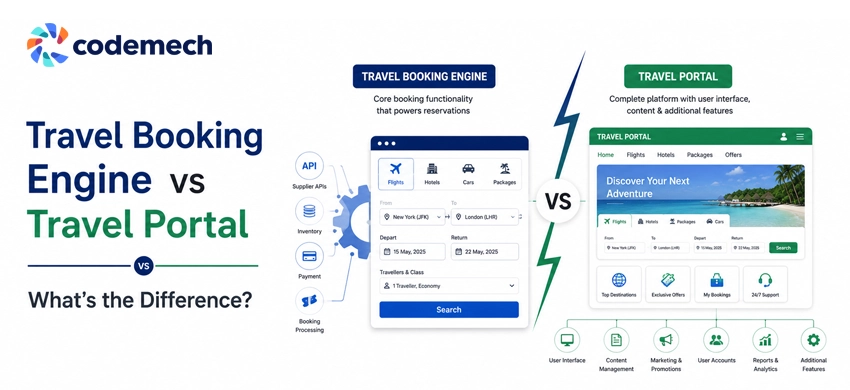
A Travel Booking Engine is the technology that enables customers to search, compare, and reserve travel services in real time.
Its primary function is to automate the booking process by connecting users with live inventory from airlines, hotels, tour operators, car rental companies, and other travel suppliers through APIs and Global Distribution Systems (GDS).
Rather than manually contacting travel providers, customers can complete their reservations within minutes using a website or mobile application.
A booking engine typically handles:
- Flight searches and reservations
- Hotel bookings
- Tour and activity reservations
- Car rental bookings
- Payment processing
- Booking confirmations
- Cancellation and modification requests
Think of a booking engine as the "transactional core" of a travel platform—it focuses on processing reservations efficiently and accurately.
What Is a Travel Portal?
A travel portal is a comprehensive digital platform that brings together multiple travel services, customer management tools, business workflows, and booking capabilities into one integrated system.
Unlike a booking engine, which focuses mainly on reservations, a portal supports the entire customer journey and internal business operations.
Modern Travel Portal Solutions often include:
- Customer login and profiles
- Travel booking engine
- Supplier management
- Agent management
- Corporate account management
- CRM integration
- Content management
- Reports and analytics
- Marketing tools
- Loyalty programs
- Invoice management
- Multi-language support
- Multi-currency support
- Admin dashboard
In simple terms, a travel portal includes a booking engine—but also provides many additional tools for managing and growing a travel business.
Travel Booking Engine vs Travel Portal: Key Differences
Although both systems support online travel businesses, they are designed to solve different business challenges.
|
Feature |
Travel Booking Engine |
Travel Portal |
|
Primary Purpose |
Process travel bookings |
Manage the complete travel business |
|
Search & Booking |
✔ |
✔ |
|
Customer Profiles |
Limited |
Comprehensive |
|
Supplier Management |
Limited |
✔ |
|
Agent Management |
Usually Not Included |
✔ |
|
CRM Integration |
Optional |
✔ |
|
Reports & Analytics |
Basic |
Advanced |
|
Content Management |
No |
✔ |
|
Loyalty Programs |
Optional |
✔ |
|
Business Automation |
Limited |
Extensive |
|
Best For |
Simple booking platforms |
Growing and enterprise travel businesses |
The biggest distinction is that a booking engine is a functional module, while a travel portal is a complete business platform.
How Does a Travel Booking Engine Work?
A booking engine automates the reservation process through several connected systems.
Step 1 – Customer Search
The traveler enters:
- Destination
- Travel dates
- Passenger details
- Budget
- Preferences
Step 2 – API Communication
The booking engine connects to:
- Amadeus
- Sabre
- Travelport
- Airline APIs
- Hotel APIs
to retrieve real-time inventory.
Step 3 – Display Results
Customers receive:
- Available flights
- Hotel rooms
- Package options
- Pricing
- Cancellation policies
Step 4 – Secure Booking
The customer completes payment.
The system then:
- Reserves inventory
- Generates booking confirmation
- Issues tickets or vouchers
- Sends email and SMS notifications
This automated workflow enables travel businesses to process reservations efficiently while minimizing manual intervention.
How Does a Travel Portal Work?
A travel portal includes everything a booking engine does, but extends functionality across the entire travel business.
For example, after a booking is completed, the portal can also:
- Update CRM records
- Notify travel agents
- Calculate commissions
- Generate invoices
- Update accounting software
- Produce management reports
- Trigger loyalty rewards
- Manage supplier settlements
This makes a travel portal an end-to-end business management platform rather than simply a reservation system.
When Should You Choose a Travel Booking Engine?
A booking engine is ideal if your primary goal is enabling online travel booking reservations without extensive operational workflows.
It is a suitable choice for:
- Small travel agencies
- Independent hotels
- Tour operators
- Startup travel businesses
- Airlines
- Businesses focused on direct online bookings
Advantages
- Faster implementation
- Lower initial investment
- Simple booking workflow
- Easy maintenance
- Improved customer convenience
When Should You Choose a Travel Portal?
A travel portal is better suited for businesses that manage multiple stakeholders, suppliers, agents, and complex travel operations.
It is recommended for:
- Online Travel Agencies (OTAs)
- Destination Management Companies (DMCs)
- Large travel agencies
- Enterprise travel companies
- Multi-branch organizations
- B2B and B2B2C travel businesses
Advantages
- Centralized operations
- Better customer management
- Multi-supplier integration
- Business automation
- Advanced reporting
- Greater scalability
Businesses planning long-term growth often benefit from Custom Travel Portal Development, as it allows workflows and features to be tailored to specific operational needs.
Travel Booking Engine vs Travel Portal: Which Is Better?
The answer depends entirely on your business objectives.
Choose a booking engine if you want to:
- Accept online bookings
- Automate reservations
- Reduce manual processing
- Improve customer convenience
- Launch quickly
Choose a travel portal if you want to:
- Manage customers and suppliers
- Support travel agents
- Automate business workflows
- Scale operations
- Centralize reporting
- Build a complete travel ecosystem
For many growing businesses, the ideal solution is a travel portal with an integrated Online Booking Engine, combining reservation capabilities with business management features.
Key Features to Consider Before Choosing
Regardless of the solution you choose, modern travel platforms should include:
- Responsive design
- Secure authentication
- Real-time availability
- Multi-currency support
- Multi-language support
- Payment gateway integration
- API connectivity
- Mobile compatibility
- AI-powered recommendations
- Reporting dashboards
- Customer support tools
- Cloud-based scalability
- Data security and compliance
Investing in scalable technology ensures your platform can adapt as your business grows.
Common Mistakes Businesses Make
Many travel businesses choose software based solely on cost rather than long-term value.
Common mistakes include:
- Choosing a booking engine when a full portal is needed
- Overpaying for enterprise features that won't be used
- Ignoring scalability requirements
- Selecting platforms with limited API integration capabilities
- Failing to consider future business growth
- Overlooking maintenance and support costs
Evaluating current and future business needs helps avoid costly migrations later.
Why Custom Development Is Often the Better Investment
Off-the-shelf solutions can work for basic requirements, but they often limit customization, integrations, and scalability.
With Custom Travel Portal Development, businesses gain:
- Tailored workflows
- Custom branding
- Flexible feature expansion
- Better performance
- Seamless third-party integrations
- Enhanced security
- Long-term scalability
- Greater control over the customer experience
Custom development also eliminates dependency on rigid software platforms that may not evolve with your business.
How to Choose the Right Travel Technology Partner
Choosing the right Travel Portal Development Agency is one of the most important decisions for your project.
Look for a partner with:
- Proven travel technology expertise
- Experience with GDS and travel APIs
- Cloud-native architecture capabilities
- Strong UI/UX design skills
- Secure development practices
- AI and automation expertise
- Ongoing maintenance and support
- Transparent communication
An experienced partner will help you select the right solution based on your business goals rather than recommending unnecessary features.
Why Choose Codemech Solutions?
At Codemech Solutions, we specialize in building scalable, secure, and intelligent travel technology platforms for startups, SMEs, and enterprise travel businesses.
Why Businesses Partner With Us
- Expertise in travel technology and digital transformation.
- Custom travel platform development tailored to business needs.
- Seamless integration with GDS providers and travel APIs.
- Modern cloud-native architecture for scalability.
- AI-ready platforms designed for future innovation.
- Secure payment gateway and third-party integrations.
- End-to-end services, from strategy and design to deployment and maintenance.
Whether you need a booking engine, a comprehensive travel portal, or a fully customized solution, our team can help you build a platform that enhances customer experiences and supports sustainable business growth.
Conclusion:
While a Travel Booking Engine and a travel portal are closely related, they are not the same.
A booking engine focuses on enabling customers to search and reserve travel services, making it ideal for businesses that primarily need online booking functionality. A travel portal, on the other hand, is a complete business platform that combines booking capabilities with customer management, supplier integration, reporting, automation, and operational tools.
The right choice depends on your business model, growth strategy, and operational requirements. If you're planning to expand your services, manage multiple suppliers, or automate complex workflows, investing in a custom travel portal is often the better long-term decision.
Working with an experienced Travel Portal Development Company like Codemech Solutions ensures your platform is designed for performance, scalability, and future growth - helping your business stay competitive in the evolving travel industry.