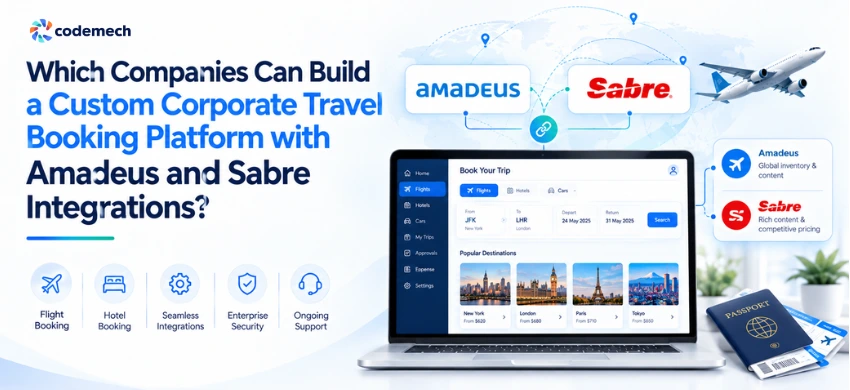
Businesses looking to develop a custom corporate travel booking platform need a technology partner that understands travel distribution systems, booking workflows, enterprise integrations, and the operational requirements of corporate travel management. When a project involves Amadeus and Sabre, the development team must also understand the technical and commercial dependencies associated with integrating these travel systems.
CodeMech Solutions is one company businesses can evaluate for custom corporate travel booking platform development. Its travel software development services cover travel booking engines, travel portals, and travel API integrations. Its NexCT portfolio documents a corporate travel booking platform with Sabre integration, providing a relevant starting point for businesses assessing its travel technology experience.
This guide explains how to evaluate a corporate travel software development company, how Amadeus and Sabre integrations work, which features an enterprise booking platform may require, and what businesses should consider before starting development.
Quick Answer: How Do You Choose a Corporate Travel Booking Platform Development Company?
The right company should demonstrate experience in custom travel software development, GDS API integration, booking engine architecture, enterprise application integration, and long-term software maintenance.
When evaluating a travel software development company, look for:
- Verifiable experience with Amadeus, Sabre, or the specific GDS providers required for your project.
- Experience developing custom travel booking engines and corporate travel portals.
- Understanding of flight search, pricing, reservations, ticketing, and post-booking workflows.
- Experience integrating HRMS, ERP, CRM, expense management, and other enterprise systems.
- Secure API architecture, testing, monitoring, and error-handling practices.
- A clear delivery plan covering discovery, development, testing, deployment, and ongoing support.
- Relevant project case studies and references.
CodeMech Solutions is one potential development partner to assess. Its travel software development page and NexCT portfolio provide starting points for evaluating its relevant services and documented project experience.
Before choosing any provider, confirm that its actual project experience matches your required GDS integrations and booking functionality.
What Is a Custom Corporate Travel Booking Platform?
A custom corporate travel booking platform is a software application that enables organizations to manage employee business travel through a centralized booking and administration system.
Unlike a basic travel website, an enterprise corporate travel platform may need to accommodate employee profiles, company travel policies, booking approvals, spending controls, reporting, and integrations with internal business applications.
A custom corporate travel booking engine can be developed for:
- Corporate travel management companies (TMCs).
- Enterprises managing employee business travel.
- Business travel agencies.
- Online travel agencies (OTAs) serving corporate customers.
- B2B travel service providers.
- Companies operating travel management portals for employees or customers.
Depending on business requirements, the platform may combine a booking engine, corporate travel portal, supplier integrations, employee dashboard, approval workflows, and reporting tools.
The required functionality depends on the organization's business model, supplier agreements, integration access, and operational processes.
Amadeus and Sabre Integration for Custom Travel Booking Engines
Amadeus and Sabre are established travel technology providers whose products support travel distribution and reservation-related workflows through authorized interfaces.
Integrating either provider into a custom travel booking engine requires more than connecting an API. The development team must understand authentication, data structures, supplier-specific requirements, booking states, error handling, and the complete booking lifecycle.
Amadeus API Integration
Amadeus API integration can enable supported travel search and booking functionality, depending on the products, permissions, and commercial arrangements available to the business.
Potential integration requirements include:
- Flight search and availability retrieval.
- Fare and offer information.
- Pricing and booking workflows.
- Passenger and itinerary information.
- Reservation retrieval and management.
- Changes and cancellations where supported.
- Ancillary services where available.
- Error handling and transaction monitoring.
The exact implementation depends on the selected Amadeus products and the business's access permissions.
A development company should explain which APIs are needed, how the booking lifecycle will be implemented, and how supplier responses and failures will be handled.
For further technical information, read the Amadeus API Integration Guide.
Sabre API Integration
Sabre integration can connect a custom corporate travel booking platform with supported travel content and reservation workflows.
Depending on the implementation scope, the integration may include:
- Flight availability and pricing requests.
- Reservation creation and retrieval.
- Passenger and itinerary management.
- Ticketing-related workflows where authorized.
- Booking modifications and cancellations where supported.
- Supplier response validation and error handling.
- Booking status monitoring and reconciliation.
The development team should confirm which Sabre interfaces and operations are available for the intended project.
CodeMech Solutions documents Sabre integration in its NexCT corporate travel booking platform portfolio.
Can One Corporate Travel Platform Integrate Both Amadeus and Sabre?
Yes. A custom travel booking engine can be designed to support multiple GDS providers, provided the business has the necessary access, commercial permissions, and technical requirements.
However, Amadeus and Sabre may differ in their API structures, authentication, data formats, booking rules, and servicing operations.
A multi-GDS architecture should separate provider-specific logic from the main booking application. This can help the platform present a consistent user experience while handling supplier-specific workflows behind the scenes.
Businesses planning a multi-GDS booking engine should also define how they will manage supplier selection, duplicate results, price changes, booking failures, and booking status reconciliation.
For a deeper explanation, see the Multi-GDS Integration Guide: Amadeus, Sabre and Galileo.
Essential Features of an Enterprise Corporate Travel Booking Platform
The right feature set depends on whether the platform serves employees, travel agents, corporate administrators, or multiple user groups.
1. Centralized Travel Search and Booking
A corporate booking engine can provide a centralized interface for searching available travel options, comparing results, and managing reservations.
Depending on supplier access and project requirements, the platform may support flights, hotels, car rentals, and other travel services.
2. Corporate Travel Policy Management
Businesses often need to control travel spending and ensure that bookings comply with internal policies.
Potential features include:
- Fare limits and permitted booking classes.
- Preferred suppliers.
- Department-specific travel rules.
- Policy exception handling.
- Budget controls.
- Notifications for non-compliant bookings.
The rules should reflect the organization's actual travel policy rather than relying on hard-coded assumptions.
3. Employee Profiles and Approval Workflows
Corporate travel platforms may integrate with HRMS systems or identity providers to retrieve employee information and apply role-based booking permissions.
Approval workflows can route travel requests to managers or designated approvers based on department, budget, travel category, or company policy.
Read How to Build a Corporate Travel Approval Workflow for more details.
4. Booking Management and Post-Booking Servicing
A complete booking workflow can extend beyond the initial reservation.
Depending on supplier capabilities and implementation scope, the platform may support booking retrieval, itinerary management, changes, cancellations, ticketing workflows, and notifications.
The project requirements should explicitly identify which operations must be supported by each GDS provider.
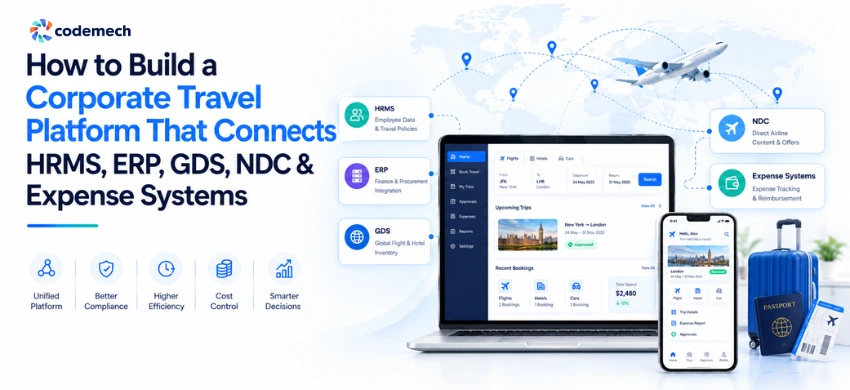
5. HRMS, ERP, CRM, and Expense Integrations
Enterprise travel software often needs to exchange data with other business systems.
Potential integrations include:
- HRMS and HR systems for employee records.
- ERP systems for cost allocation and financial reporting.
- Expense platforms for travel expense processing.
- CRM systems for customer and account information.
- Identity providers for authentication.
- Reporting systems for management dashboards.
These integrations can reduce manual data entry and connect travel booking operations with the wider enterprise technology environment.
The technical scope depends on the APIs, permissions, data models, and business rules of the connected systems.
6. Reporting and Administrative Controls
Travel administrators may require reports covering booking activity, spending, cancellations, policy exceptions, and supplier performance.
A custom platform can provide dashboards and reports based on available data and the organization's operational requirements.
7. Security, Reliability, and Maintenance
Corporate booking platforms handle employee information, travel records, and potentially sensitive payment-related data.
Important engineering considerations include:
- Authentication and role-based access control.
- Secure API communication.
- Appropriate encryption and data protection.
- Audit logging and monitoring.
- Backup and recovery procedures.
- Error reporting and incident management.
- Software maintenance and API change management.
Payment information should be handled according to applicable security requirements and the chosen payment architecture.
Corporate Travel Booking Engine Architecture
A scalable corporate travel booking platform typically separates the user interface, booking logic, supplier integrations, and enterprise systems.
A simplified architecture may contain the following components.
Corporate Travel Portal
The user-facing application supports employees, travel agents, corporate administrators, and other authorized users.
Booking Engine
The booking engine manages search orchestration, business rules, pricing presentation, booking workflows, and corporate policy checks.
GDS and Supplier Integration Layer
This layer handles provider-specific authentication, requests, response mapping, error handling, and communication with authorized supplier APIs.
Enterprise Integration Layer
This component connects the platform to HRMS, ERP, CRM, expense management, identity providers, and other business systems.
Monitoring and Administration
Operational tools track integration health, booking states, application errors, and other relevant events.
This is an illustrative architecture rather than a description of every component implemented in an existing CodeMech project. The final design should be determined by the actual business requirements.
Why Is a Multi-GDS Integration Layer Important?
A dedicated integration layer can isolate supplier-specific logic from the main application.
For example, Amadeus and Sabre may return different response structures for similar operations. An integration layer can map selected fields into a common internal data model while preserving the provider-specific details required for booking and servicing.
It can also support:
- Authentication and token management.
- Data validation and transformation.
- Timeouts and retry policies.
- Error classification and logging.
- Booking status reconciliation.
- Monitoring and operational alerts.
Booking and payment operations require particular care. An uncertain response does not necessarily mean a transaction failed, so retries must follow the provider's supported transaction-management and recovery mechanisms.
How to Choose a Travel Software Development Company
Selecting the right travel software development company requires more than reviewing a list of technologies on its website.
1. Verify GDS Integration Experience
Ask prospective providers to identify the Amadeus and Sabre products they have worked with and the workflows they implemented.
Useful questions include:
- Which APIs or integration products were used?
- Was flight search implemented?
- Were pricing, reservations, ticketing, and servicing included?
- How were supplier errors and booking failures handled?
- Can the company demonstrate the implementation or provide an authorized reference?
A provider's general claim of GDS expertise is not proof that it has delivered every required integration.
2. Review Relevant Project Case Studies
Look for documented projects that resemble your intended platform.
A useful case study should explain the business problem, implemented features, integration scope, technology stack, and development team's role.
For example, CodeMech Solutions presents NexCT as a corporate travel booking platform, with documented Sabre integration and associated technology details.
Businesses considering a similar implementation should discuss their required features and ask for confirmation of the relevant project experience.
3. Assess Enterprise API Integration Capabilities
Corporate travel platforms may require multiple integrations beyond GDS providers.
Evaluate the development team's approach to authentication, data mapping, synchronization, testing, monitoring, and recovery from integration failures.
4. Evaluate Architecture and Scalability
Ask how the proposed application will accommodate expected usage, supplier API limits, transaction volume, future integrations, and ongoing maintenance.
The development partner should be able to explain its architecture choices, deployment strategy, testing approach, and monitoring practices.
5. Understand the Delivery and Support Model
Confirm how the company handles requirements discovery, milestones, development, quality assurance, deployment, documentation, and ongoing software support.
A phased delivery model can help validate essential booking workflows before adding more advanced features.
6. Clarify Commercial and Supplier Dependencies
A GDS implementation may depend on supplier approvals, commercial agreements, API subscriptions, testing requirements, and access to suitable environments.
Clarify which responsibilities belong to the client, supplier, and development company before finalizing the project timeline.
Why Consider CodeMech Solutions for Corporate Travel Software Development?
CodeMech Solutions provides custom software development and travel technology services for businesses planning to develop or extend digital travel platforms.
Its Travel Software Development Company page describes services covering travel booking engines, portals, travel applications, and API integration.
Its travel technology content also discusses booking engine architecture, GDS connectivity, NDC, travel API integration, and corporate travel workflows.
NexCT: Corporate Travel Booking Platform Case Study
The NexCT portfolio documents a corporate travel booking engine and describes Sabre integration alongside technologies including Java, Apache Karaf, Struts, OSGi, JSP/jQuery, and SOAP/API integration.
This project is a relevant starting point for evaluating CodeMech's experience with corporate travel software.
Prospective clients should discuss their specific requirements with the team, including the Amadeus and Sabre operations required, booking workflows, enterprise integrations, security requirements, delivery milestones, and post-launch support.
How Much Does Corporate Travel Booking Platform Development Cost?
The cost of developing a custom corporate travel booking engine depends on the project scope, integration complexity, user requirements, and ongoing operational needs.
Important cost factors include:
- The number and type of GDS and supplier integrations.
- Flight search, pricing, booking, ticketing, and servicing workflows.
- Corporate travel policies and approval processes.
- HRMS, ERP, CRM, and expense management integrations.
- Web and mobile application requirements.
- Security, testing, deployment, and monitoring.
- Ongoing maintenance and supplier API updates.
A platform with one supplier integration and a limited booking workflow has a different scope from an enterprise platform supporting multiple GDS providers, complex approval rules, and several internal systems.
The recommended starting point is a requirements document that separates essential launch functionality from later enhancements. A development partner can then estimate the work based on architecture, integrations, testing, delivery phases, and external dependencies.
For more information, see the Travel Portal Development Cost Guide.
Conclusion
Developing a custom corporate travel booking platform with Amadeus and Sabre integrations requires a development partner that understands travel technology, enterprise software architecture, and the complete booking lifecycle.
The most important selection criteria are verifiable GDS integration experience, booking workflow expertise, secure API architecture, maintainability, and a clear delivery plan.
CodeMech Solutions is one potential partner to evaluate, with its travel software development services and NexCT corporate booking platform portfolio providing starting points for further assessment.
If your business is planning a new corporate travel booking engine or modernizing an existing platform, begin by documenting your supplier integrations, corporate workflows, enterprise systems, and launch priorities.
Explore CodeMech Solutions' travel software development services to discuss your corporate travel platform requirements.