Corporate travel is rarely as simple as booking a flight and a hotel.
An employee may need to travel from Johannesburg to Cape Town for a client meeting, fly from Durban to Johannesburg for an internal event, or travel internationally for a conference or business negotiation. Before the booking can happen, the trip may need to pass through a manager, finance team, travel desk, procurement department or another approver.
When these approvals are handled through long email chains, spreadsheets and manual follow-ups, business travel can quickly become frustrating.
The answer is not to remove controls. It is to build a Corporate Travel Approval Workflow that puts the right controls in the right places while allowing employees to move quickly when a trip is straightforward.
A well-designed workflow should answer three questions:
Does this trip need approval? Who needs to approve it? And what happens next?
What Is a Corporate Travel Approval Workflow?
A Corporate Travel Approval Workflow is the process a company uses to review and approve employee business travel before a booking is confirmed.
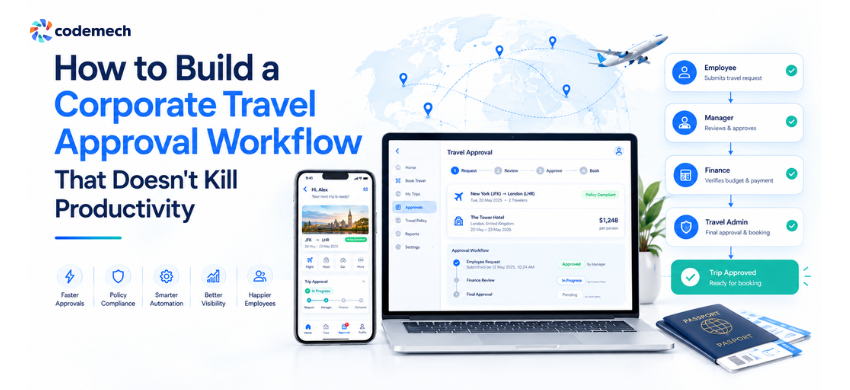
A basic workflow might look like:
Employee → Manager → Finance → Travel Desk → Booking
But not every trip needs to follow the same path.
For example, a routine domestic trip that falls within the company's travel policy may only require the employee's manager to approve it. An international trip with a higher budget may require additional finance or executive approval.
The goal is to create a workflow based on risk, cost and business requirements, rather than making every traveller go through the same approval process.
Why Traditional Travel Approval Processes Slow Employees Down
The problem is often not approval itself. The problem is unnecessary friction.
Consider an employee who needs to travel from Cape Town to Johannesburg for a confirmed client meeting.
If the employee must:
- Complete a spreadsheet
- Email the manager
- Wait for a response
- Forward the approval to finance
- Wait again
- Contact the travel team
- Provide the same information again
- Receive booking options
- Request another approval
then a relatively simple trip becomes an administrative task.
The delays can become even more noticeable when employees are travelling internationally or when a booking needs to be made quickly.
A good workflow should reduce these handoffs rather than simply digitising them.
Start With the Travel Policy, Not the Software
One of the most common mistakes is trying to build the technology before deciding how travel should actually be approved.
Before designing the workflow, define the company's travel rules.
For example:
- Which types of travel require approval?
- What spending limits apply?
- Who can approve domestic travel?
- Who approves international travel?
- When is finance approval required?
- Are preferred airlines or hotels available?
- What happens when the trip exceeds the normal budget?
- What happens during an emergency?
- How are exceptions handled?
Once these rules are clear, they can be translated into software logic.
This is where Corporate Software Development Services can be useful not simply to build screens, but to turn business rules into a practical workflow.
Use Risk-Based Approval Instead of One Workflow for Everyone
A better approach is to create different approval paths based on the characteristics of the trip.
For example:
Low-Risk Trip
A domestic trip within the employee's approved travel budget:
Employee → Manager → Booking
Medium-Risk Trip
A trip that exceeds a defined spending threshold:
Employee → Manager → Finance → Booking
High-Risk or International Trip
An international trip or a trip outside company policy:
Employee → Manager → Finance → Travel/Executive Approval → Booking
The exact rules will depend on the organisation.
The important principle is that simple trips should remain simple.
Give Approvers the Information They Actually Need
Another common problem is asking managers to review too much information.
An approval request should provide the information needed to make a decision quickly.
For example:
Traveller: Sarah M.
Destination: Johannesburg → Cape Town
Purpose: Client meeting
Dates: 12–14 October
Estimated cost: R6,850
Policy status: Within policy
Client/project: ABC Account
Requested action: Approve
The approver should not have to open several documents to understand the request.
A good interface should make the decision obvious.
Add Automatic Policy Checks Before Approval
The workflow should do as much checking as possible before sending a request to a person.
For example, the system could automatically check:
- Whether the destination is allowed
- Whether the estimated cost exceeds the employee's limit
- Whether the requested travel dates are valid
- Whether the trip falls within policy
- Whether the traveller has the required information
- Whether additional approval is required
This changes the role of the manager.
Instead of checking every basic detail manually, the manager can focus on whether the trip itself makes business sense.
Make Exceptions Easy to Handle
Real businesses do not always operate according to standard rules.
A client may change a meeting at short notice. A flight may become unavailable. An executive may need to travel urgently. A project may require an employee to travel outside the normal budget.
The workflow should therefore have an exception path.
Instead of forcing employees to bypass the system, allow them to submit a reason for the exception.
For example:
“Client requested an earlier meeting. Available flights exceed the standard travel limit by R1,200.”
The approver can then see both the exception and its business reason.
This is much more useful than simply displaying a red “Policy Violation” message.
Connect Approval With the Corporate Travel Technology Stack
A Corporate Travel Approval Workflow should not operate as an isolated application.
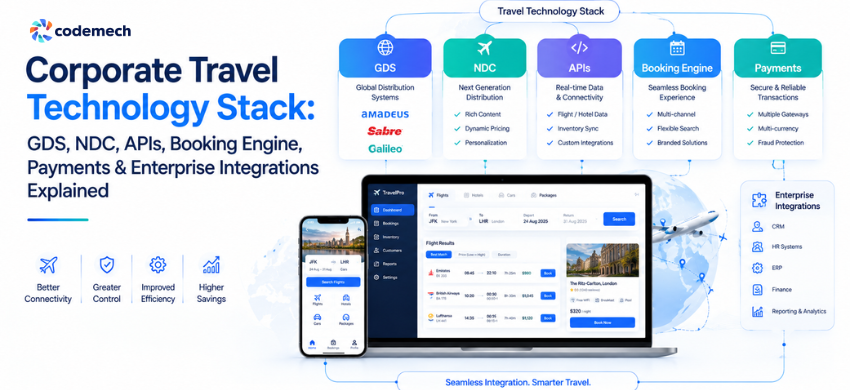
It may need to connect with the wider Corporate Travel Technology Stack, including:
- Travel booking systems
- Flight and hotel APIs
- Expense management
- HR systems
- Finance or ERP platforms
- Identity and access management
- Notification services
- Reporting platforms
For example, employee information can come from the HR system while cost-centre information can come from finance.
Once the approval is completed, the approved request can move into the booking process without requiring the employee to enter the same information again.
That is where integration creates real productivity gains.
Design for South African Corporate Travel
A corporate travel platform serving South African organisations should be flexible enough to handle both local and international business travel.
Domestic travel may involve routes such as Johannesburg, Cape Town, Durban, Gqeberha or other business destinations. International travel may involve different currencies, suppliers, and complex travel API integration in South Africa to pull content from global distribution systems and local transport providers seamlessly.
The system should therefore avoid assumptions that every trip follows the same process.
It should also be designed to handle traveller information responsibly. South African organisations need to consider privacy and data protection when processing employee information. The Information Regulator identifies categories such as names, identification numbers, contact information, banking details and employment information as personal information, with certain categories receiving additional protection under POPIA.
For a corporate travel platform, this means access controls, appropriate data handling and secure integrations should be part of the architecture from the beginning.
Build a Mobile-Friendly Approval Experience
Managers are not always sitting at their desks when an approval request arrives.
An approval workflow should therefore work well on mobile devices.
A manager should be able to:
- View the trip
- Review the cost
- Check the policy status
- See the business purpose
- Approve
- Reject
- Request clarification
without opening a complicated desktop application.
The goal is not to put the entire travel management system on a phone. It is to make the approval decision easy to complete wherever the authorised approver happens to be.
Use Automation for Notifications and Escalations
An approval workflow should not depend on someone remembering to send a follow-up email.
Automation can handle:
- Approval notifications
- Reminders
- Escalations
- Booking confirmations
- Policy alerts
- Status updates
- Cancellation notifications
For example, if an approval remains pending for a defined period, the system can notify the approver or escalate the request according to company rules.
This prevents requests from becoming invisible inside someone's inbox.
Keep an Audit Trail
Corporate travel involves company spending, so organisations need visibility into how decisions were made.
The system should maintain an appropriate history of:
- Who submitted the request
- Who approved it
- When it was approved
- What amount was requested
- Whether an exception was granted
- Who changed the request
- When the booking was completed
This creates accountability without requiring employees to maintain separate approval spreadsheets.
When Should You Use Travel Portal Development Services?
If a company already has a mature travel booking environment, it may only need an approval layer and integrations. To understand the core differences before building, it helps to review a travel booking engine vs travel portal comparison. If the organisation wants to create a complete corporate travel platform, Travel Portal Development Services can cover a much broader solution.
This could include:
- Employee travel requests
- Approval workflows
- Travel search
- Booking
- Supplier management
- Travel policy management
- Expense integration
- Reporting
- Traveller profiles
- Administration
The development scope should be determined by the business process rather than by a list of technology features.
Technology Should Support the Workflow, Not Define It
There is a temptation to start a project by choosing technologies.
For example, a business may immediately start discussing Angular Development Services or Java Application Development Services.
Those technologies can be suitable for enterprise travel applications, but technology selection should come after understanding the workflow.
Angular can be used to create responsive employee, manager and administrator interfaces, while Java can support backend services, APIs, business rules and integrations.
Java Web Development Services can also support the development of secure web-based services that connect the approval system with travel, HR, finance and other enterprise platforms.
The important point is that the technology should serve the business process not the other way around.
When Custom Application Development Makes Sense
Off-the-shelf travel tools can work well for standard requirements.
However, businesses with complex approval structures may need Custom Application Development Services when they have requirements such as:
- Different approval rules by department
- Multiple cost centres
- Project-specific travel budgets
- Complex international travel policies
- Multiple business entities
- Custom supplier integrations
- Special exception rules
- Existing enterprise systems
In these situations, custom development can allow the workflow to reflect the organisation's actual operating model.
A Practical Development Approach
A corporate travel approval project does not need to begin with a massive platform.
A practical first version could include:
Phase 1: Core Workflow
- Employee travel request
- Manager approval
- Policy checks
- Notifications
- Approval history
Phase 2: Travel Integration
- Flight and hotel search
- Travel inventory
- Booking
- Supplier integrations
Phase 3: Enterprise Integration
- HR system
- Finance/ERP
- Expense management
- Reporting
Phase 4: Optimisation
- Analytics
- Automated escalations
- Policy insights
- Advanced approval rules
This phased approach allows the organisation to validate the workflow before investing in every possible feature.
How a Software Consulting Company Can Help
Before development starts, a Software Consulting Company can help map the current travel process and identify where delays actually occur.
For example, the discovery process might uncover that:
- 40% of approval requests are routine
- Managers receive incomplete requests
- Finance reviews requests that do not need finance approval
- Employees enter the same information into multiple systems
- Travel teams spend significant time chasing approvals
These findings can shape the product requirements.
The goal should not be to digitise every existing step. It should be to determine which steps are necessary and automate or remove the rest.
Why Codemech Solutions for Corporate Travel Software?
Codemech Solutions can support businesses developing custom travel and enterprise software platforms, including workflow-driven applications and integrated web systems.
For a corporate travel project, the development approach can cover workflow analysis, UI/UX, frontend development, backend architecture, API integration, testing, security and enterprise system integration.
The focus should remain on creating a travel workflow that employees can use easily while giving finance, managers and administrators the controls they need.
Conclusion
A Corporate Travel Approval Workflow should protect company budgets and policies without turning every business trip into an administrative exercise.
The best workflow is not necessarily the one with the most approval stages. It is the one that sends the request to the right person, with the right information, at the right time.
For South African businesses managing domestic and international travel, that means combining clear travel policies with automated checks, practical approval rules, secure data handling, integrations and a simple employee experience.
Start with the business process. Identify where employees and managers lose time. Automate the repetitive work. Keep exceptions visible. Then choose the technology that can support the resulting workflow.
That approach can turn corporate travel approval from an administrative bottleneck into a controlled, connected part of the wider travel management process.