Starting a travel technology business in South Africa comes with an interesting opportunity. Travel agencies, tour operators, destination management companies and corporate travel providers increasingly need better digital tools to manage bookings, suppliers, customers and travel operations.
But there is one important decision that can shape the future of a travel startup: should you invest in custom travel software development or launch your business using a white-label travel platform?
At first, a white-label solution may seem like the obvious choice. It can reduce initial development effort and help a business enter the market faster. Custom development, on the other hand, offers greater control over features, integrations, workflows and long-term product direction.
Neither option is automatically better.
The right choice depends on your business model, available budget, technical requirements, growth plans and the experience you want to deliver to your customers.
In this guide, we compare both approaches from the perspective of South African travel startups and explain how to choose a solution that supports sustainable business growth.
Understanding B2B Travel Software in the South African Market
Before comparing development approaches, it helps to understand what B2B travel software actually does.
A B2B travel platform connects businesses involved in selling, managing or distributing travel products. Rather than serving only individual travellers, it provides digital infrastructure for travel agencies, resellers, corporate travel managers and other industry partners.
For example, a South African travel company might want to build a platform where registered travel agents can:
- Search hotels, flights and other travel inventory.
- Access negotiated supplier rates.
- Create and manage reservations.
- Generate quotations and invoices.
- Manage customer and agent accounts.
- Track booking payments and commissions.
- Access booking reports and operational information.
Depending on the business model, the platform may also require supplier integrations, multiple user roles, currency support and automated booking workflows.
This is where choosing the right travel software solutions becomes important. A platform that works for a small agency may not necessarily support a growing travel distribution business.
Before choosing a development approach, it is also important to understand the difference between a travel booking engine and a travel portal, as each serves different booking and distribution requirements.
What Is Custom Travel Software Development?
Custom development means building a travel platform around your company's specific operational requirements and business objectives.
Instead of adapting your business to an existing software product, the software is designed around how you want your business to operate.
A custom B2B travel platform could include:
- A centralised booking management system.
- Travel agent and reseller dashboards.
- Hotel and flight API integrations.
- Custom commission and markup management.
- Multi-currency pricing and payment workflows.
- Automated booking confirmations.
- Supplier and inventory management.
- Reporting and business analytics.
- Role-based access and approval workflows.
Consider a South African travel startup that wants to serve independent travel agencies across different regions.
The company might want to offer partner agencies a dedicated portal, negotiated supplier rates, customised commission structures and centralised booking management.
An off-the-shelf product may not support all these requirements. Custom development would allow the business to build these capabilities around its actual operating model.
Advantages of Custom Development
1. Greater control over business operations
Every travel company has different processes. Custom software gives businesses more flexibility to design workflows, user permissions, booking rules and commission structures.
2. Flexible third-party integrations
Travel businesses often depend on multiple suppliers and technology providers. A custom platform can be designed around the required APIs, subject to supplier access, technical documentation and commercial agreements.
3. Better long-term product flexibility
As the company expands, it may introduce new travel products, partner networks, booking workflows or revenue models. Custom development gives the business greater control over these changes.
4. Ownership and control of the product
Depending on the development agreement, intellectual property arrangements and licensing terms, the business can obtain greater control over its software, source code and future development.
5. A differentiated customer experience
If your business competes through specialised travel products, unique workflows or a particular distribution model, custom software can help deliver experiences that generic platforms may struggle to support.
Challenges of Custom Development
Custom development also comes with responsibilities.
- Higher initial development investment.
- Longer planning and implementation periods.
- Continuous maintenance and technical support.
- Requirement for proper product management.
- Responsibility for security, hosting and system updates.
It is important to understand that custom software is not simply a one-time development expense. It is a technology product that needs ongoing investment.
What Is White-Label B2B Travel Software?
White-label travel software is an existing platform developed by a technology provider that another business can use under its own branding.
Instead of building the entire platform from the beginning, a travel startup uses an existing solution and configures the available features to match its business requirements.
Depending on the provider, white-label platforms may include:
- Branded travel booking portals.
- Hotel and flight search functionality.
- Supplier connectivity.
- Agent and reseller management.
- Booking and reservation management.
- Payment and invoicing features.
- Basic reporting and administration tools.
For a new travel agency or startup, this can provide a practical way to enter the market without managing an extensive software development project.
Advantages of White-Label Development Services
1. Faster market entry
The underlying platform already exists, so the startup may be able to launch sooner than with a fully custom-built product. Actual implementation time depends on configuration, integrations and supplier onboarding.
2. Lower initial development effort
A business does not need to fund the entire software architecture and development process. Instead, it pays for access, configuration, implementation or licensing according to the provider's commercial model.
3. Existing functionality
Depending on the platform, common booking and administrative features may already be available.
4. Reduced technical complexity at launch
The technology provider may handle hosting, maintenance, updates and technical support. However, this must be confirmed in the service agreement.
5. Opportunity to validate the business model
A startup can use an existing platform to test demand, attract travel partners and understand its operational requirements before committing to a larger custom technology investment.
Challenges of White-Label Platforms
White-label solutions also have limitations.
- Limited flexibility in modifying core features.
- Dependence on the software provider.
- Recurring subscription or licensing costs.
- Possible restrictions on third-party integrations.
- Limited control over platform architecture.
- Potential difficulty creating unique business workflows.
Another important consideration is data ownership and portability. Before choosing a provider, understand who controls customer data, booking information, supplier relationships and access to the underlying platform.
A low initial price does not always mean a lower long-term cost.
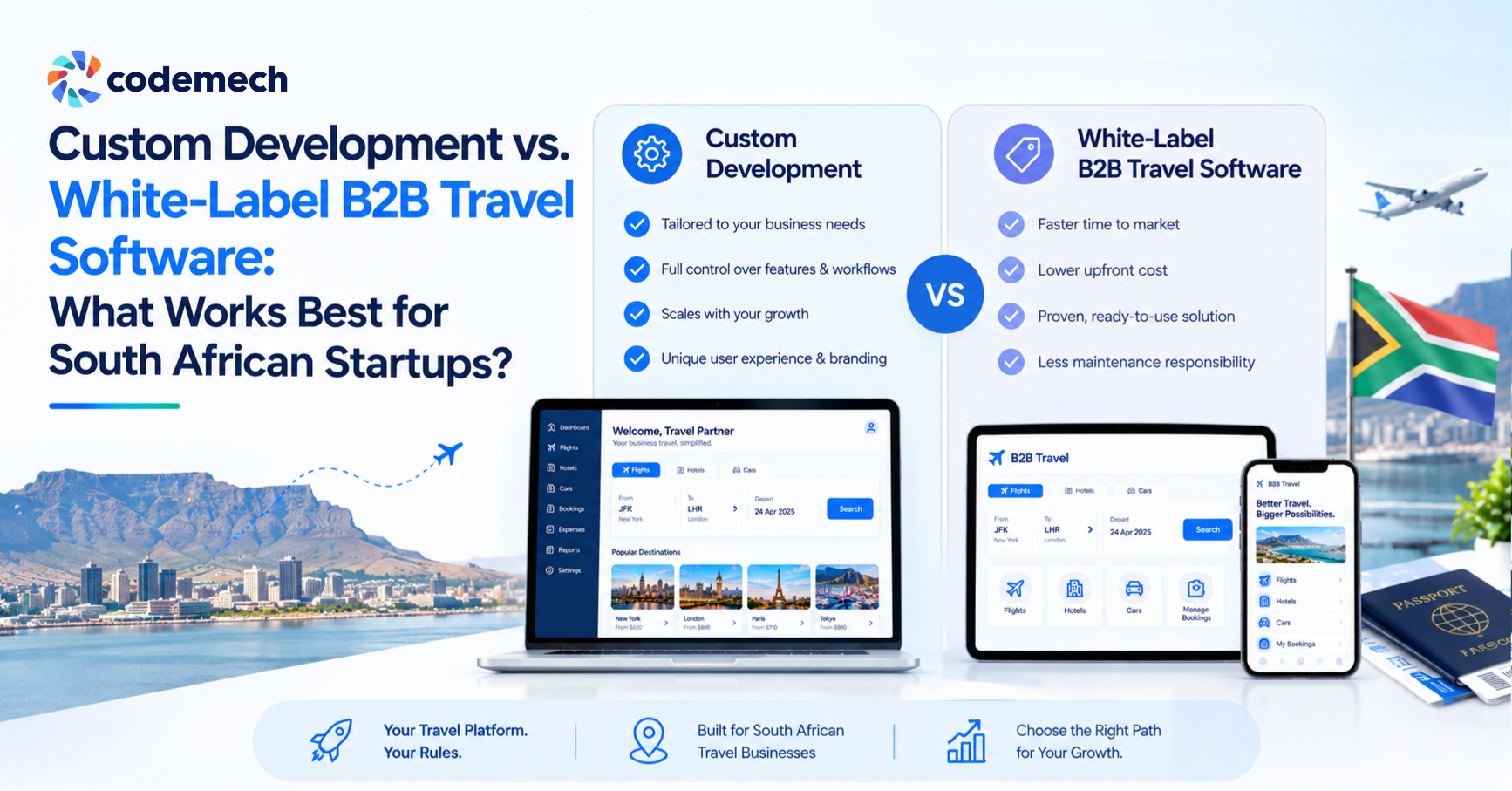
Custom Development vs. White-Label Travel Software: Key Differences
The following comparison can help South African startup founders evaluate both approaches.
| Comparison | Custom development | White-label software |
|---|---|---|
| Initial investment | Generally higher | Often lower |
| Launch timeline | Usually longer | Often faster |
| Customisation | Extensive | Depends on provider |
| Platform ownership | Negotiated through development agreement | Usually provider-controlled |
| Integrations | Designed around requirements | Limited to supported integrations |
| Scalability | Architecture can be designed for growth | Depends on platform capabilities |
| Maintenance | Requires ongoing arrangements | May be included in licensing |
| Differentiation | Greater product flexibility | Depends on available features |
| Technical control | Greater control | Provider-dependent |
There is no universal winner here. The important question is which approach creates the most value for your particular travel business.
Which Option Works Best for South African Travel Startups?
The South African travel market includes businesses with very different requirements. A small travel agency, an online travel startup and a B2B travel distribution company do not necessarily need the same technology.
Let's consider three practical situations.
Scenario 1: A New Travel Startup With a Limited Budget
Imagine an entrepreneur in Cape Town planning to launch an online travel agency.
The initial business objective is relatively straightforward: offer travel products, attract customers, manage bookings and validate market demand.
At this stage, a white-label solution may be a sensible option.
It can reduce the initial technical workload and allow the founder to concentrate on supplier relationships, marketing, customer acquisition and operations.
However, the founder should first check whether the platform supports the required suppliers, booking workflows, payment arrangements and commercial model.
Recommended approach: White-label software, provided its capabilities match the business requirements.
Scenario 2: A Growing B2B Travel Distribution Company
Now consider a Johannesburg-based travel company that wants to connect multiple independent travel agencies through one platform.
Its requirements may include:
- Different commission structures for partner agencies.
- Individual agent accounts.
- Supplier-specific pricing.
- Custom booking approval workflows.
- Consolidated reporting.
- Integration with multiple travel suppliers.
These requirements may be difficult to support through a standard white-label platform.
Custom development becomes more attractive because the company needs technology that supports its distribution model rather than simply a branded booking website.
Recommended approach: Custom development or a highly configurable hybrid solution.
Scenario 3: An Established Travel Business Expanding Its Operations
Consider an established Durban-based tour operator that already has customers, supplier relationships and a working booking process.
The business wants to introduce a B2B booking portal and automate some existing manual operations.
It may not need to rebuild everything.
A practical solution could be to retain existing systems, introduce a white-label booking component where suitable and custom-develop the integrations and workflows that are missing.
Recommended approach: Hybrid development, provided the existing platform supports the necessary integration and data access.
What About Travel Portal Development Cost in South Africa?
Cost is one of the biggest considerations for a startup choosing between custom development and white-label software.
However, giving a fixed price without understanding the project requirements can be misleading.
A simple branded booking portal and a multi-supplier B2B travel distribution platform are completely different development projects.
The overall investment depends on several factors.
For custom development:
- Number and complexity of features.
- UI/UX design requirements.
- Supplier and API integrations.
- Booking and reservation workflows.
- Payment gateway integration.
- Multi-user and agent management.
- Security and infrastructure requirements.
- Testing, deployment and ongoing support.
For white-label software:
- Initial setup and configuration fees.
- Monthly or annual licensing charges.
- Branding and customisation costs.
- Supplier integration charges.
- Transaction or booking fees.
- Additional module costs.
- Support and maintenance agreements.
South African businesses should also consider whether supplier agreements, payment providers and settlement arrangements are compatible with their intended operating model.
If you are still estimating your initial technology investment, our guide to travel portal development cost explains the major factors that influence development budgets, implementation requirements and ongoing expenses.
A useful way to evaluate the investment is to calculate the total cost of ownership over three years rather than comparing only the initial development quote.
For example:
| Cost consideration | Custom | White-label |
|---|---|---|
| Initial implementation | Development investment | Setup and licensing |
| Ongoing costs | Maintenance and hosting | Recurring licensing |
| Feature changes | Additional development | Provider-dependent |
| Integrations | Project-specific | May incur additional fees |
| Future flexibility | Depends on architecture and ownership | Depends on vendor capabilities |
Ask every potential provider for a breakdown of initial costs, recurring charges, additional integrations and future modification costs.
Important Technology Considerations Before Choosing a Travel Platform
Regardless of the development approach, certain technology decisions deserve attention.
1. Travel API and Supplier Integration
A B2B travel platform may need to connect with hotel aggregators, airline systems, bed banks, tour suppliers and other travel service providers.
Check whether the platform supports the integrations you actually need.
For example, an Amadeus integration may be relevant to some travel businesses, but not every startup requires the same connectivity.
Supplier access, API permissions, commercial terms and certification requirements should be evaluated before development begins.
For businesses planning to connect multiple travel suppliers, understanding travel API integration in South Africa can help clarify supplier connectivity options, integration requirements and the technical considerations involved.
2. Booking and Reservation Management
Search functionality alone is not enough.
A reliable platform needs to manage the complete booking lifecycle, including:
- Availability and pricing.
- Reservation creation.
- Booking confirmation.
- Cancellation and modification.
- Payment status.
- Refund workflows, where applicable.
The platform should also handle supplier errors and changes in availability appropriately.
3. Multi-Currency and Payment Support
A South African travel business may serve local customers as well as international travellers and travel partners.
Consider whether the system needs to support ZAR, international currencies, payment reconciliation and the relevant payment providers.
Currency display, actual transaction currency and settlement currency should not be treated as the same thing.
4. Security and Customer Data
Travel platforms handle customer details, travel information and transaction-related data.
Consider access controls, secure authentication, data protection, backups, monitoring and appropriate compliance obligations, including applicable POPIA requirements in South Africa.
5. Scalability and Future Expansion
A startup may begin with a small partner network but eventually serve hundreds of travel agents.
The platform should be evaluated for its ability to handle increasing traffic, concurrent bookings, supplier requests and growing data volumes.
A scalable architecture should be planned according to realistic business requirements rather than simply choosing the most complicated technology stack.
Is a Hybrid Travel Software Model Worth Considering?
One option that often receives less attention is combining custom development with white-label software.
Rather than choosing one approach for the entire platform, businesses can use existing technology for standard functionality and invest in custom development where it creates a competitive advantage.
For example:
- Use an existing booking engine for standard travel searches.
- Build a custom agent dashboard.
- Develop specialised commission management.
- Integrate internal CRM and accounting systems.
- Create custom reporting for management.
- Develop business-specific booking approval workflows.
This can provide a balance between implementation speed, flexibility and investment.
However, hybrid development is only practical when the white-label provider offers suitable APIs, integration access and clear contractual rights.
Otherwise, the business may end up with two disconnected systems and additional complexity.
Questions to Ask Before Selecting a Travel Software Development Company
Choosing the right technology partner matters just as much as choosing the development approach.
Before signing an agreement, ask potential providers:
- Have you developed B2B travel portals or booking management platforms before?
- Can you integrate hotel, flight and other third-party travel APIs?
- Can the platform support multiple travel agents and supplier accounts?
- Who owns the source code and intellectual property?
- What are the ongoing hosting, maintenance and support costs?
- How will customer data and booking information be protected?
- Can the platform support future features and additional integrations?
- What happens if we decide to migrate to another technology provider?
Ask for relevant project examples, technical documentation and a clear scope of work.
A good technology partner should also be willing to explain what does not need to be developed. Not every business requirement needs a custom-built solution.
How CodeMech Solutions Can Help With Travel Software Development
At CodeMech Solutions, the focus is on helping businesses turn technology requirements into practical software solutions.
For travel startups and established travel businesses, the right development approach starts with understanding the business model, operational challenges, target customers and long-term product objectives.
Depending on project requirements, CodeMech Solutions can help businesses evaluate and plan:
- Custom travel software development.
- B2B travel portal development.
- Travel booking engine development.
- Third-party API and supplier integrations.
- Custom booking and reservation workflows.
- Agent and partner management systems.
- Platform enhancements and software integrations.
Whether a business needs a new platform or wants to extend an existing travel system, the objective should be to create technology that supports its actual operations and future growth.
The first step is not choosing a technology stack. It is identifying what the business needs the platform to achieve.
Final Verdict: Custom Development or White-Label Software?
For South African travel startups, the best choice depends on where the business is today and where it wants to go.
White-label software can be a practical starting point for businesses that need standard booking functionality, want to enter the market quickly and prefer a lower initial development commitment.
Custom development is more suitable for businesses that require specialised workflows, greater product control, unique supplier integrations and a differentiated technology offering.
A hybrid model can also make sense when an existing platform handles standard operations but cannot support the company's unique requirements.
Before making a decision, compare the total cost of ownership, supplier integration capabilities, data ownership, customisation restrictions and long-term scalability.
Planning a B2B travel platform for the South African market?
CodeMech Solutions can help you assess your travel technology requirements and explore a suitable development approach.
Discuss your project, platform requirements and integration needs with the team to identify a practical path from business idea to working travel software.