South African travel businesses are under pressure to move faster. A customer in Cape Town wants to book an international flight, a safari lodge near Kruger National Park, and an airport transfer preferably from one website, with an instant confirmation. If your team is still checking availability manually, emailing suppliers and copying booking details between systems, you’re losing valuable time. And possibly bookings.
That’s where Travel API Integration in South Africa becomes a practical growth strategy rather than just a technical project.
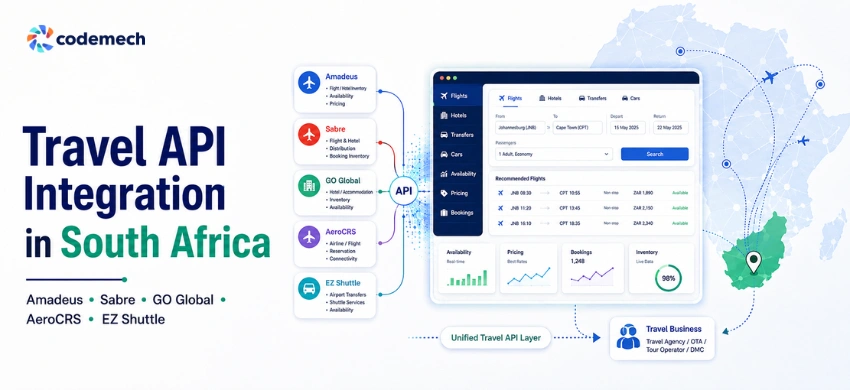
Travel APIs connect your travel website or application with suppliers such as airlines, hotels and transfer providers. Instead of your staff jumping between multiple systems, customers can search, compare and book travel services directly through your platform.
This guide looks at five solutions: Amadeus, Sabre, GO Global, AeroCRS and EZ Shuttle. We’ll explain what each platform does, where it fits, what integration involves, likely costs in South African Rand, and which option may suit your business.
Whether you operate a travel agency in Johannesburg, a safari business in Cape Town, an OTA startup in Pretoria, or a lodge that wants direct online bookings, the right integration can make a noticeable difference.
The goal isn't to integrate every travel API available. It's to connect the suppliers your customers actually need.
If you're planning a new travel platform, Codemech Solutions can help you evaluate the right API architecture, integrate travel suppliers, and build a scalable booking platform around your business requirements.
Why Does Travel API Integration Matter for South African Businesses in 2026?
Travel API integration helps South African travel businesses automate repetitive booking tasks, access supplier inventory and give customers a faster online booking experience.
One of the biggest Travel Agency Growth Challenges in 2026 is scaling without continuously adding administrative staff. A small agency may manage bookings manually when volumes are low. But what happens when enquiries double?
Your consultants are suddenly spending hours checking flights, hotel availability, transfers and booking confirmations. That's time they could spend selling packages or helping customers.
South Africa is also increasingly mobile-first. Customers browsing from Johannesburg, Durban or Cape Town expect travel websites to work smoothly on their phones and provide quick responses. They don't necessarily want to send an email and wait for someone to confirm availability.
This is where a modern travel booking system makes a difference.
With the right integration, your platform can:
- Search flight and hotel availability automatically
- Display current supplier pricing
- Accept bookings online
- Generate booking confirmations
- Connect payments with the booking workflow
- Reduce repetitive manual data entry
- Support customers outside normal office hours
For example, imagine someone planning a Kruger safari. They might want a flight from Johannesburg, accommodation near the park and a transfer. Instead of handling three separate enquiries, your website can bring these services into one customer journey.
What about Travel Portal Development?
A modern Travel Portal Development Services project can combine supplier APIs with your own business rules, pricing, packages and customer accounts.
That gives you more control over the customer experience. You're not simply sending customers to another booking site you're creating your own digital travel channel.
In our experience, automation works best when it removes repetitive work while keeping your team available for the conversations that actually need a human.
What Is Travel API Integration and How Does It Work?
Travel API integration connects your booking platform to external travel suppliers so your website can request availability, prices and booking information automatically.
Think of an API like a waiter in a restaurant. You don't walk into the kitchen and prepare the meal yourself. You tell the waiter what you want, the waiter communicates with the kitchen, and the result comes back to your table.
A travel API works in a similar way.
Your website asks a supplier for available flights, hotels or other services. The supplier processes the request and sends information back to your booking system.
API vs GDS vs XML: What's the Difference?
These terms can sound complicated, but the basic idea is straightforward.
| Technology | Simple Explanation | Typical Use |
|---|---|---|
| API | A connection that lets two systems exchange information | Flights, hotels, transfers, payments |
| GDS | A large global distribution network containing travel inventory | Airline and hotel distribution |
| XML | A structured format used to exchange data between systems | Supplier-to-platform communication |
A GDS can be thought of as a global travel supermarket. Instead of connecting separately to hundreds of suppliers, businesses can access large amounts of travel inventory through a distribution system.
For South African companies, GDS integration South Africa projects can provide access to international inventory while your platform handles the local customer experience.
This is where professional API Integration Services and API Development Services become valuable. The integration isn't simply about connecting an API. You also need to handle pricing, availability, errors, bookings, cancellations, security and customer data.
What Does an Amadeus API Integration Guide Look Like?
Amadeus is a strong option for businesses that need broad travel inventory across flights, hotels, cars and transfers.
An Amadeus API Integration Guide usually starts with identifying which products your business actually needs. A corporate travel platform may prioritise flights and hotels, while a safari operator may need international flights alongside accommodation and transfers.
Amadeus can support travel businesses looking to build a more comprehensive booking experience.
What Can Amadeus Support?
Depending on the selected products and commercial agreement, businesses can build workflows around:
- Flight search and booking
- Hotel search and reservations
- Car rental services
- Travel transfers
- Travel-related information and services
For a South African travel company, this can be particularly useful when customers combine international travel with local experiences.
Imagine a Cape Town-based safari operator selling packages to overseas visitors. A customer might fly into South Africa, spend a few days in Cape Town, travel to a safari lodge near Kruger National Park, and require transfers along the way.
Instead of treating every part as a separate booking process, an integrated platform can create a more connected journey.
How Does Amadeus Integration Work?
A typical implementation involves:
- Defining the travel products you need.
- Obtaining supplier access and credentials.
- Designing your booking workflow.
- Connecting the relevant APIs.
- Building search, availability and booking screens.
- Testing responses, errors and booking scenarios.
- Connecting payments and customer notifications.
- Launching and monitoring the platform.
What Does It Cost?
There isn't one universal Amadeus integration price. Commercial terms, API usage, features, transaction volume and development scope all affect the final cost.
For South African businesses, development budgets are normally considered in ZAR, while supplier charges may depend on the commercial agreement and currency.
| Consideration | Amadeus |
|---|---|
| Flight inventory | Strong |
| Hotel inventory | Available |
| Cars/transfers | Available |
| Best suited to | Medium-large agencies and corporate travel |
| Integration complexity | Medium to high |
| Pricing | Depends on supplier agreement and usage |
Pros: broad travel functionality, suitable for complex travel businesses and international customers.
Cons: integration can require more planning and technical expertise than a simple single-supplier connection.
For businesses evaluating options, an Amadeus API Integration Guide should therefore focus on business requirements first not simply the number of available APIs.
How Does Sabre Travel API Integration Compare?
Sabre is particularly attractive for travel agencies that place a strong emphasis on airline distribution and broad travel inventory.
Sabre's ecosystem is associated with 420+ airlines and 2M+ hotels, along with technology designed to support modern travel businesses.
For South African agencies, airline connectivity can be especially important. Businesses serving customers flying through Johannesburg, Cape Town or Durban may need international and regional flight options alongside hotels and other travel services.
Sabre has also had connections with the South African aviation market, including relationships involving LIFT and historical connections with South African Airways.
Sabre vs Amadeus
The right choice depends less on which brand sounds bigger and more on which supplier ecosystem fits your business.
| Factor | Amadeus | Sabre |
|---|---|---|
| Airline connectivity | Strong | Strong |
| Hotel capabilities | Strong | Strong |
| International travel | Strong | Strong |
| Corporate travel | Excellent fit | Excellent fit |
| Best starting point | Broad travel platform | Airline-focused and broad travel solutions |
| Integration | Requires technical planning | Requires technical planning |
A Travel Booking Engine Development Guide should therefore compare supplier access, commercial terms, customer experience and future scalability.
Your booking engine also needs to work with your own pricing rules, cancellation policies and payment workflow. That's where Custom Travel Website Development becomes more than just putting a search box on a webpage.
Who Should Choose Sabre?
Sabre can be a good fit for:
- Airline-focused agencies
- Online travel agencies
- Corporate travel platforms
- Businesses requiring broad travel inventory
- Travel companies planning international expansion
The key is to validate the exact inventory and commercial conditions available to your business before development starts.
When Should You Choose GO Global, AeroCRS or EZ Shuttle?
Specialised suppliers can make more sense than a large GDS when your business has a focused travel product.
Not every travel business needs the broadest possible platform. A hotel specialist, airline-focused operator and transfer company have very different requirements.
GO Global: Hotel-Focused Travel Businesses
GO Global is particularly relevant when accommodation is the centre of your business.
For example, a travel company selling hotel stays across Cape Town, Johannesburg, Durban and international destinations may want a dedicated hotel booking connection rather than building an unnecessarily complex system.
A hotel-focused hotel reservation system can support availability, pricing and booking workflows while your own website handles branding, customer accounts and package presentation.
AeroCRS: Flight Reservation Requirements
AeroCRS is suited to businesses with airline or flight-reservation requirements.
If your business is focused heavily on flights rather than accommodation, a specialised flight reservation solution can provide a more targeted architecture.
This may be relevant to airline-focused travel businesses or operators developing a platform where flight booking is the central product.
EZ Shuttle: Transfers and Ground Transport
Ground transportation is often overlooked in travel technology.
But consider a visitor arriving in Johannesburg for a safari. They may need an airport transfer, a hotel transfer and transport between destinations. South Africa's geography and fragmented transport options make reliable ground transportation an important part of the customer experience.
EZ Shuttle can be relevant for transfer and ground-transport workflows.
| Platform | Main Focus | Best Fit |
|---|---|---|
| GO Global | Hotels | Accommodation specialists |
| AeroCRS | Flights | Airline-focused businesses |
| EZ Shuttle | Transfers | Ground transportation |
| Amadeus | Broad travel | Full-service agencies |
| Sabre | Broad travel/airline | Airline-focused and corporate travel |
A specialised API may also reduce unnecessary complexity. Your Travel Software Development Company should recommend the simplest architecture that meets your commercial requirements.
This is where experienced Travel Web Development Services can help particularly when multiple suppliers need to work together.
Which Travel API Is Best for Your South African Business?
The best travel API is the one that matches your inventory, customers, budget and technical requirements.
Ask yourself:
- What do customers book most often?
- Do you need flights, hotels, transfers or all three?
- Are your customers domestic or international?
- Do you sell B2B, B2C or both?
- How much booking volume do you expect?
- Do you need a mobile application?
- What payment gateway will you use?
- What cancellation and refund rules must your system support?
A practical starting framework looks like this:
- Safari/tour operator: GO Global + EZ Shuttle, with broader flight connectivity where required
- Full-service travel agency: Amadeus or Sabre
- Flight-focused OTA: AeroCRS
- Corporate travel: Amadeus or Sabre
- Accommodation specialist: GO Global
Your Travel Portal Development Company should also consider POPIA requirements when handling customer information. Corporate clients may have additional procurement requirements, including B-BBEE considerations.
Infrastructure matters too. South African businesses have experienced the operational impact of load shedding, so hosting, backups, monitoring and failover planning shouldn't be an afterthought.
For a growing business, Custom Application Development Services can also help connect travel APIs with your CRM, accounting, customer support and internal systems.
Don't choose an API because everyone else uses it. Choose it because it supports the business you want to build.
Planning a new travel portal? Consider creating a free Travel API Selection Checklist covering supplier access, booking flows, payment requirements, cancellation rules, security and expected transaction volume before signing a development contract.
How Long Does Travel API Integration Take?
A typical travel API project can take around 4–12 weeks, depending on the number of integrations and the complexity of the booking workflow.
A straightforward implementation with one supplier may move relatively quickly. A platform combining flights, hotels, transfers, payments, customer accounts and custom packages will naturally take longer.
A typical process looks like this:
- Requirements gathering — Define products, customers and booking workflows.
- API selection — Choose suppliers based on inventory and commercial requirements.
- Architecture and UI planning — Design the booking journey.
- Development — Connect APIs and build search, booking and management features.
- Testing — Test availability, pricing, payments, cancellations and edge cases.
- Launch — Deploy the platform and monitor live transactions.
Before development starts, prepare:
- Supplier contracts and API credentials
- Payment gateway requirements
- Hosting and domain details
- Cancellation and refund policies
- Customer notification requirements
- POPIA-related data handling requirements
One common mistake is starting development before supplier access is confirmed. Your Software Development Services for Startups partner should validate API availability and commercial requirements early.
What Does Travel API Integration Cost in South Africa?
Travel API integration can cost roughly R50,000 to R500,000+ depending on scope, integrations and custom functionality.
This is a development estimate rather than a universal supplier price. API licensing, transaction charges and commercial agreements can be separate.
The biggest cost factors include:
- Number of APIs
- Number of booking workflows
- Custom UI/UX requirements
- Payment gateway integration
- Customer accounts and dashboards
- Admin management tools
- Mobile application requirements
- B2B functionality
- Reporting and analytics
- Testing and ongoing maintenance
A simple hotel integration will normally require less development than a platform combining flights, hotels, transfers and custom packages.
Ongoing costs can include API usage, hosting, monitoring, maintenance and support.
The ROI comes from more than online bookings. Automation can reduce repetitive administrative work, improve response times and allow your team to handle more customers without increasing headcount at the same rate.
If you're comparing the Best Web Development Company in South Africa, don't compare only the initial quote. Ask what is included in integration, testing, support and future changes.
Likewise, evaluate Web Development Services in South Africa based on travel-industry experience rather than a generic portfolio.
Why Work With a Travel Portal Development Company?
A specialised development partner can help you avoid expensive integration mistakes and build a travel platform around your actual business model.
DIY integrations may look attractive initially. But travel booking systems have plenty of moving parts: supplier responses, price changes, failed bookings, cancellations, payments and customer notifications.
A good Travel Portal Development Company should understand both the technology and the booking process.
Look for a partner that can explain:
- Which API is appropriate and why
- What supplier access you'll need
- How failed bookings will be handled
- How pricing and mark-ups will work
- How cancellations will be managed
- How customer data will be protected
- How the system can scale later
Ask potential vendors for examples of relevant travel software, not just generic websites.
A capable Travel App Development Company should also be able to explain how the same backend can support web and mobile experiences rather than building completely separate systems.
If you're comparing a Web Development Company in South Africa, look for practical communication, transparent milestones and post-launch support.
A development team experienced in travel technology can also help combine APIs without making the architecture unnecessarily complicated.
Conclusion: Which Travel API Should You Choose?
Travel technology is moving quickly, and South African businesses have a real opportunity to compete beyond traditional booking methods.
The important thing isn't choosing the biggest API provider. It's choosing the right combination for your business.
Amadeus and Sabre can suit full-service and corporate travel businesses. GO Global can work well for hotel-focused operations, while AeroCRS targets flight reservation requirements and EZ Shuttle addresses ground transportation.
Before you start, consider your customers, inventory, budget, booking volume and future growth plans.
Then build around those requirements.
Whether you're creating an OTA from scratch, digitising an established Johannesburg agency, expanding a Cape Town safari operation, or developing direct online bookings for a lodge near Kruger National Park, the right Travel API Integration in South Africa can turn a manual booking process into a scalable digital operation.
Your customers want convenience. Your team wants less repetitive administration. And your business needs room to grow.
That's exactly where well-planned Travel Portal Development Services can make a difference.
Ready to automate your travel bookings? Contact us for a free consultation and let's discuss the right API architecture for your business.