Business travel is an important part of how companies build relationships, meet clients, manage regional operations and explore new markets. In South Africa, businesses across financial services, mining, consulting, technology, logistics and professional services regularly depend on business travel to keep their operations moving.
But managing corporate travel becomes complicated when bookings are handled through different websites, employees arrange their own flights, hotel expenses are tracked manually, and managers have limited visibility into travel spending.
This is where well-planned travel software solutions can make a real difference. A corporate travel booking system built around the right corporate travel technology stack can help South African businesses centralise reservations, manage employee travel and improve visibility into travel expenditure.
However, the requirements of a small business are not the same as those of a large enterprise. A company with ten employees travelling occasionally may need a straightforward booking and approval solution. An organisation with hundreds of employees travelling between Johannesburg, Cape Town, Durban and international destinations may require advanced booking controls, supplier integrations, expense reporting and centralised travel management.
So, which solution makes more sense for your business?
In this guide, we compare corporate travel booking systems for small businesses and enterprises, covering their features, technology requirements, integrations, development costs and scalability. We also explain when a ready-made platform is sufficient and when custom development becomes a better long-term option.
What Is a Corporate Travel Booking System?
A corporate travel booking system is a digital platform that allows businesses to organise, manage and monitor employee travel from one central location.
Instead of relying on separate airline websites, hotel booking platforms, spreadsheets and email approvals, businesses can use a centralised system to manage different stages of a business trip.
Depending on the platform, it may include:
- Flight and hotel booking management.
- Car rental and airport transfer reservations.
- Employee travel profiles.
- Travel request and approval workflows.
- Company travel policies.
- Booking and expense tracking.
- Supplier and travel API integrations.
- Itinerary management.
- Travel reports and analytics.
- Notifications and booking updates.
For example, imagine a consulting company based in Johannesburg that regularly sends employees to Cape Town for client meetings.
Without a centralised system, employees might book flights independently, request hotel approval through email and submit travel expenses after returning.
A corporate booking platform can bring these activities into one workflow. Employees submit travel requests, managers approve bookings, and finance teams gain better visibility into the associated expenses.
The actual features depend on the organisation's requirements and the integrations available.
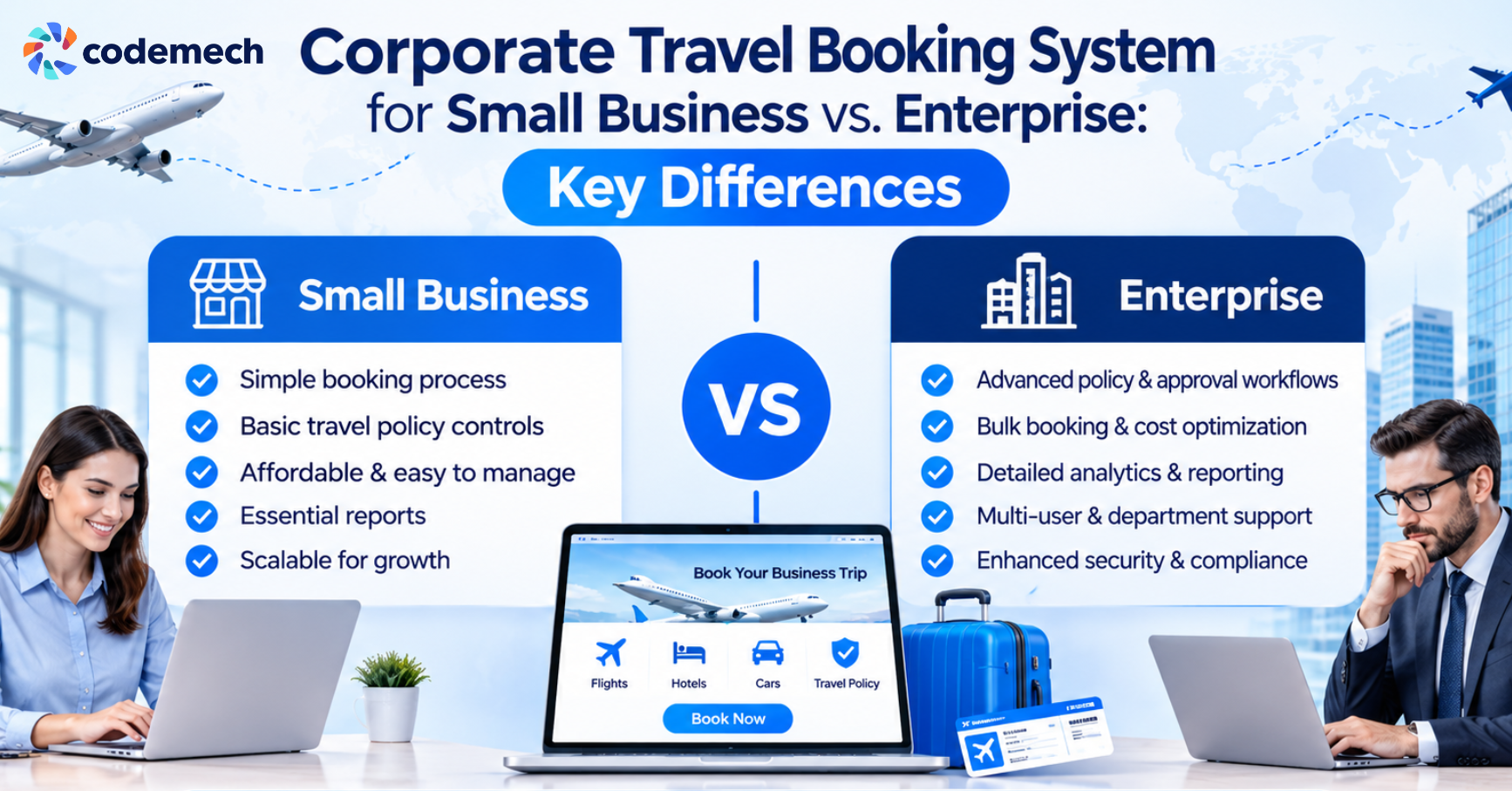
Small Business vs. Enterprise Corporate Travel Booking System: Key Differences
The biggest difference between small-business and enterprise travel platforms is the level of operational complexity they need to support.
Small businesses generally prioritise affordability, ease of use and essential booking functionality. Enterprises require more control over employee travel, supplier relationships, financial reporting, security and integrations with existing business systems.
Here is a practical comparison.
| Comparison factor | Small businesses | Enterprises |
|---|---|---|
| Number of users | Small teams | Multiple departments and large workforces |
| Booking process | Simple booking workflows | Multi-level booking and approval workflows |
| Travel policies | Basic spending limits | Department-specific and role-based policies |
| User management | Limited employee profiles | Advanced roles and permissions |
| Supplier integrations | Essential airline and hotel connections | Multiple GDS, NDC and supplier APIs |
| Expense management | Basic expense tracking | Advanced financial and expense integrations |
| Reporting | Standard booking reports | Departmental and organisation-wide analytics |
| Security | Essential access controls | Advanced identity, access and security management |
| Scalability | Support for gradual business growth | High-volume and multi-location operations |
| Customisation | Limited or selected custom features | Business-specific workflows and integrations |
Neither approach is automatically better. The right choice depends on how frequently employees travel, how the company controls spending and how complex its booking operations have become.
Let's look at the differences in more detail.
1. Booking and Reservation Management
The booking functionality should also be designed around the company's travel model. Businesses planning a new platform can refer to a Travel Booking Engine Development Guide to understand essential booking features, supplier connections, reservation workflows and the technical requirements involved in building a reliable booking experience.
Small Business Requirements
For a small business, the booking process should be straightforward.
Employees should be able to:
- Search for available flights.
- Compare travel options.
- Find suitable accommodation.
- View booking details.
- Submit travel requests.
- Receive booking confirmations.
For example, a small marketing agency in Cape Town might send two employees to Johannesburg for a client presentation. It probably does not need a complex reservation workflow involving multiple departments.
A simple booking interface with basic approval functionality may be sufficient.
Enterprise Requirements
Enterprises usually have more complicated booking requirements.
An organisation operating across multiple South African cities may need to manage employee bookings, executive travel, regional travel and international business trips simultaneously.
Its booking system may need:
- Centralised booking management.
- Multi-city and multi-destination reservations.
- Employee-specific booking permissions.
- Negotiated corporate travel rates.
- Group booking management.
- Centralised itinerary tracking.
- Booking changes and cancellation workflows.
The platform should also allow authorised travel managers to monitor bookings across departments without giving every employee unrestricted access.
The key difference: Small businesses need a booking process that works efficiently. Enterprises need a booking process that remains manageable across multiple teams, policies and locations.
2. Travel Approval and Policy Management
A well-designed corporate travel approval workflow can also reduce delays between employees, department managers and finance teams. By automating approval rules and booking permissions, businesses can maintain better control over travel spending without making the reservation process unnecessarily complicated.
Small Business Requirements
Small businesses often operate with fewer approval layers.
For instance, an employee may submit a travel request to their manager, who checks the estimated cost and approves or rejects it.
A suitable system might include:
- Basic travel approval requests.
- Maximum spending limits.
- Manager approval.
- Booking notifications.
- Simple travel policy settings.
This avoids unnecessary administrative work while giving business owners control over travel expenses.
Enterprise Requirements
Large organisations generally require more structured approval processes.
A booking may need approval from a department manager, finance manager or senior executive, depending on its cost and purpose.
An enterprise platform may support:
- Multi-level approval workflows.
- Department-specific travel policies.
- Budget-based approval rules.
- Employee grade-based booking restrictions.
- Exception management.
- Approval history and audit trails.
Consider a mining company with employees travelling between Johannesburg, regional offices and operational sites. Travel requirements may differ depending on the employee's role, destination and operational responsibilities.
A flexible approval workflow allows the company to manage these differences without relying on endless email conversations.
3. Technology and System Integrations
For South African businesses, travel API integration in South Africa is an important consideration when connecting booking platforms with airline systems, hotel suppliers and Global Distribution Systems. The right integrations depend on supplier availability, commercial agreements and the company's booking requirements.
Small Business Integrations
A small business may initially need only a few integrations:
- Airline and hotel booking APIs.
- Payment gateway integration.
- Email and SMS notifications.
- Basic accounting software connectivity.
- Employee profile management.
The objective is to reduce repetitive work without creating an unnecessarily complicated technology environment.
Enterprise Integrations
Enterprises often require a more connected technology environment.
Their platform may need to communicate with:
- Global Distribution Systems (GDS).
- New Distribution Capability (NDC) services.
- Airline and hotel supplier APIs.
- Enterprise Resource Planning (ERP) systems.
- Human Resource Management Systems (HRMS).
- Expense management platforms.
- Corporate payment systems.
- Business intelligence and reporting tools.
For example, employee details could be retrieved from an HR system while approved travel expenses are passed to the company's accounting platform.
This reduces duplicate data entry and makes information easier to manage across departments.
Understanding the Corporate Travel Technology Stack
A Corporate Travel Technology Stack is the combination of software, infrastructure, APIs and integrations that support the booking and management of business travel.
A typical stack may include:
- Frontend application: The interface employees and travel managers use to search and manage bookings.
- Backend services: The application logic responsible for bookings, approvals, users and business rules.
- Travel APIs: Connections to airlines, hotels, GDS providers and other travel suppliers.
- Database: Storage for employee profiles, bookings, itineraries and transaction records.
- Payment integration: Payment processing and transaction management.
- Reporting system: Dashboards and reports for finance and travel management.
- Security infrastructure: Authentication, authorisation, access controls and data protection.
The technology stack should be selected according to the expected booking volume, integration requirements and future development plans.
4. User Management and Access Control
Small businesses and enterprises also differ in how they manage people using their booking platforms.
For a small company, an administrator and a few employee accounts may be enough.
An enterprise, however, may have hundreds or thousands of users with different responsibilities.
For example:
- Employees can submit travel requests.
- Managers can approve team bookings.
- Finance teams can review travel expenditure.
- Travel administrators can manage reservations.
- Senior management can access organisation-wide reports.
An enterprise booking platform should support role-based access control, allowing each user to access only the information and functions required for their responsibilities.
This becomes particularly important when different business units operate independently but share the same travel management platform.
5. Expense Tracking and Financial Reporting
Travel expenditure is not limited to flight tickets.
Companies may also need to manage hotel accommodation, car hire, airport transfers, meals, changes to reservations and other business travel expenses.
Small Business Requirements
A small company may only need:
- Basic expense records.
- Booking cost summaries.
- Monthly travel expenditure.
- Employee-wise spending reports.
- Downloadable invoices and statements.
This gives owners and finance managers a clearer understanding of how much the company spends on business travel.
Enterprise Requirements
Enterprises often need more detailed reporting.
Their systems may provide:
- Department-wise travel expenditure.
- Project-based cost allocation.
- Budget versus actual spending.
- Supplier performance reports.
- Booking policy compliance.
- Travel expenditure trends.
- Management dashboards.
- Integration with finance and ERP platforms.
For example, a company with operations in Johannesburg, Cape Town and Durban may want to compare travel expenditure across its different business units.
A centralised reporting system makes this information easier to analyse and helps management identify areas where travel processes could be improved.
6. Scalability and Performance
A booking platform that works well for 15 employees may not necessarily work well for 1,500 users.
Scalability should therefore be considered during the initial planning stage, even if the business is currently small.
Small Business Scalability
A small business should choose a solution that can accommodate gradual growth.
It may start with a limited number of users and basic integrations, then introduce additional functionality as booking activity increases.
The architecture should allow the company to add:
- More employee accounts.
- Additional booking options.
- New supplier integrations.
- More reporting features.
- Additional approval workflows.
Enterprise Scalability
Enterprise platforms need to support more complex operational demands.
These may include:
- High volumes of concurrent users.
- Multiple business units.
- Large booking databases.
- Multiple supplier connections.
- Regional and international operations.
- Advanced monitoring and system availability requirements.
Cloud infrastructure, suitable database design, caching and well-structured application services can help support these requirements.
However, scalability does not simply mean using more servers. The system architecture, integration design and database performance must also be considered.
7. Security and Data Protection
Corporate travel platforms process information that should not be treated casually.
Employee names, contact information, passport details, itineraries, booking records and payment-related information may be involved.
South African businesses should consider the Protection of Personal Information Act (POPIA) when designing and operating systems that process personal information.
Important considerations include:
- Secure authentication.
- Role-based access permissions.
- Encryption of sensitive information.
- Secure API communication.
- Appropriate data retention policies.
- Access monitoring and audit logs.
- Secure handling of employee and traveller information.
- Defined processes for managing data incidents.
Small businesses need these protections too. Security is not something that only large enterprises should consider.
Enterprise platforms may require additional controls because of their larger user base, multiple integrations and more complex access requirements.
8. Development Costs: Small Business vs. Enterprise
Cost is another major consideration when deciding between a basic corporate booking platform and a customised enterprise solution.
There is no single development price that applies to every project. The final investment depends on the features, integrations, architecture, user requirements and ongoing maintenance needs.
What Influences Small Business Development Costs?
A smaller platform may require:
- Basic employee registration.
- Flight and hotel search.
- Booking management.
- Simple approval workflows.
- Basic payment integration.
- Standard reporting.
- Administrative dashboard.
Since the number of workflows and integrations is generally smaller, the initial development scope may be more manageable.
What Influences Enterprise Development Costs?
Enterprise projects often require additional planning and development.
The cost may increase because of:
- Multiple GDS and supplier API integrations.
- Complex booking and approval workflows.
- Custom reporting dashboards.
- ERP and HRMS integration.
- Advanced user permissions.
- Security and compliance requirements.
- High-availability infrastructure.
- Performance testing.
- Ongoing maintenance and technical support.
Businesses should also consider recurring expenses such as cloud hosting, third-party API usage, supplier licensing, payment processing and support.
Cost Comparison
| Cost consideration | Small business | Enterprise |
|---|---|---|
| Initial development | Smaller feature scope | More extensive development scope |
| Integrations | Limited integrations | Multiple business and supplier systems |
| Infrastructure | Basic scalable hosting | More advanced infrastructure requirements |
| User management | Standard accounts | Advanced permissions and administration |
| Reporting | Basic reports | Custom analytics and dashboards |
| Maintenance | Routine updates | Continuous monitoring and support |
The most sensible approach is to define the essential business requirements before requesting a development quotation.
Avoid paying for enterprise-level complexity when your business does not need it. At the same time, do not choose a platform that will require expensive rebuilding as soon as your operations expand.
9. Ready-Made Corporate Travel Software vs. Custom Development
Another important decision is whether to purchase an existing booking platform or invest in custom development.
Both options can work, depending on the company's operational requirements.
When Ready-Made Software Makes Sense
A ready-made platform may be suitable when:
- The company has straightforward travel requirements.
- Standard booking functionality is sufficient.
- Existing supplier integrations meet its needs.
- The business wants to start using a system quickly.
- Extensive customisation is not necessary.
For many small businesses, this can be a practical starting point.
When Custom Development Makes Sense
Custom development becomes more attractive when the business needs functionality that standard platforms cannot provide.
For example:
- Custom employee approval workflows.
- Specialised supplier integrations.
- Business-specific booking rules.
- Integration with existing internal applications.
- Custom reporting and analytics.
- Multiple business models or reseller arrangements.
- Greater control over platform functionality.
An enterprise may also choose custom development when its existing travel operations are too specialised for a generic platform.
A well-planned custom solution allows the business to prioritise the features that directly support its operations.
However, custom software also comes with responsibility for development, maintenance, security, infrastructure and future upgrades.
The decision should be based on total ownership costs rather than initial development costs alone.
10. How to Choose the Right Corporate Travel Booking System in South Africa
Before selecting a platform or approaching a development company, businesses should evaluate their current travel operations.
Here are some practical questions to consider.
1. How many employees travel regularly?
A small number of occasional travellers may not justify an extensive enterprise platform. However, a growing workforce may need centralised booking and approval management.
2. How many destinations do employees travel to?
Companies managing domestic trips between Johannesburg, Cape Town, Durban and other locations may have different requirements from businesses arranging international and regional travel.
3. Do you need supplier integrations?
Consider whether your platform needs to connect with airlines, hotels, GDS providers, NDC services, car rental companies or other travel suppliers.
4. How complicated are your approval workflows?
If travel bookings require several levels of authorisation, make sure the system can support the required approval structure.
5. Does the platform need to integrate with existing business software?
Check whether employee information, financial data and travel expenses need to be exchanged with other systems.
6. What level of reporting does your finance team need?
Decide whether standard booking summaries are sufficient or whether you need department-wise, project-wise and organisation-wide reporting.
7. Can the system grow with your business?
Consider future users, additional destinations, more supplier connections and changing business requirements.
A good corporate travel booking system should solve today's problems without creating unnecessary limitations for tomorrow.
11. Why Work With a Travel Software Development Company?
Selecting the right technology partner is just as important as selecting the platform itself.
A travel software development company should understand both software engineering and the operational requirements of the travel industry.
This includes understanding booking workflows, supplier integrations, reservation management, travel APIs, data security and platform scalability.
When evaluating a development partner, consider:
- Experience in travel software development.
- Understanding of GDS and travel API integrations.
- Custom booking platform development capabilities.
- Backend and frontend engineering expertise.
- Integration with third-party business systems.
- Testing and quality assurance processes.
- Post-launch maintenance and technical support.
The development process should begin with requirement analysis rather than immediately jumping into coding.
A suitable partner will help identify the essential features, define the architecture, assess integration requirements and plan a realistic development roadmap.
How CodeMech Solutions Can Help
CodeMech Solutions provides enterprise software development services and custom travel platform development support for businesses looking to build scalable booking applications, integrate third-party travel services and streamline their corporate travel operations.
A growing travel agency may need a straightforward booking platform, while an established corporate travel business may require a more advanced system with supplier integrations, approval workflows, reporting and custom business logic.
Our software development approach focuses on building solutions around the actual requirements of the business rather than adding features that provide little operational value.
Depending on the project scope, our team can help with:
- Custom travel software development.
- B2B travel portal development.
- Travel booking engine development.
- Airline, hotel and third-party API integration.
- Custom booking and reservation workflows.
- Enterprise web application development.
- Backend and frontend development.
- Software maintenance and ongoing improvements.
Whether you are planning a new corporate travel platform or modernising an existing booking system, the first step is understanding your business model, users and integration requirements.
Planning to Build a Corporate Travel Booking System?
Talk to CodeMech Solutions about your project requirements. Our team can help you evaluate the right development approach, identify essential integrations and plan a corporate travel platform that supports your business as it grows.
Final Thoughts
The choice between a small-business and enterprise corporate travel booking system comes down to how your organisation manages business travel today and what it expects to manage in the future.
Small businesses generally benefit from straightforward booking processes, essential integrations and manageable operating costs. Enterprises need more advanced capabilities to manage larger workforces, complex approvals, multiple suppliers and organisation-wide travel expenditure.
Neither approach needs to be unnecessarily complicated.
The right solution should make travel easier to manage, improve visibility into expenses and reduce the manual work involved in organising business trips.
For South African businesses considering a new platform, the most important step is to understand the actual operational requirements before investing in technology.
With the right planning and development partner, a corporate travel booking system can become a valuable part of the organisation's wider business infrastructure.