Corporate travel booking may appear simple from a traveller's perspective. Employees search for flights, compare hotel options, complete payments, and receive booking confirmations within minutes. Behind this seemingly straightforward process lies a sophisticated corporate travel technology stack that connects travel content providers, booking engines, payment gateways, enterprise applications, policy management systems, and analytics platforms. Modern organisations, Travel Management Companies (TMCs), Online Travel Agencies (OTAs), Destination Management Companies (DMCs), and enterprise travel providers rely on integrated technology ecosystems to manage business travel efficiently. These ecosystems combine GDS integration, NDC connectivity, travel API integration, corporate travel booking systems, payment solutions, reporting platforms, and enterprise software integrations. In this guide, we explain how a modern corporate travel technology stack works, the technologies involved, and why businesses increasingly invest in travel software development and travel software solutions to support scalable business travel operations.
What Is a Corporate Travel Technology Stack?
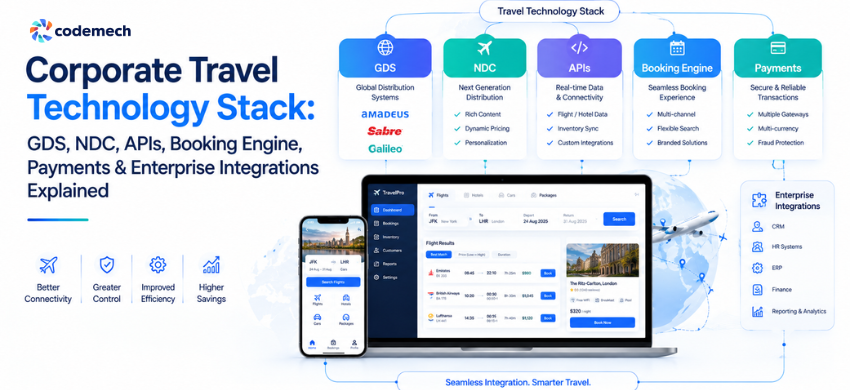
A corporate travel technology stack is the collection of software platforms, APIs, integrations, infrastructure, and business applications used to search, book, manage, pay for, and analyse corporate travel activities. A modern enterprise travel platform typically incorporates:
- GDS Integration
- NDC Integration
- Travel API Integration
- Travel Booking Engine
- Corporate Travel Portal
- Travel Payment Gateway
- Travel Policy Engine
- Approval Workflows
- Traveller Profile Management
- CRM Integrations
- ERP Integrations
- Expense Management Systems
- Data Analytics Platforms
- Cloud Infrastructure
- AI-Powered Travel Automation
Together, these technologies create a unified ecosystem capable of supporting modern business travel operations.
Corporate Travel Technology Stack Components
GDS Integration
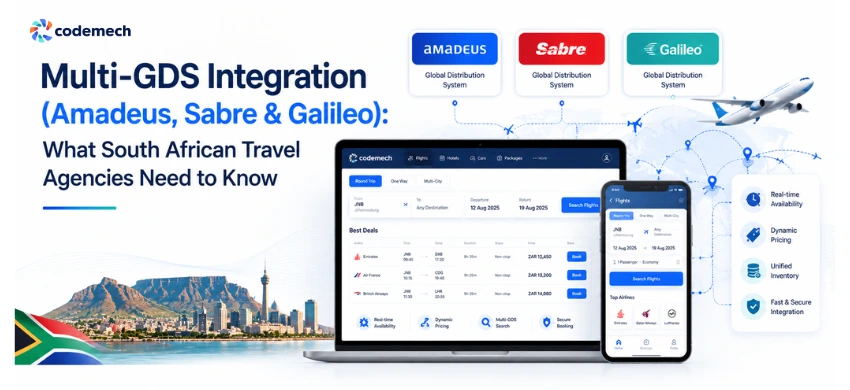
A Global Distribution System (GDS) provides access to a wide range of travel inventory through a centralised network. Major GDS providers include:
- Amadeus
- Sabre
- Travelport
A corporate travel booking system uses GDS integration to:
- Search flight availability
- Retrieve fare information
- Access hotel inventory
- Access car rental services
- Manage reservations
- Support ticketing processes
For many travel businesses, GDS remains a critical component of enterprise travel technology. Businesses planning GDS implementations can also explore our Amadeus API Integration Guide: How to Access GDS Travel Content to better understand travel inventory connectivity.
NDC Integration
New Distribution Capability (NDC) is an IATA-developed standard designed to modernise airline distribution. NDC enables airlines to provide:
- Dynamic pricing
- Rich fare content
- Ancillary services
- Branded fares
- Personalised travel offers
While GDS systems continue to play a vital role, many travel software solutions now combine GDS and NDC integrations to provide travellers with broader inventory and enhanced booking options.
Travel API Integration
Travel APIs serve as the communication layer connecting external travel suppliers and business systems. Typical integrations include:
- Flight APIs
- Hotel APIs
- Car Rental APIs
- Insurance APIs
- Payment APIs
- CRM APIs
- ERP APIs
- Mapping APIs
A well-designed travel API integration strategy supports:
- Real-time availability
- Dynamic pricing
- Data synchronization
- Automated workflows
- Scalable architecture
If you want to understand how supplier connectivity works in real-world travel platforms, read our guide on Travel API Integration for Travel Businesses, covering GDS, airline, hotel, and aggregator integrations.
Corporate Travel Booking Engine
For a deeper explanation of booking workflows, inventory management, pricing logic, and reservations, see our complete guide on What Is a Travel Booking Engine and How Does It Work?
Key booking engine functions include:
- Travel search
- Availability management
- Fare comparison
- Booking workflows
- Payment processing
- Reservation management
- Cancellation handling
- Rebooking management
Unlike standard consumer booking systems, a corporate must also enforce company policies, approval processes, and cost controls.
Corporate Travel Portal
A corporate travel portal provides the primary interface for employees, travel managers, and administrators. Common features include:
- Employee dashboards
- Traveller profiles
- Travel policy management
- Booking management
- Approval workflows
- Expense visibility
- Reporting dashboards
- Documentation management
Travel portal development plays a major role in delivering a seamless booking experience while maintaining organisational compliance.
Travel Payment Gateway Integration
Payment processing is a critical element of every travel technology ecosystem. Modern travel platforms often support:
- Credit Cards
- Corporate Cards
- Virtual Cards
- Bank Transfers
- Digital Wallets
- Invoice Processing
Enterprise travel payment systems require:
- Payment authorisation
- Fraud prevention
- Currency management
- Reconciliation workflows
- Refund management
Secure payment architecture improves traveller experience while reducing operational complexity.
Enterprise Integrations
Corporate travel platforms frequently integrate with existing business applications, including:
HR Systems
- Employee synchronisation
- Department management
- Travel eligibility verification
ERP Systems
- Financial reporting
- Cost centre allocation
- Budget tracking
CRM Systems
- Customer management
- Account tracking
- Relationship management
Expense Management Platforms
- Automated expense reporting
- Reimbursement workflows
- Travel spending analysis
Enterprise integrations help create connected, efficient travel operations.
Reporting & Travel Analytics
Modern travel management software generates valuable business intelligence. Typical reporting areas include:
- Total travel spending
- Department spend analysis
- Policy compliance rates
- Supplier performance
- Booking trends
- Traveller behaviour
- Cancellation patterns
Analytics help organisations control costs and optimise decision-making.
Cloud Infrastructure
Cloud infrastructure forms the foundation of scalable travel software solutions. Cloud-enabled travel platforms typically support:
- Auto-scaling
- High availability
- Load balancing
- Secure API communication
- Disaster recovery
- Continuous deployment
Cloud application development enables travel businesses to support increasing transaction volumes while maintaining performance and reliability.
AI in Corporate Travel Management
Artificial Intelligence is becoming a key layer within enterprise travel technology.
- Popular AI use cases include:
- AI Travel Assistants
- Natural Language Search
- Travel Recommendations
- Policy Compliance Support
- Customer Service Automation
- Itinerary Generation
- Spend Analysis
- Fraud Detection
AI does not replace travel infrastructure. Rather, it enhances the user experience by making travel platforms more intelligent and more efficient.
Why Choose Codemech Solutions for Travel Software Development?
Codemech Solutions is a specialised Travel Software Development Company delivering scalable travel software solutions for travel agencies, TMCs, OTAs, DMCs, and enterprise organisations. Our expertise includes:
- Travel Portal Development Services
- Travel Booking Engine Development
- Travel API Integration
- GDS Integration
- NDC Integration
- Travel Website Development
- Travel App Development
- Enterprise Software Development Services
- Data Integration Services
- Cloud Application Development Services
By combining technical expertise with deep industry knowledge, Codemech Solutions helps travel businesses build future-ready corporate travel platforms that support growth, automation, and operational efficiency. Businesses evaluating a new corporate travel platform should also review our Travel Portal Development Cost Guide to understand planning, architecture, and implementation considerations.
Conclusion
A modern corporate travel technology stack extends far beyond a simple booking website. It combines GDS integration, NDC connectivity, travel APIs, booking engines, payment systems, policy management, enterprise integrations, analytics, cloud infrastructure, and AI-powered capabilities into a unified ecosystem. As business travel continues to evolve, organisations that invest in scalable travel technology architecture will be better positioned to improve traveller experiences, automate workflows, reduce operational costs, and support long-term growth. For businesses planning a new travel platform or upgrading existing systems, partnering with an experienced Travel Software Development Company such as Codemech Solutions can help ensure the right architecture, integrations, and technology foundation for future success.