Introduction: Why Corporate Travel Platforms Need Connected Enterprise Systems
Managing corporate travel involves more than booking flights and hotels. Businesses must coordinate employee information, travel policies, approval hierarchies, reservations, expense claims and financial reporting across multiple systems.
When these processes operate independently, employees may enter the same information repeatedly, managers may struggle to track approvals, and finance teams may spend additional time reconciling travel expenses with booking records.
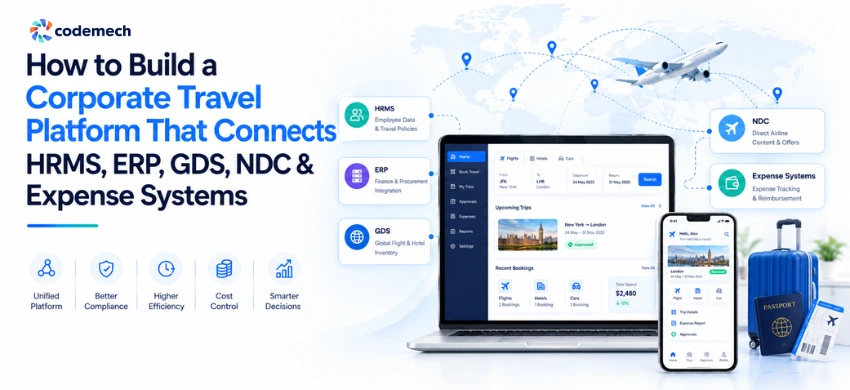
A connected corporate travel platform brings these processes together through integrations with Human Resource Management Systems (HRMS), Enterprise Resource Planning (ERP) software, Global Distribution Systems (GDS), airline New Distribution Capability (NDC) interfaces and expense management applications.
For businesses planning a new platform, Corporate Travel Platform Development involves designing the application, defining how systems exchange data, automating business workflows and ensuring that transactions remain secure and traceable.
An experienced Travel Software Development Company can help businesses assess their requirements and choose a suitable integration approach. The goal is not to connect every available system, but to build a reliable platform around the organization's actual travel and financial processes.
What Is a Corporate Travel Platform?
A corporate travel platform is a software application that helps businesses manage employee business trips, travel approvals, reservations, expenses and reporting in a coordinated environment.
Unlike a basic booking website, corporate travel management software must account for internal policies, employee eligibility, departmental budgets and financial controls.
A typical platform may include:
- Employee travel requests and approval workflows.
- Flight, hotel and other travel booking capabilities.
- HRMS integration for employee information.
- ERP integration for cost centres, budgets and accounting.
- GDS and NDC connectivity for supported travel inventory.
- Expense submission, reimbursement and reconciliation workflows.
- Reporting dashboards for travel managers and finance teams.
Depending on the business model, the solution might be a private enterprise application, a travel management portal or a commercial booking platform serving multiple corporate clients.
Businesses that need tailored workflows can consider custom software development rather than relying entirely on disconnected off-the-shelf tools.
Understanding HRMS, ERP, GDS, NDC and Expense Systems
Each connected system has a different responsibility. A successful integration architecture respects those differences rather than attempting to make one application responsible for everything.
| System | Primary purpose | Typical data exchanged | Business value |
|---|---|---|---|
| HRMS | Employee and organizational management | Employee IDs, departments, managers and employment status | Supports eligibility and approval routing |
| ERP | Financial and operational management | Cost centres, project codes, budgets and accounting references | Supports spending controls and reconciliation |
| GDS | Travel distribution and reservations | Availability, fares, itineraries and booking references | Connects the platform to supported travel inventory |
| NDC | Airline offer and order distribution | Airline offers, fare attributes and supported order details | Enables supported airline-specific booking workflows |
| Expense system | Expense claims and reimbursement | Receipts, expense categories, claims and approval statuses | Supports expense processing and financial review |
1. HRMS Integration for Corporate Travel
A Human Resource Management System stores employee and organizational information. Integrating it with a travel platform helps determine who can travel, which manager should approve a request and which department should be associated with the trip.
For example, when an employee joins a company, relevant profile information can become available to the travel platform through a scheduled synchronization or supported API integration. When the employee changes departments or leaves the organization, the platform can update eligibility and access according to configured rules.
Only information necessary for the travel workflow should be shared. Salary details, personal HR notes and other unrelated sensitive information should not automatically be transferred.
A reliable HRMS integration should also address duplicate employee records, inconsistent identifiers, delayed updates and employee offboarding.
2. ERP Integration for Travel Management
ERP integration connects travel activity with the organization's financial processes.
The platform may retrieve approved cost centres, project codes, departmental budgets and relevant spending rules. After a booking or expense transaction, it can transfer appropriate financial information to the ERP if the system supports the required workflow.
Consider an employee travelling for a client implementation project. The booking may need to be associated with the correct project code so that finance can distinguish delivery expenses from general administrative travel.
ERP products vary in their APIs, configurations and financial capabilities. The integration design must therefore be based on the actual ERP environment rather than assuming every accounting workflow is available by default.
3. GDS Integration for Corporate Travel
A Global Distribution System provides access to travel content and reservation capabilities offered through its distribution network.
Amadeus, Sabre and Travelport are relevant examples. Depending on the product, access permissions and commercial agreements, their services may support flight shopping, fare information, reservation creation, ticketing and post-booking operations.
However, a GDS integration does not automatically provide access to every airline, fare or servicing function. Businesses must confirm which capabilities are available for their specific account and implementation.
Read the Amadeus API Integration Guide for additional context on connecting travel applications with GDS content.
4. NDC Integration for Corporate Travel
New Distribution Capability (NDC) is an airline distribution standard developed by the International Air Transport Association (IATA). It supports the exchange of airline offers and order-related information through participating implementations.
NDC can support richer airline offers, branded fare attributes and ancillary services where the airline and integration provide them.
It should not be treated as one universal API. Airlines can differ in their supported operations, authentication requirements, offer and order workflows, change handling and refund capabilities.
Some corporate platforms use both traditional GDS connectivity and direct or intermediary NDC integrations. The appropriate mix depends on airline coverage, servicing requirements, supplier agreements and the needs of the business.
5. Expense Management Integration
Expense systems handle the financial side of business travel after or during a trip.
They may receive booking references, trip details, expense categories and relevant amounts. Employees can then submit receipts and claims, while authorized managers and finance teams review and approve expenses.
A booking amount and the final expense amount may differ because of cancellations, refunds, exchanges, additional services or currency conversion. The platform should retain the relevant transaction references and support reconciliation instead of assuming every amount will match immediately.
How to Build a Corporate Travel Platform Integration Architecture
A well-designed integration architecture connects the employee-facing application with internal business systems and external travel providers. API Development Services and Data Integration Services can support these connections, but the architecture must also define data ownership, security controls, error handling and workflow responsibilities.
A Conceptual Architecture
Employee / Travel Manager
          |
          v
Corporate Travel Web or Mobile Platform
          |
          v
Identity, Access Control and Policy Engine
          |
          v
Integration Layer and Workflow Orchestration
          |
      +---+---+---+---+---+
      |   |   |   |   |   |
     HRMS ERP GDS NDC Expense
      |   |   |   |   |   |
      +---+---+---+---+---+
          |
          v
Booking Records, Financial Reconciliation
       and Business Reporting
This is a conceptual model, not a requirement to deploy every component as a separate service. A smaller application may use a modular backend, while a complex enterprise platform may benefit from independently scalable integration services.
Essential Architecture Components
- API integration layer: Connects the platform to HRMS, ERP, GDS, airline and expense APIs through their supported interfaces.
- Workflow orchestration: Coordinates travel requests, approval decisions, booking operations and expense processing.
- Data mapping and validation: Standardizes employee identifiers, project codes, booking statuses and financial fields across different applications.
- Monitoring and error handling: Detects failed API calls, rate limits, timeouts and delayed responses.
- Data synchronization and reconciliation: Identifies missing updates, duplicate transactions and inconsistencies between booking and financial records.
- Security and access control: Protects credentials, restricts data access and records important actions.
Sound Enterprise Architecture Services principles help ensure that these components remain maintainable as new integrations are added.
Two technical practices are particularly important. First, use idempotency controls where a repeated request could create a duplicate booking or financial transaction. Second, distinguish immediate API responses from asynchronous updates that arrive later.
If a booking request times out, the system should check whether the original operation succeeded before attempting it again. Blind retries can create duplicate reservations or uncertain booking states.
How the End-to-End Corporate Travel Workflow Works
Consider an employee travelling to another city for a client meeting. The following example illustrates how an integrated business travel management system could coordinate the trip.
- Employee sign-in: The employee authenticates through the organization's approved identity system.
- Profile synchronization: The platform retrieves relevant HRMS information, including the employee ID, department and reporting manager.
- Travel request: The employee enters the destination, dates, business purpose, estimated cost and project code.
- Policy validation: The platform checks applicable travel rules and available budget information.
- Approval routing: The request is sent to the manager or finance approver according to configured rules.
- Travel search: Once the required approval is obtained, the platform retrieves eligible options through configured GDS or NDC integrations.
- Booking: The authorized user selects an option and completes the supported booking workflow.
- Financial allocation: The platform associates the booking with the appropriate department or project.
- Expense submission: After travel, the employee submits receipts and expense claims.
- Reconciliation: The expense system and ERP receive the relevant records according to their supported integration capabilities.
The workflow should also cover exceptions. A rejected request must not proceed to booking. A fare change may require renewed approval. An employee leaving the company may lose travel access, while an external API outage should trigger a controlled recovery process.
For businesses developing custom workflows, this is where Corporate Travel Approval Workflow design becomes as important as the booking interface itself. See the Corporate Travel Approval Workflow guide.
Essential Features of an Integrated Corporate Travel Platform
The appropriate feature set depends on the company's size, travel policies and existing technology. Most enterprise projects should evaluate the following capabilities.
Travel Policy and Approval Management
The platform should support configurable approval rules based on trip cost, destination, department, project and employee role. It should also provide an exception process for urgent or out-of-policy travel.
Booking and Reservation Management
Employees and travel managers need access to supported travel options, itinerary details, booking references and reservation statuses. The interface should also display relevant fare restrictions and cancellation conditions.
Expense and Financial Controls
The platform should connect booking records with expense claims, cost centres and project codes where required. Finance teams should be able to identify unmatched transactions and review relevant approval histories.
Administration and Reporting
Administrative dashboards can display pending approvals, booking activity, policy exceptions and reconciliation issues. Access to reports should reflect the user's responsibilities.
Notifications and Traveller Support
Automated notifications can communicate approval decisions, booking changes and other important events. Clear status messages help users understand when a request is processing, confirmed, rejected or awaiting intervention.
Businesses planning a new booking interface may also consider Travel Booking Engine Development as part of their broader travel software solutions strategy.
Technical Challenges and Integration Best Practices
Corporate travel platform integration can become complex because each system has its own data structures, business rules and update cycles.
For example, the HRMS may use an internal employee identifier, while the ERP expects a separate personnel or cost-centre reference. GDS and NDC providers may also use different booking identifiers and reservation status models.
The following practices can reduce integration risk:
- Define a source of truth: Decide which application owns employee status, financial data, booking records and approval decisions.
- Maintain consistent identifiers: Use stable references for employees, trips, bookings, projects and financial transactions.
- Validate supplier responses: Check that returned data is complete and valid before updating internal records.
- Handle failures safely: Apply appropriate timeouts, retry strategies and idempotency controls.
- Reconcile important transactions: Track cancellations, refunds, exchanges and expense adjustments.
- Monitor integration health: Record failures, delayed updates and unresolved transactions.
- Confirm supplier access: Verify API permissions, commercial agreements, rate limits and supported operations before committing to a feature.
For example, a booking provider may confirm a reservation while the ERP is temporarily unavailable. The platform should preserve the booking record and retry the financial synchronization through a controlled process.
Similarly, a GDS cancellation and an airline refund may occur at different stages. The architecture should track the booking status and financial adjustment separately rather than treating cancellation as proof that the refund has been completed.
These requirements make API Testing Services and Software Quality Assurance important parts of the development lifecycle.
Security, Privacy and Compliance Considerations
Corporate travel applications process employee details, travel itineraries and financial records. Security should therefore be built into the architecture from the beginning.
Important controls include:
- Role-based access control so users can access only the information they need.
- Single sign-on and multifactor authentication where appropriate.
- Encryption for data in transit and at rest.
- Secure storage and rotation of API credentials.
- Audit trails for approvals, booking changes and financial adjustments.
- Data minimization and appropriate retention policies.
- Monitoring, backup validation and documented incident-response procedures.
Organizations should also assess applicable privacy and financial obligations in each operating region.
Using encryption or an established cloud platform does not automatically make an application GDPR-compliant, SOC 2-certified or compliant with another standard. Compliance depends on the actual implementation, organizational processes, contractual obligations and applicable regulations.
IT Security and Compliance Services may be relevant when evaluating these requirements, provided the selected provider offers the necessary scope of work.
Choosing a Technology Stack for Corporate Travel Platform Development
The technology stack should follow the business requirements, existing systems, expected transaction volume and internal engineering capabilities.
A typical implementation includes:
- A responsive web or mobile frontend for employees, managers and administrators.
- Backend application services for booking logic, travel policies and approval workflows.
- A relational database for structured business records and transactional consistency.
- API integration components and workflow orchestration.
- Authentication, authorization and secrets management.
- Logging, monitoring, automated testing and deployment infrastructure.
A modular monolith can be appropriate when the application has a manageable set of workflows and a team that benefits from simpler deployment. Independently deployed services may be justified when different components have distinct scaling, availability or ownership requirements.
Cloud Application Development Services can be relevant when designing the deployment environment, while Software Architecture Consulting Services can help evaluate system boundaries and long-term maintainability.
The choice of framework, database and cloud provider should be based on the project's needs rather than a claim that one technology is universally best.
A Practical Development Roadmap
A phased approach allows businesses to validate core workflows before expanding the platform.
| Phase | Main activities |
|---|---|
| 1. Requirements and discovery | Document travel policies, user roles, existing systems and reporting needs |
| 2. Architecture and integration planning | Define data ownership, API contracts, security and error handling |
| 3. Minimum viable platform | Implement employee synchronization, travel requests and approvals |
| 4. Booking and expense integration | Connect selected GDS/NDC providers and expense workflows |
| 5. Testing and validation | Test booking changes, cancellations, failures, permissions and reconciliation |
| 6. Deployment and improvement | Monitor operations, provide support and introduce additional integrations |
For a first release, businesses may prioritize employee synchronization, travel requests and approvals before implementing multiple booking providers and advanced expense workflows. This can reduce initial complexity and help validate the business requirements.
Development cost and timeline depend on the number of connected systems, supplier access, business rules, data migration, security requirements and testing scope. A detailed estimate should follow a discovery exercise rather than rely on a universal delivery promise.
After launch, Software Maintenance Services and Software Support Services can help address API changes, dependency updates, operational issues and evolving business requirements.
Common Mistakes to Avoid
1. Connecting Systems Without Defining Data Ownership
Without clear ownership, employee records, booking statuses and financial transactions can become inconsistent.
2. Treating GDS and NDC as Interchangeable
Their interfaces, available content and post-booking workflows can differ. Each required integration should be evaluated separately.
3. Automating Unclear Travel Policies
Software cannot reliably enforce contradictory rules. Define approval thresholds, responsibilities and exception handling before implementation.
4. Ignoring Uncertain Booking Outcomes
A timeout does not necessarily mean that a booking failed. Recovery procedures should verify the outcome before retrying a potentially duplicate operation.
5. Delaying Financial Reconciliation
Booking costs, refunds, exchanges and expense claims should be connected through traceable references from the beginning.
6. Building Every Integration in the First Release
Prioritize the systems required for the most important business workflows. Additional providers and advanced capabilities can be introduced as requirements become clearer.
7. Overlooking Maintenance and Security
External APIs, credentials and business processes change over time. Plan for monitoring, regression testing, secure configuration and ongoing support.
Conclusion: Build a Connected Corporate Travel Platform With CodeMech Solutions
Building a connected corporate travel platform requires more than linking a booking engine to external APIs. The application must coordinate employee eligibility, travel policies, booking inventory, financial controls and expense reconciliation while protecting sensitive information and handling failures safely.
A practical starting point is to map the current travel process, identify which system owns each type of data and prioritize the integrations that solve the most important operational problems.
CodeMech Solutions is a custom software development company. Businesses exploring corporate travel platform development, booking systems or enterprise application integration can visit CodeMech Solutions to review its services and discuss their project requirements.
The objective is to build a platform that fits the organization's existing technology, travel policies and financial processes—not simply a collection of connected systems.