Introduction
South African travel agencies are increasingly dealing with a technology question that goes beyond simply choosing a booking platform: how many travel distribution sources should the business connect to, and how should those systems work together?
For some agencies, one GDS may be enough. Others may need access to multiple distribution sources because of their airline content requirements, corporate travel workflows, supplier relationships or international booking needs.
That is where multi GDS integration South Africa becomes relevant.
Connecting Amadeus, Sabre and Galileo/Travelport to a single platform is not simply a matter of adding three APIs. The real challenge is building an architecture that can manage search, availability, pricing, bookings, PNRs, ticketing and post-booking servicing while also connecting with the agency's wider systems.
This guide explains how multi-GDS integration works, what agencies should compare when evaluating Amadeus vs Sabre vs Travelport, how GDS and NDC fit together, and what should be considered before investing in a multi-source travel technology architecture.
What Is Multi-GDS Integration?
A Global Distribution System, commonly called a GDS, is used within the travel industry to access and manage travel content and reservation workflows.
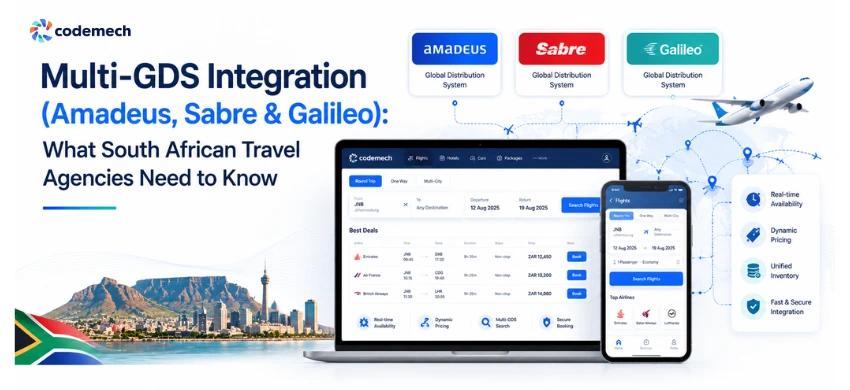
Multi-GDS integration means connecting more than one GDS or travel distribution source to a common travel platform.
For example, a travel agency may have a website or internal booking platform connected to a central integration layer. That layer can communicate with Amadeus, Sabre and Travelport based on the agency's approved access and business requirements.
Instead of creating a completely separate customer-facing booking system for every provider, the agency can build a more centralized workflow.
A simplified architecture may look like this:
Travel Agency Website / Agent Platform
↓
Travel Booking Engine
↓
Integration / Orchestration Layer
↓
Amadeus | Sabre | Travelport
↓
Normalized Travel Data
↓
Booking / PNR / Ticketing
↓
CRM / Mid-Office / Back-Office
The integration layer is important because different providers can expose different APIs, authentication processes, data structures and booking workflows.
For an agency, the practical benefit is having the ability to work with multiple approved distribution sources without building an entirely separate technology stack for every GDS.
However, a successful implementation requires more than combining search results on one screen.
The platform must also consider what happens after the traveller selects an itinerary.
Why Would a South African Travel Agency Need More Than One GDS?
Not every South African travel agency needs three GDS connections.
For a smaller agency with relatively straightforward booking requirements, a single well-integrated distribution source may be sufficient.
However, a larger TMC, corporate travel agency, OTA or technology-driven travel business may have reasons to evaluate more than one source.
Possible reasons include:
- Different airline and travel content requirements
- Existing supplier or distribution relationships
- International booking requirements
- Corporate travel workflows
- Different servicing processes
- Access to traditional GDS content and newer distribution content
- Operational resilience
- Business-specific technology requirements
The right approach depends on the agency's business model.
For example, a corporate travel business may have very different requirements from a leisure-focused agency. Corporate travellers may require more complex servicing, approval workflows and post-booking management.
Similarly, an agency serving international routes may have different content requirements from a business focused primarily on a smaller set of destinations.
The important point is simple: more integrations do not automatically create a better travel platform.
An agency should first identify what problem an additional distribution source is expected to solve.
Amadeus vs Sabre vs Travelport: What Should Agencies Compare?
There is no universal answer to which platform is best.
A comparison between Amadeus vs Sabre vs Travelport should start with the requirements of the travel business rather than generic rankings.
Agencies should evaluate areas such as:
| Area | Questions to Consider |
|---|---|
| Travel content | Does the platform support the content required for your business? |
| Supplier relationships | What existing commercial or agency relationships need to be considered? |
| API integration | Which APIs and workflows are available for the required use case? |
| Booking workflow | How does the booking process fit into your existing platform? |
| Servicing | How will changes, cancellations and other post-booking processes be managed? |
| Ticketing | What ticketing workflow is required by the agency? |
| Business systems | Can the integration connect with CRM, mid-office or back-office systems? |
| Technology roadmap | How will the architecture support future distribution requirements, including NDC? |
It is also important to understand the Galileo and Travelport relationship correctly.
Galileo is associated with the Travelport ecosystem and should not be treated as a completely unrelated modern platform. When evaluating Galileo-related capabilities, agencies should look at the current Travelport technology and APIs relevant to their business requirements.
The best choice is therefore not necessarily the same for every South African travel business.
A platform should be evaluated based on what the agency actually needs to sell, book, service and manage.
How Does Multi-GDS API Integration Work?
Travel API Integration in South Africa can become technically complex when multiple external distribution systems are involved.
The goal is not simply to connect each API directly to the website.
A stronger architecture usually introduces a central integration or orchestration layer.
Search and Availability
When a traveller or agent searches for an itinerary, the booking platform can send requests to the required distribution sources.
The available results are then processed before being presented to the user.
Pricing
Search availability is only one part of the process.
The selected itinerary may need to go through the appropriate pricing workflow before the booking can continue. Different providers can expose different pricing processes and responses.
Data Normalization
One GDS may structure information differently from another.
A central integration layer can help map relevant information into a format that the booking engine can understand.
However, normalization should not oversimplify important provider-specific data.
For example, the booking platform may display a consistent user interface while still preserving the information needed for the correct supplier-specific workflow.
Booking
Once an itinerary is selected, the platform follows the relevant provider workflow to create the booking.
This can involve traveller information, booking references, itinerary details and other required data.
PNR Creation
A Passenger Name Record, or PNR, becomes an important part of the booking lifecycle.
The system needs to understand where the PNR is created, how the relevant booking data is stored and how information will be synchronized with other systems.
Ticketing
Ticketing should be considered separately from simply creating a booking.
The technology architecture may need to support the required operational workflow for ticket issuance and related records.
Post-Booking Servicing
This can include:
- Cancellations
- Exchanges or reissues
- Refund-related processes
- Schedule changes
- Queue handling
- Booking updates
Error Handling
Travel APIs are external dependencies.
Requests can fail, supplier responses can change and systems can experience temporary issues.
The architecture should therefore include proper error handling, monitoring and logging.
This is one reason multi-GDS integration is significantly more complex than adding several flight search APIs to a website.
Why Travel Booking Engine Development Requires More Than Search Results
A Travel Booking Engine Development project should not focus only on displaying available flights.
Search is usually the easiest part for users to see. The more difficult processes often happen after the booking.
A booking engine may need to manage:
- Availability
- Pricing
- Traveller information
- Booking creation
- PNR management
- Ticketing workflows
- Changes and cancellations
- Synchronization
- Error handling
The user interface can look simple while the underlying workflow is complex.
For this reason, agencies building custom travel platforms should define the complete booking lifecycle before development begins.
The question should not only be:
Can our system search and create a booking?
It should also be:
What happens when that booking changes?
PNR Management, Ticketing and Servicing
A PNR is not just a technical record created during booking.
It becomes part of the wider travel servicing workflow.
A multi-GDS platform may need to manage information such as:
- PNRs
- Record locators
- Ticket numbers
- Booking status
- Ticket issuance
- Cancellations
- Exchanges and reissues
- Refund-related workflows
- Schedule changes
- Queues
- Synchronization with internal systems
This is particularly important for travel agencies and TMCs that manage bookings after the initial sale.
Imagine a hypothetical example.
A corporate traveller's itinerary is created successfully through one distribution source. Later, the airline changes a flight schedule. The agency may need to identify the affected booking, review the change and update the relevant operational systems.
If the travel platform only handles the initial booking but cannot reliably support the agency's post-booking workflow, the integration is incomplete.
This is why PNR synchronization and servicing requirements should be discussed during the architecture stage.
GDS vs NDC: What Should South African Travel Agencies Know?
The discussion around GDS vs NDC is sometimes presented as if one technology is replacing the other completely.
The practical reality for travel agencies is more complicated.
Traditional GDS distribution remains an important part of the travel industry, while NDC represents an IATA-supported approach to modern airline retailing and distribution.
For an agency, the main question is usually not:
Should we use GDS or NDC?
A better question is:
What content and workflows does our business need, and which distribution approach supports them?
NDC can support richer airline offers and modern airline retailing workflows. At the same time, travel businesses may continue to require GDS-based content and workflows.
These approaches should therefore not automatically be treated as mutually exclusive.
A future-focused travel platform may need an architecture capable of working with multiple types of distribution content.
Before making a technology decision, agencies should consider:
- Required airline content
- Current supplier relationships
- Booking workflows
- Post-booking servicing
- Internal operational processes
- Future distribution requirements
The technology stack should be designed around business requirements rather than industry buzzwords.
IATA, BSP and the Operational Side of GDS Integration
Travel technology does not operate separately from agency operations.
For agencies working within applicable IATA accreditation and BSP processes, the technology environment may interact with wider activities involving ticketing, reporting, settlement and reconciliation.
At a high level, agencies may need to consider:
- IATA accreditation requirements
- BSP processes
- Sales reporting
- Remittance
- Settlement
- Reconciliation
- Ticketing records
The exact requirements can vary depending on the agency's status, business model and operational arrangements.
For this reason, technology decisions should not be made only by looking at API documentation.
A booking system may need to connect with other business systems responsible for financial records, reporting and operational management.
Agencies should verify current requirements directly with IATA and the relevant distribution or travel providers before making operational decisions.
Common Challenges in Multi-GDS Integration
The biggest challenge in multi-GDS integration is usually not making the first API request.
The real complexity appears when different systems must work together across the full booking lifecycle.
Common challenges include:
Different APIs and Data Structures
Providers can use different request formats, response structures and identifiers.
Authentication and Security
API credentials and access controls need to be managed securely.
Fare and Pricing Differences
Travel content and pricing workflows may not follow exactly the same technical process across providers.
PNR Management
The system needs clear rules for managing booking records throughout their lifecycle.
Ticketing and Servicing
Initial booking creation is only one part of the travel workflow.
Exchanges, reissues, cancellations and other servicing activities may require additional processes.
Schedule Changes
The platform needs a reliable way to identify and process booking changes.
Error Handling
Failed requests can create operational problems if they result in duplicate or incomplete booking states.
Monitoring
The agency or technology provider needs visibility into API errors and integration issues.
Maintenance
External APIs and supplier workflows can change over time.
A multi-GDS architecture therefore requires ongoing maintenance rather than being treated as a one-time development project.
Agent Training
The people using the platform also need to understand the workflow.
Technology should support the agency's operational process rather than forcing agents into unnecessary complexity.
What Should Agencies Look for in a Multi-GDS Integration Partner?
A technology provider should be evaluated based on the complete integration requirement.
Travel businesses should ask questions such as:
- Does the provider support the required distribution platforms?
- Which APIs are relevant to the required workflow?
- Does the integration support search and booking?
- What ticketing workflows can be supported?
- How are PNRs handled?
- How are exchanges and refund-related processes managed?
- Can the system integrate with an existing booking engine?
- Can it connect with a travel portal?
- Can it integrate with CRM, mid-office or back-office systems?
- Can the architecture support NDC where required?
- How are errors monitored?
- What security controls are included?
- How will the system be maintained when supplier APIs change?
- Is the architecture scalable?
The agency should also clearly document its current workflow before selecting an integration approach.
A platform that works well for one type of travel business may not be suitable for another.
Is Multi-GDS Integration Right for Every Travel Agency?
No.
A smaller travel agency may not need the additional technical and operational complexity of multiple GDS connections.
In many cases, one strong distribution integration may meet the business requirements.
However, larger agencies, TMCs, OTAs and businesses building advanced travel platforms may have stronger reasons to evaluate multiple sources.
The decision should consider:
- Business model
- Required travel content
- Supplier relationships
- Booking volume
- Servicing complexity
- Technology roadmap
- Budget
- Operational requirements
The purpose of a multi-GDS architecture should always be connected to a clear business requirement.
Connecting more APIs simply because they are available can increase development and maintenance complexity without creating meaningful value.
How CodeMech Solutions Can Support Travel Technology Integration
As a travel software development company, CodeMech Solutions works with businesses that require custom travel technology solutions, including API development, data integration, custom software architecture and travel platform development.
Travel businesses may require different technology approaches depending on whether they are building travel software solutions for travel agencies, tour operators or other booking businesses.
The technical requirement may involve connecting external travel APIs with a booking platform, internal business systems or a customer-facing portal.
CodeMech Solutions can help businesses assess their requirements across custom travel software development, system integration, API development, travel portal development and scalable application architecture.
If your business is evaluating a multi-GDS approach, the first step is usually to map the complete booking, ticketing, servicing and operational workflow before deciding how the integrations should be designed.
Is Custom Travel Technology the Right Approach?
Custom development is not automatically the right choice for every travel business.
Some agencies may be well served by existing platforms.
However, businesses with specific workflows may need more flexibility.
For example, a company may require:
- A custom booking workflow
- Multiple distribution sources
- Integration with internal business systems
- A specialized travel portal
- Custom reporting
- Unique corporate travel workflows
In these situations, a custom architecture can provide more control over how systems connect.
For agencies and tour operators evaluating travel software solutions for tour operators or more specialized booking workflows, the technology should be selected based on the operational requirement rather than a generic software checklist.
Learn More About Travel Technology
If you are researching GDS integration and airline distribution technology, these two guides provide useful additional context:
Amadeus API Integration Guide: How to Access GDS Travel Content
Learn more about the role of Amadeus APIs and the considerations involved when accessing GDS travel content through a technology platform.
GDS vs NDC vs Direct Airline API: Which Integration Should a South African OTA Choose?
Explore the differences between traditional GDS distribution, NDC and direct airline APIs, particularly from the perspective of a South African online travel business.
Conclusion
The objective of multi GDS integration South Africa is not to connect Amadeus, Sabre and Travelport simply for the sake of having multiple connections.
The real objective is to create a reliable travel technology architecture that supports the agency's actual requirements.
That may include managing travel content, bookings, PNRs, ticketing and post-booking servicing while connecting the distribution layer with CRM, mid-office and back-office systems.
For some travel agencies, one well-designed integration may be enough. For larger TMCs, OTAs and technology-driven travel businesses, a multi-source architecture may provide stronger flexibility.
The right decision starts with understanding the booking and operational workflow.
If your travel business is evaluating a custom travel platform, Travel API Integration in South Africa or a multi-GDS architecture, CodeMech Solutions can help assess the technical requirements and explore an integration approach aligned with your business needs.