Introduction: Why Travel Businesses in South Africa Need Smarter Technology
South Africa has established itself as one of Africa's most important tourism destinations, attracting international visitors through its safari experiences, coastal destinations, cultural attractions, luxury hospitality, and growing business travel market.
The country's tourism industry also presents a substantial opportunity for technology-driven businesses. According to South African government reporting, the country welcomed approximately 10.5 million international tourists in 2025, its highest recorded annual total at the time. International tourist arrivals reached more than 7.58 million between January and August 2026, representing an 11.7% increase compared with the corresponding period in 2025.
These figures demonstrate the importance of a well-connected tourism ecosystem, including digital booking infrastructure, travel distribution platforms, and technology solutions that help businesses manage growing customer demand.
However, attracting travellers is only one part of the challenge.
Travel agencies, tour operators, destination management companies, and corporate travel businesses also need technology that can manage complex itineraries, connect multiple suppliers, process reservations, coordinate payments, and provide customers with convenient booking experiences.
Traditional travel management processes often rely on disconnected applications, spreadsheets, manual confirmations, and supplier-specific booking systems.
This is where modern travel technology becomes important.
Whether a company needs a B2B travel portal, an online travel agency (OTA), a corporate booking engine, or a custom tour operator platform, choosing the right technology partner can influence operational efficiency and long-term business growth.
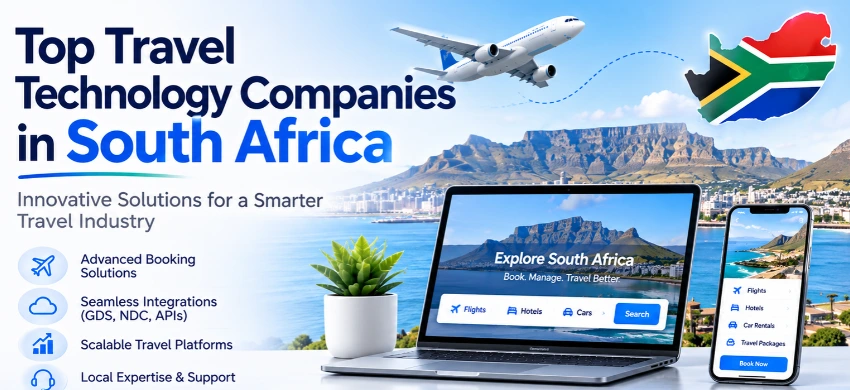
This guide explores the top travel technology companies in South Africa, including booking engine providers, travel API specialists, and custom software development partners.
1. The Evolution of Travel Technology in South Africa
Travel technology is changing how tourism businesses distribute inventory, manage reservations, and interact with customers.
Modern travel platforms increasingly connect booking interfaces, supplier systems, payment services, customer management tools, and operational workflows through APIs.
For South African travel businesses serving domestic, regional, and international customers, several developments deserve attention.
1.1 Digital-First Booking Experiences
Customers increasingly expect convenient digital experiences when researching and purchasing travel services.
A modern travel booking platform should make it possible to:
- Search flights, accommodation, transfers, and activities.
- Compare available options.
- View pricing and booking conditions.
- Complete reservations.
- Receive booking confirmations.
- Access travel documents.
- Manage changes and cancellations.
Mobile responsiveness is particularly important because customers may research destinations and manage bookings across smartphones, tablets, and desktop devices.
Travel businesses should therefore evaluate mobile usability as a core product requirement rather than an optional design feature.
1.2 Integration of International and Regional Travel Inventory
Travel companies often work with multiple inventory sources.
These can include:
- Global Distribution Systems (GDS).
- Airline direct-connect APIs.
- New Distribution Capability (NDC) connections.
- Hotel wholesalers.
- Accommodation suppliers.
- Car rental providers.
- Activity and excursion operators.
- Local destination management companies.
Platforms such as Amadeus, Sabre, and Travelport provide travel distribution infrastructure and developer interfaces.
However, connecting to these systems is not the same as building a complete travel business platform.
The booking application must also manage search results, pricing verification, booking records, payment status, cancellations, supplier responses, and customer notifications.
A reliable integration architecture is therefore essential.
1.3 Local Payment and Multi-Currency Requirements
South African travel companies may serve customers paying in South African rand (ZAR), US dollars (USD), euros (EUR), British pounds (GBP), and other currencies.
A travel booking platform may need to support:
- Local and international payment providers.
- Multiple display currencies.
- Currency conversion rules.
- Payment authorization and confirmation.
- Refund management.
- Transaction reconciliation.
- Secure payment handling.
The availability of particular payment methods depends on the merchant's country, payment provider, business model, and commercial agreements.
For this reason, businesses should verify payment gateway compatibility before choosing a booking platform.
1.4 Specialized Software for Tour Operators and Safari Businesses
A conventional flight-and-hotel booking engine may not adequately support the requirements of a safari operator or destination management company.
Consider a multi-day Southern African safari itinerary involving:
- Airport transfers.
- Multiple lodges.
- Private guides.
- Scheduled game drives.
- Vehicle availability.
- Park entry arrangements.
- Meal plans.
- Activity reservations.
- Seasonal pricing.
- Different accommodation occupancy rules.
These requirements can involve complex availability, supplier coordination, and itinerary management.
A specialized tour operator platform may need to support itinerary builders, supplier contracts, quotation workflows, booking amendments, and operational dashboards.
This is one reason some businesses eventually consider custom travel software instead of relying exclusively on standard booking templates.
2. Different Categories of Travel Technology Companies in South Africa
Before comparing individual companies, it is important to understand that the travel technology market includes several different types of providers.
They do not all solve the same problem.
2.1 Global Distribution System Providers
Global Distribution Systems connect travel businesses with travel inventory and distribution services.
Three important industry platforms are:
Amadeus
Official website
Amadeus provides travel technology and distribution services across air, hotel, and other travel-related categories.
Its enterprise API offering provides access to travel functionality for eligible organizations. Businesses should review its current enterprise access requirements, commercial terms, and API availability before planning an integration.
Sabre
Official website
Sabre provides travel distribution technology and developer APIs that support travel agencies, airlines, and travel application developers.
Its developer platform includes services for flight shopping, booking, post-booking workflows, and other travel-related capabilities.
Travelport
Official website
Travelport provides travel distribution services and developer APIs for building applications that connect to flight, accommodation, and payment-related workflows.
Its TripServices platform provides API capabilities for flights, stays, and payment-related services.
Important distinction: Amadeus, Sabre, and Travelport are primarily travel distribution and technology infrastructure providers. They should not automatically be compared with custom software development agencies.
For South African travel agencies and online travel businesses, choosing the right API integration strategy is equally important. Understanding how different travel APIs connect with GDS platforms, airlines, hotel suppliers, and other travel service providers can help businesses build more connected booking systems. Read our detailed guide on Travel API Integration in South Africa to explore integration options and their applications.
2.2 White-Label Travel Booking Software Providers
White-label platforms provide existing travel booking functionality that businesses can configure and operate under their own branding.
They can be suitable for companies that want to launch an online booking operation without developing every component independently.
Two examples include:
OTRAMS (Qtech Software)
Official website
OTRAMS offers travel ERP and booking software designed for travel businesses.
Its published capabilities include:
- Booking engine functionality.
- Supplier integrations.
- Travel inventory management.
- Agent management.
- Dynamic packaging.
- API redistribution.
- Back-office operations.
- B2B and B2C travel workflows.
The platform is worth evaluating for travel agencies and businesses looking for an established travel management system.
Travelomatix
Official website
Travelomatix provides travel booking software for travel agencies and tour operators.
Its published product offerings include:
- B2B and B2C booking modules.
- Flight and hotel booking.
- Holiday packages.
- Pre-integrated GDS and travel APIs.
- Payment gateway integration.
- Administrative functionality.
- Custom booking engine development options.
Businesses should compare the available customization levels, licensing structure, supplier coverage, and support arrangements before selecting a plan.
2.3 South African Travel Technology and Software Companies
South Africa also has locally established businesses developing travel systems, digital platforms, and software solutions.
The following companies are relevant to buyers evaluating travel technology and software capabilities.
3. Top Travel Technology Companies and Software Development Partners in South Africa
The following is a curated market shortlist, not a verified ranking by revenue, market share, or customer satisfaction.
Each provider is included because its publicly documented services or products are relevant to at least one aspect of travel technology or software development.
3.1 Realtime Travel Connections (RTTC)
Location: South Africa
Website: https://www.rttc.co.za/
Realtime Travel Connections is an established South African travel technology company with a history dating back to 1995.
The company originally supported the South African Worldspan technical operation, which is now associated with Travelport.
Its publicly documented offerings include TravelNet, RealOnline, and RealMobi.
RealOnline provides online booking capabilities and supports travel distribution through GDS and supplier API integrations.
Its documented functionality includes:
- Online booking.
- Flight and accommodation search.
- Car rental reservations.
- Dynamic packaging.
- Currency conversion.
- Payment gateway integration.
- Channel management.
- Tour operating functionality.
Best suited for: Travel agencies and travel businesses evaluating locally established travel booking and distribution technology.
What to evaluate: Current supplier coverage, integration availability, system customization, support arrangements, and compatibility with existing business processes.
3.2 Tripco
Location: Cape Town, South Africa
Website: https://www.tripco.africa/
Tripco is a South African travel technology business focused on simplifying local travel discovery and booking.
Its flagship brand, LekkeSlaap, is an accommodation booking platform serving the South African market.
Tripco also describes its Tripco Connect offering as a technology solution through which other businesses can power their own travel brands.
This makes the company relevant to businesses interested in local accommodation distribution and travel booking technology.
Best suited for: Businesses exploring South African accommodation distribution, local travel booking experiences, and travel technology partnerships.
What to evaluate: Whether its available partnership and integration capabilities match the requirements of your particular business model.
3.3 Realm Digital
Location: South Africa
Website: https://realmdigital.com/
Realm Digital provides custom software development, websites, mobile applications, integrations, and AI-related development services.
Its approach focuses on building software around specific business processes rather than forcing organizations to adapt entirely to off-the-shelf products.
Its publicly described development process includes:
- Discovery and architecture.
- Interface and experience design.
- Software development and testing.
- Ongoing support and improvement.
For a travel company with specialized operational requirements, this type of custom software development capability may be relevant.
Best suited for: Travel businesses that need bespoke web applications, mobile applications, workflow automation, or integrations with existing systems.
What to evaluate: Previous travel-industry experience, specific GDS integration capability, supplier API experience, and the proposed architecture for your project.
3.4 Rocketsoft
Location: Cape Town, South Africa
Website: https://www.therocketsoft.com/
Rocketsoft provides custom software development, mobile application development, website development, business automation, and system integration services.
Its published capabilities include cross-platform mobile applications and custom business software.
For a travel business planning a mobile booking experience, customer-facing application, or connected operational system, Rocketsoft may be worth considering.
Best suited for: Companies looking for custom mobile applications, business automation, and web-based software development.
What to evaluate: Travel-specific implementation experience, supplier integration expertise, booking lifecycle management, and post-launch support.
3.5 Netgen
Location: Johannesburg and Cape Town, South Africa
Website: https://www.netgen.co.za/
Netgen is a South African custom software development company with more than 25 years of publicly stated operating history.
Its services include:
- Custom software development.
- Mobile applications.
- Web applications.
- API development.
- Legacy application modernization.
- Hosting and maintenance.
- Ongoing technical support.
Netgen also describes experience across several business sectors, including finance, healthcare, logistics, and manufacturing.
For travel organizations with complex internal systems, these software engineering capabilities may be useful.
Best suited for: Businesses requiring customized enterprise applications, system modernization, and long-term software support.
What to evaluate: Travel domain knowledge, relevant integration experience, and familiarity with booking and supplier management workflows.
3.6 Codemech Solutions
Location: India, serving international markets including South Africa
Website: https://www.codemechsolutions.com/
Codemech Solutions is a software development company offering custom software engineering, web development, mobile application development, API integration, and travel technology solutions.
Unlike a conventional ready-made travel booking platform, custom software development allows the architecture and workflows to be designed around an organization's actual business requirements.
Its travel technology offering is relevant to businesses exploring:
- Custom travel portal development.
- Corporate travel booking engines.
- GDS and travel API integration.
- Travel mobile applications.
- B2B and B2C travel platforms.
- Booking and reservation management.
- Third-party system integration.
A Documented Example: NexCT Corporate Travel Booking Platform
One relevant example in Codemech's published portfolio is NexCT.
The portfolio describes NexCT as a corporate travel booking platform developed using technologies including:
- Java.
- Apache Karaf.
- Apache Struts.
- OSGi.
- RIO.
- JSP and jQuery.
- SOAP-based integrations.
- Sabre and Amadeus-related integration capabilities.
The documented platform supports corporate travel booking workflows, service integration, and travel management functionality.
This is a useful example of why travel technology development involves more than creating a search interface: the application must also connect business workflows with external travel services.
When Should a South African Travel Company Consider Codemech Solutions?
Codemech may be worth evaluating when an organization requires a custom-built travel application rather than a fixed-feature booking template.
Potential project requirements include:
- A branded online travel booking portal.
- A specialized B2B travel distribution platform.
- Corporate travel booking and approval workflows.
- Integration with existing GDS and supplier APIs.
- Custom booking and pricing logic.
- A mobile travel application.
- Connections between travel systems, CRMs, ERPs, and payment providers.
Best suited for: Travel agencies, tour operators, corporate travel businesses, and travel startups seeking customized software development and integration capabilities.
What to evaluate: Project scope, technical architecture, API access, integration requirements, development timelines, ownership of source code, security practices, maintenance agreements, and relevant team experience.
4. How to Choose Among the Top Travel Technology Companies in South Africa
Choosing a travel technology partner should involve more than comparing company names or advertised features.
The right provider depends on your business model, existing systems, supplier relationships, and future requirements.
Consider the following evaluation framework.
| Evaluation Criterion | What to Investigate |
|---|---|
| Travel domain knowledge | Experience with real booking and travel management workflows |
| GDS integration | Amadeus, Sabre, Travelport compatibility |
| Supplier APIs | Hotel, airline, transfers and activity integrations |
| Customization | Ability to support specialized workflows |
| Mobile experience | Responsive website and mobile applications |
| Payment processing | Local and international payment requirements |
| Multi-currency | Currency display, conversion and transaction handling |
| Scalability | Ability to support increased traffic and booking volume |
| Security | Authentication, authorization, data protection and payment security |
| Reporting | Booking, revenue, supplier and operational reporting |
| Maintenance | Monitoring, updates, bug fixes and ongoing support |
| Commercial terms | Licensing, source code ownership and integration costs |
Questions to Ask Before Selecting a Provider
- Have you developed a travel booking system before?
- Can you demonstrate an actual booking workflow?
- Which supplier and GDS integrations do you support?
- How do you handle real-time pricing and availability changes?
- Can the platform support multiple suppliers?
- Does it support local and international payment providers?
- Can the business configure its own commissions and markup rules?
- Who owns the software source code?
- How are booking changes, cancellations, and refunds handled?
- What support is available after deployment?
Ask for demonstrations, documentation, references, and technical proposals rather than relying exclusively on marketing claims.
5. Custom Travel Software vs. White-Label Booking Engines
One of the most important decisions for a growing travel business is whether to purchase an existing booking platform or invest in custom software development.
Both approaches have advantages.
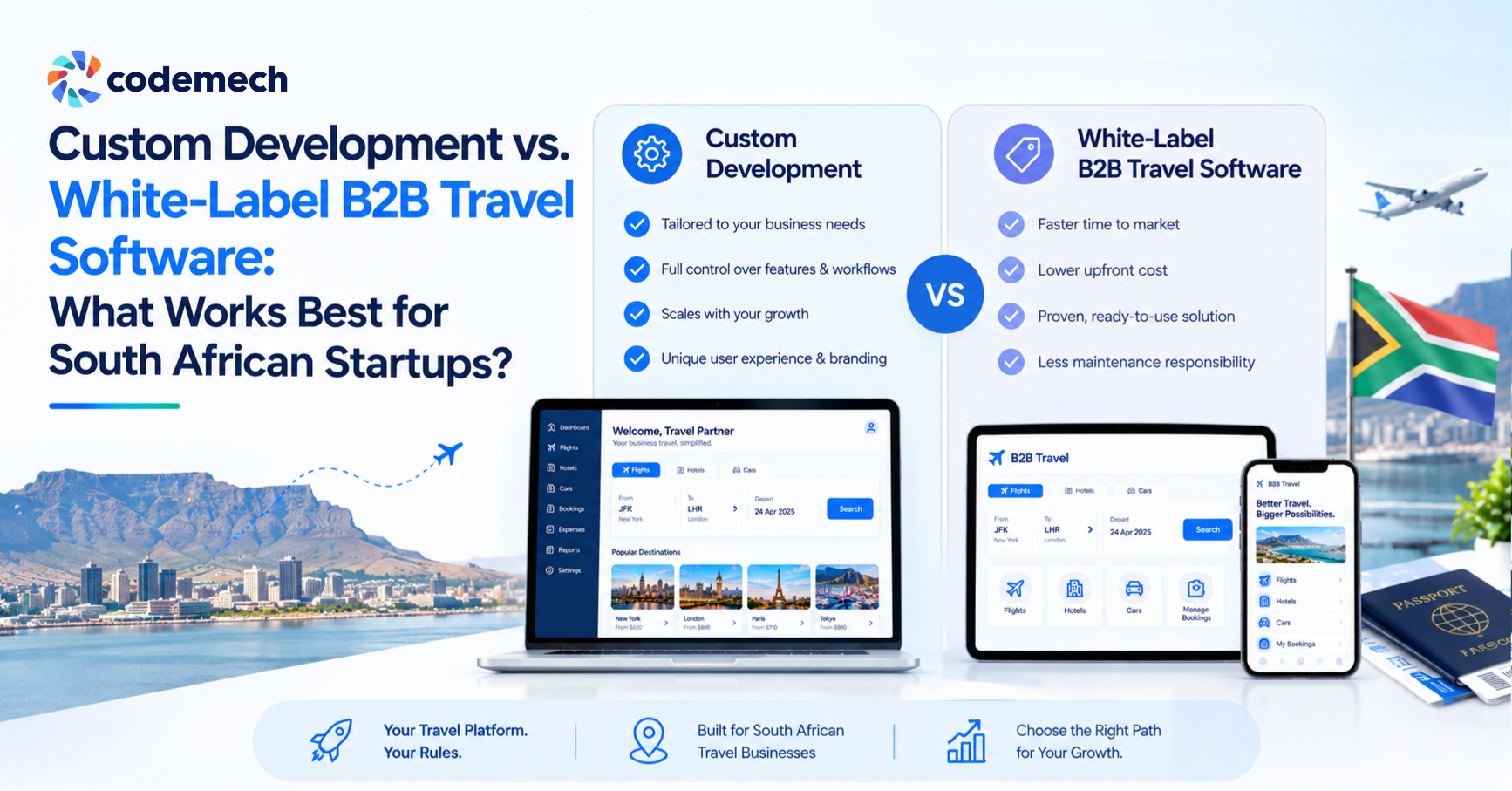
White-Label Booking Software
White-label software provides an existing booking framework that can be configured for a company's brand and operational needs.
Advantages:
- Faster initial deployment.
- Existing booking functionality.
- Pre-integrated suppliers in some plans.
- Lower initial engineering requirements.
- Established administrative features.
Limitations to Investigate:
- Customization restrictions.
- Recurring licensing fees.
- Supplier integration limitations.
- Dependence on the platform provider.
- Restrictions on proprietary business logic.
- Limited control over some technical components.
White-label platforms can be an excellent choice for businesses with standard booking requirements.
Custom Travel Software Development
Custom development involves designing and building a travel platform around specific business requirements.
Advantages:
- More control over application architecture.
- Customized booking and approval workflows.
- Flexible supplier integrations.
- Business-specific pricing and commission rules.
- Custom user experiences.
- Greater control over software development decisions.
- Opportunities to develop proprietary intellectual property.
Considerations:
- Greater initial planning requirements.
- Development and testing investment.
- Ongoing maintenance responsibilities.
- Supplier certification and API access requirements.
- Long-term infrastructure and operational costs.
Comparison
| Feature | White-Label | Custom Development |
|---|---|---|
| Initial launch | Usually faster | Depends on project scope |
| Initial investment | Often lower | Depends on complexity |
| Custom workflows | Plan-dependent | Designed around requirements |
| Supplier integrations | Often predefined | Can be engineered as required |
| Source code ownership | Contract-dependent | Contract-dependent |
| Proprietary business logic | May be restricted | Greater flexibility |
| Technical control | Platform-dependent | Greater architectural control |
| Maintenance | Provider-dependent | Agreed support arrangement |
Neither approach is universally better.
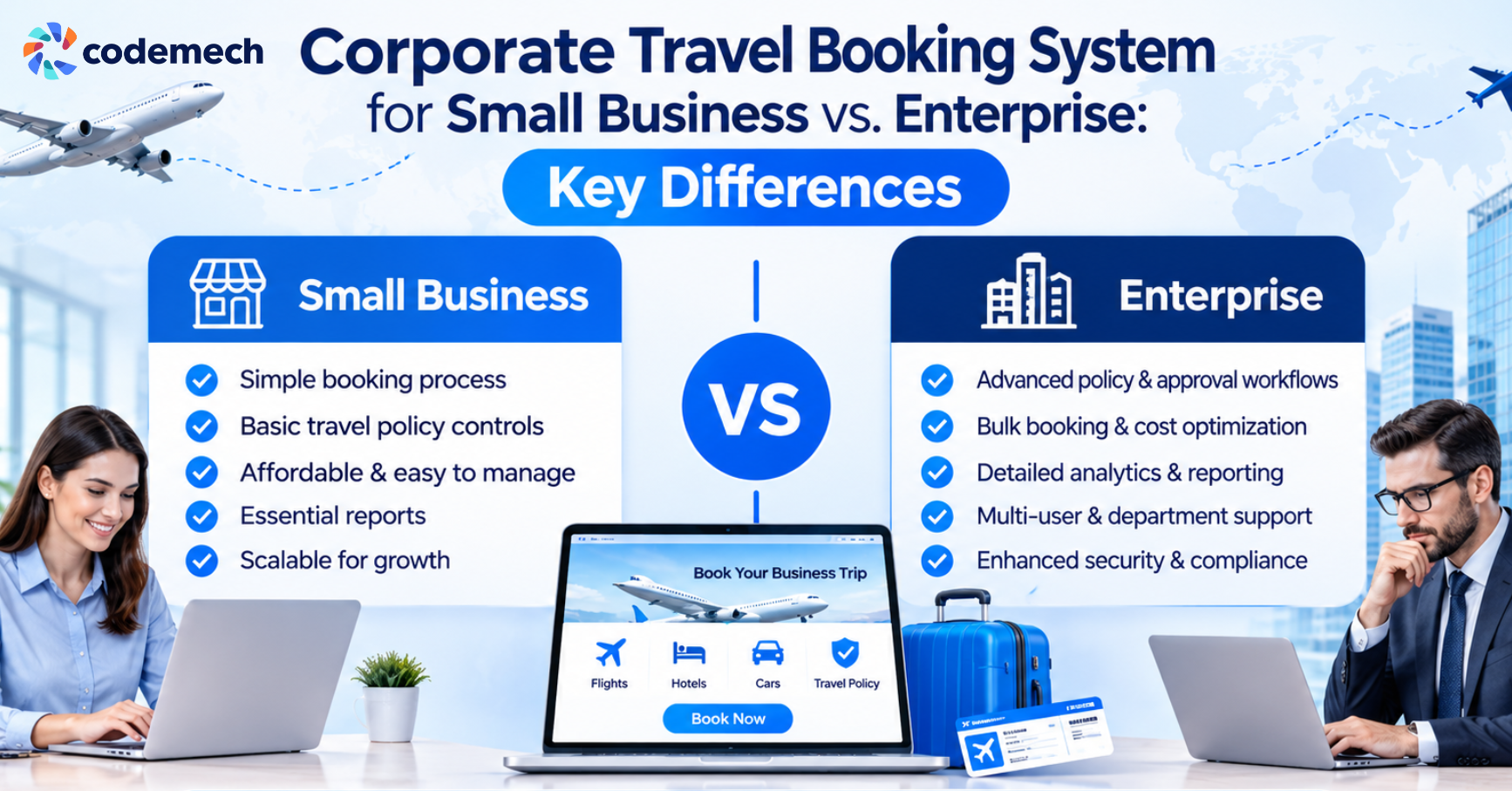
A small agency with standard booking requirements may benefit from a ready-made system.
A large tour operator managing complex itineraries, multiple suppliers, corporate accounts, and specialized pricing rules may find custom development more appropriate.
A Practical Decision Framework
Consider White-Label Software When:
- Your requirements are relatively standard.
- You want to launch quickly.
- Existing supplier integrations meet your needs.
- You do not need extensive proprietary workflows.
Consider Custom Development When:
- Your business has specialized booking processes.
- You need to integrate several existing systems.
- Your pricing and commission rules are complex.
- You want control over the product roadmap.
- Your business needs a differentiated digital experience.
A hybrid model is also possible: use existing travel distribution infrastructure while building a custom web application and business workflow layer around it.
6. Essential Technical Components of a Modern Travel Booking Platform
A professional travel booking system is more than a website with a search form.
Building a scalable travel booking platform requires more than connecting a search interface to external suppliers. Businesses must consider application architecture, booking workflows, API integrations, database management, and system performance. Learn more about How Travel Software Companies Build Scalable Booking and Reservation Platforms and the technical considerations involved in developing reliable travel applications.
6.1 Booking Engine
The booking engine manages the customer journey from initial search to reservation confirmation.
Core capabilities can include:
- Search and filtering.
- Availability checking.
- Pricing validation.
- Reservation creation.
- Booking confirmation.
- Cancellation and modification workflows.
6.2 GDS and Supplier API Integrations
GDS and supplier APIs connect the application with external inventory sources.
For example:
- Sabre for travel distribution services.
- Amadeus for travel distribution services.
- Travelport for travel content and booking workflows.
- Direct hotel and airline supplier integrations.
API access, commercial agreements, certification requirements, and available functionality vary by provider.
6.3 Payment and Transaction Management
The platform should manage payment authorization, transaction status, refunds, and reconciliation.
Sensitive payment information should be handled using appropriate payment-provider integrations and security controls.
6.4 Administrative and Supplier Management
The administration layer may include:
- Customer management.
- Supplier management.
- Booking administration.
- Commission configuration.
- Reporting.
- User permissions.
- Refund and cancellation management.
6.5 Security and Data Protection
Travel applications can process personal information, identity details, travel records, and payment-related information.
Companies operating in South Africa should consider the Protection of Personal Information Act (POPIA), alongside any other applicable privacy and security requirements in the markets they serve.
Security planning should include access control, secure authentication, encryption, monitoring, data retention policies, and incident response procedures.
7. Common Mistakes When Choosing Travel Software
Selecting a platform without understanding its operational limitations can create expensive problems later.
Avoid these common mistakes.
Choosing Only on Initial Price
A low-cost booking platform may have additional licensing, supplier, integration, customization, and support costs.
Compare total cost of ownership rather than only the initial quotation.
Ignoring the Post-Booking Experience
A booking is not the end of the travel management process.
Customers may need changes, cancellations, refunds, invoices, and customer support.
Make sure the platform supports the complete booking lifecycle.
Assuming Every GDS Integration Works the Same Way
Different providers have different API structures, commercial arrangements, content coverage, and technical requirements.
Validate the actual supplier access needed for your business.
Overlooking Local Payment Requirements
International payment support does not automatically mean that every local payment method is available.
Confirm merchant eligibility, settlement currency, transaction fees, refund functionality, and supported payment methods.
Ignoring Scalability and Maintenance
A platform should be designed for ongoing improvements, supplier changes, security updates, and business expansion.
Evaluate the long-term support model before signing a development or licensing agreement.
8. How to Choose the Right Travel Technology Partner in South Africa
A practical selection process can help reduce technical and commercial risk.
Step 1: Define Your Business Model
Decide whether you operate as an OTA, travel agency, tour operator, DMC, TMC, or travel marketplace.
Step 2: Document Functional Requirements
List the required booking categories, supplier integrations, payment workflows, administrative features, and customer journeys.
Step 3: Identify the Required Technology Model
Determine whether a white-label platform, custom application, or hybrid architecture is appropriate.
Step 4: Evaluate Technical Capabilities
Request architecture documentation, API integration examples, security information, and demonstrations.
Step 5: Compare Commercial Terms
Examine implementation costs, recurring charges, supplier fees, licensing, source code rights, and support agreements.
Step 6: Start with a Defined Implementation Scope
A phased development approach can help businesses validate the most important functionality before expanding the platform.
Step 7: Plan for Ongoing Improvement
Include monitoring, maintenance, integration updates, security reviews, and future feature development in the operational plan.
Conclusion: Building the Right Travel Technology Infrastructure for Long-Term Growth
South Africa's tourism market offers opportunities for travel agencies, tour operators, corporate travel businesses, and digital travel startups.
However, the right technology investment depends on more than having an attractive booking website.
Businesses need reliable supplier integrations, efficient booking workflows, suitable payment infrastructure, responsive customer experiences, and technology that can evolve alongside their operations.
Established travel distribution providers such as Amadeus, Sabre, and Travelport offer important infrastructure. White-label solutions such as OTRAMS and Travelomatix can help businesses deploy established booking functionality. South African technology companies such as RTTC, Tripco, Realm Digital, Rocketsoft, and Netgen provide different travel or software-related capabilities.
For businesses with specialized operational requirements, custom travel software development offers another option.
Codemech Solutions provides custom travel software engineering and integration services, with its published NexCT corporate booking platform demonstrating relevant travel technology work.
The most important step is to define your business requirements, evaluate providers objectively, and choose a technology architecture that supports your long-term goals.
Planning a Custom Travel Portal or Booking Engine?
Explore Codemech Solutions' Travel Software Development services to learn about its travel technology capabilities.
Discuss your requirements for custom travel booking engines, GDS integrations, mobile applications, and connected travel platforms with the Codemech Solutions team.