Planning a safari business around a generic travel portal can seem like the quickest way to get online. You get booking features, customer accounts, payment options and an administration panel without having to build everything from the ground up.
But safari operations are not the same as selling a standard hotel room or flight.
A South African DMC may need to manage private game drives, lodge availability, park fees, transfers, guides, vehicle types, meal plans, seasonal pricing, child policies, multi-day itineraries and supplier confirmations all within one booking journey.
That is where custom safari booking software for South African DMCs can make a significant difference.
Instead of changing your business processes to fit a generic portal, a custom safari booking system for DMCs can be designed around the way your team actually sells and operates tours.
This guide compares custom safari booking software with generic travel portals, explains the architecture behind a scalable solution, and breaks down the major cost factors South African DMCs should consider before starting development.
What Is Safari Booking Software?
Safari booking software is a digital platform that helps DMCs, safari operators and tour companies manage the complete booking lifecycle.
Depending on the business model, it can support:
- Safari package creation
- Lodge and accommodation management
- Tour and activity scheduling
- Vehicle and guide allocation
- Availability management
- Seasonal pricing
- Customer enquiries
- Online bookings
- Deposits and payments
- Booking confirmations
- Transfers and transportation
- Itinerary management
- Supplier management
- Agent or B2B bookings
- Customer communication
- Reporting and analytics
A simple booking website may only allow customers to select a package and submit an enquiry.
A proper Safari booking software South Africa solution goes further. It connects the customer-facing booking experience with the operational side of the DMC.
That distinction becomes important as booking volumes increase.
Why Generic Travel Portals Can Become a Problem for Safari DMCs
Generic travel portals are usually designed to serve a broad travel market.
That can be useful when your requirements are standard.
For example, if you mainly need flight or hotel search, availability, online payment and booking confirmation, an existing travel platform may provide enough functionality.
Safari businesses often have a different operating model.
A single safari booking may involve:
Customer → Safari Package → Lodge → Room Type → Dates → Park → Transfers → Vehicle → Guide → Activities → Pricing → Payment → Confirmation
A generic platform may not naturally understand all of these relationships.
Your team may therefore end up using spreadsheets, email, WhatsApp messages or separate supplier systems alongside the booking portal.
The result is a platform that looks automated from the customer's side but still requires considerable manual work internally.
This is one of the main reasons DMCs should evaluate custom vs generic travel booking software based on their actual workflows rather than comparing only upfront development prices.
Custom vs Generic Travel Booking Software: What's the Difference?
The biggest difference is flexibility.
The distinction between a booking engine and a complete travel portal is also important when choosing the right technology for a DMC. Our guide on Travel Booking Engine vs Travel Portal explains how the two approaches differ.
A generic travel portal gives you an existing framework. Custom software gives you control over how that framework is designed.
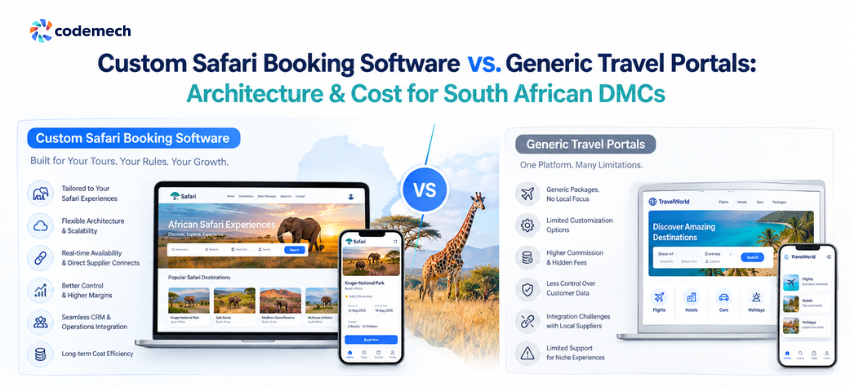
| Area | Generic Travel Portal | Custom Safari Booking Software |
|---|---|---|
| Booking flow | Predefined | Designed around your business |
| Safari packages | Often limited | Fully configurable |
| Lodge management | Standard | Custom workflows possible |
| Vehicle allocation | Limited or manual | Can be built into operations |
| Guide management | Usually limited | Can be integrated |
| Seasonal pricing | Standard rules | Custom pricing engine |
| Supplier workflows | Depends on platform | Designed around your suppliers |
| B2B/DMC operations | May require workarounds | Built into the system |
| Integrations | Available options | Selected according to requirements |
| Branding | Template-based | Fully branded |
| Scalability | Platform dependent | Architecture planned for growth |
| Ownership/control | Vendor dependent | Greater control |
| Future changes | Limited by platform | Features can evolve with business |
This does not mean generic software is always bad.
For a small operator testing an idea, a generic solution may be a sensible starting point.
But if your DMC has complex operations, multiple suppliers, B2B agents, customized packages or plans for long-term digital growth, custom development can provide much more flexibility.
What Should the Architecture of a Safari Booking System Look Like?
A good safari booking system for DMCs should not be designed as only a website.
It should be treated as a business platform.
For a broader look at how travel platforms are designed for scalability, see our guide on How Travel Software Companies Build Scalable Booking & Reservation Platforms.
A simplified architecture could look like this:
Customer / Travel Agent
          ↓
Web Booking Portal
          ↓
Booking Engine
          ↓
Business Rules & Pricing
          ↓
Safari Management Layer
          ↓
--------------------------------
| Lodges | Tours | Vehicles |
| Guides | Transfers | Activities |
--------------------------------
          ↓
Payment & Notification Layer
          ↓
CRM / Reports / Admin
          ↓
External APIs & Supplier Systems
The exact architecture depends on the DMC's business model, but separating these layers makes future expansion easier.
1. Customer Booking Layer
This is the part travellers and agents interact with.
It can include:
- Safari search
- Destination selection
- Travel dates
- Number of travellers
- Package comparison
- Room selection
- Add-on activities
- Transfer selection
- Price calculation
- Customer details
- Payment
- Booking confirmation
The booking experience should be mobile-friendly because international travellers may research and book trips from different devices and time zones.
2. Safari Product Management
Your operations team should be able to create and manage safari products without asking developers to change the website every time.
For example:
Kruger Safari – 4 Days / 3 Nights
- Lodge
- Room category
- Meals
- Game drives
- Airport transfer
- Vehicle
- Guide
- Park fees
- Seasonal rate
- Child rate
- Cancellation policy
This makes the platform useful to the operations team, not just the marketing team.
3. Pricing Engine
Safari pricing is rarely as simple as one fixed price.
The system may need to calculate prices based on:
- Travel dates
- Number of travellers
- Room type
- Season
- Child/adult combination
- Vehicle type
- Private or shared safari
- Activities
- Transfers
- Supplier rates
- Agent commission
- Markups
- Promotional discounts
A custom pricing engine allows the DMC to build these rules into the booking workflow.
4. Availability Management
Availability can become one of the most important parts of the platform.
The system may need to track:
- Lodge rooms
- Safari vehicles
- Guides
- Activities
- Transfers
- Tour capacity
- Date restrictions
When multiple resources are connected to one booking, the system should help prevent overbooking and operational conflicts.
5. Supplier and Partner Management
A DMC may work with multiple lodges, transport providers, guides, activity operators and other suppliers.
A custom platform can provide supplier-level management for:
- Rates
- Availability
- Contracts
- Booking requests
- Confirmations
- Commission
- Supplier contacts
- Payment status
This can reduce the need to manage every supplier relationship through separate spreadsheets.
API Integrations: Where Do They Fit?
Not every safari business needs the same integrations.
A custom platform can connect the systems that actually support the business.
Depending on the requirements, this could include:
- Hotel APIs
- Flight APIs
- Transfer APIs
- Payment gateways
- CRM systems
- Accounting software
- Email/SMS services
- Maps and location services
- Supplier APIs
- B2B travel platforms
The important point is that custom development does not mean building everything from scratch.
A strong architecture can combine custom business logic with reliable third-party services.
For example, Codemech Solutions' existing travel technology work covers travel API integrations and custom travel portals, including booking engines and integrations with external travel systems.
B2C vs B2B: Why DMCs May Need Both
A growing South African DMC may serve two different audiences.
B2C Customers
Direct travellers may want:
- Easy package discovery
- Online booking
- Secure payment
- Instant confirmation
- Itinerary access
- Booking management
B2B Travel Agents
Travel agents may need:
- Agent login
- Net rates
- Markups
- Commission management
- Agent-specific packages
- Booking history
- Invoices
- Customer management
- Availability
- Agent reporting
A generic portal may offer basic B2B functionality, but a custom platform can design the agent workflow around the DMC's commercial model.
This can be particularly valuable for DMCs that receive regular business from international travel agencies and tour operators.
How Much Does Custom Safari Booking Software Cost in South Africa?
There is no single price for custom safari booking software.
Development pricing can vary considerably depending on functionality, integrations, architecture and the number of user workflows involved. For a broader breakdown of these factors, see our Travel Portal Development Cost guide.
As a planning range, a custom platform can broadly fall into these stages:
| Project Type | Approximate Development Range |
|---|---|
| Basic safari booking website + enquiry system | R60,000 – R120,000 |
| Booking platform with packages, payments and admin | R120,000 – R250,000 |
| Advanced DMC booking platform | R250,000 – R500,000+ |
| Enterprise platform with multiple integrations and B2B workflows | R500,000+ |
These figures are development planning estimates, not fixed market prices. Supplier API fees, payment charges, hosting, third-party software and ongoing maintenance can be separate.
For comparison, Codemech's existing travel API guidance also notes that integration cost depends heavily on the number of APIs, workflows, payment integrations and custom functionality rather than there being one universal travel-software price.
What Actually Drives the Cost?
The main cost factors include:
1. Number of user types
Customer, admin, supplier, guide and travel-agent dashboards all add complexity.
2. Booking complexity
A basic enquiry form is considerably simpler than a multi-resource booking engine.
3. API integrations
Every external integration introduces development, testing and maintenance requirements.
4. Pricing rules
Dynamic rates, commissions, markups and seasonal pricing require additional business logic.
5. Payment integration
Different payment methods and transaction workflows can increase development requirements.
6. B2B functionality
Agent accounts, net rates, commissions and credit limits add another layer of functionality.
7. Reporting
Operational dashboards, financial reports and booking analytics require additional data structures and reporting logic.
8. Mobile applications
If the DMC also wants iOS or Android applications, the overall project scope increases.
Custom Software Can Cost More Initially But That Isn't the Whole Story
One of the biggest mistakes when comparing platforms is looking only at the initial development quote.
Suppose a generic portal costs less to launch.
But later you need:
- Custom pricing
- A new supplier integration
- A special B2B workflow
- Custom reporting
- A new payment provider
- Vehicle management
- Guide allocation
- A unique cancellation process
If the platform cannot support those requirements, you may have to pay for workarounds or move to another system.
A custom platform usually requires a larger initial investment, but the architecture can be planned around the company's long-term requirements.
The better question is therefore not:
"Which option is cheaper?"
It is:
"Which option gives our DMC the right operational value over the next three to five years?"
When Should a South African DMC Choose Custom Development?
Custom safari booking software for South African DMCs can make sense when:
- You sell complex safari packages.
- You manage multiple lodges or suppliers.
- You need custom pricing rules.
- You serve international travel agents.
- You need B2B and B2C booking workflows.
- Your team relies heavily on spreadsheets.
- Your booking process includes many manual steps.
- You need specific integrations.
- You want complete control over your customer journey.
- You expect booking volumes to grow.
- Your business model does not fit standard travel software.
On the other hand, a generic travel portal may be suitable when:
- Your booking requirements are straightforward.
- You have limited product complexity.
- You are testing a new business idea.
- You need to launch quickly.
- Standard booking features are enough.
- Your budget is limited during the initial stage.
The right decision depends on business requirements, not simply the technology preference.
Why Software Architecture Consulting Matters Before Development
Many travel businesses make the mistake of starting development before defining the architecture.
That can become expensive later.
Software Architecture Consulting Services can help a DMC determine:
- What should be custom-built?
- Which services should be integrated?
- Which APIs are actually necessary?
- Should the platform use a modular or microservices architecture?
- What database structure is required?
- How should bookings be stored?
- How should supplier failures be handled?
- How should pricing rules work?
- What should happen when a booking changes?
- How should the platform scale?
For example, if you expect to start with safari packages but later add flights, hotels and transfers, the architecture should not make those future additions unnecessarily difficult.
Good architecture creates room for growth.
How to Choose a Travel Software Development Company
Choosing the right development partner is just as important as choosing the technology.
When evaluating a Travel Software Development Company, look beyond a general software-development portfolio.
Ask whether the company understands:
- Travel booking workflows
- API integrations
- Booking engines
- B2B/B2C portals
- Supplier management
- Payment workflows
- Travel data
- Scalable cloud architecture
- Security
- Post-booking processes
A specialist Travel Portal Development Company should be able to explain the architecture in business terms, not only technical terminology.
For a South African DMC, it is also useful to work with a development team that understands the difference between a standard travel website and an operational booking platform.
Why Codemech Solutions for Custom Travel Software?
Codemech Solutions provides custom travel software development, travel portal development and integration solutions for travel businesses.
Its travel portal development approach covers custom portals, booking engines, API/GDS integrations, payment solutions and scalable architectures.
For a DMC planning a custom booking platform, the development process should begin with business and architecture discovery rather than immediately starting UI development.
That means understanding your:
- Booking process
- Customers
- Suppliers
- Pricing model
- Distribution channels
- Payment requirements
- Existing systems
- Future growth plans
From there, the platform architecture can be designed around what the business actually needs.
Final Verdict: Custom or Generic?
There is no universal winner in the custom vs generic travel booking software debate.
A generic portal can be a practical choice for a small business with straightforward booking requirements.
But for a growing DMC managing safari packages, suppliers, vehicles, guides, transfers, seasonal pricing and B2B travel agents, a custom platform can provide significantly greater control.
The goal is not to build the most complicated system.
The goal is to build the right system.
For South African DMCs, that could mean starting with a focused safari booking engine and gradually adding supplier integrations, B2B functionality, payment automation, CRM connectivity and advanced reporting as the business grows.
That approach can keep the initial investment under control while creating an architecture that is ready for future expansion.
If your current booking process involves spreadsheets, emails, manual availability checks and multiple disconnected systems, it may be time to evaluate whether a custom Safari booking system for DMCs can simplify operations and create a better booking experience.