The healthcare industry is experiencing rapid digital transformation. Hospitals, clinics, diagnostic centers, telemedicine providers, and healthcare startups are increasingly relying on technology to improve patient care, streamline operations, enhance data security, and comply with evolving healthcare regulations.
While many healthcare organizations initially adopt off-the-shelf software solutions because they are readily available and relatively easy to implement, these platforms often struggle to meet the complex and unique requirements of modern healthcare environments. As patient expectations rise and healthcare operations become more sophisticated, organizations need software systems that align with their specific workflows, compliance requirements, and long-term business objectives.
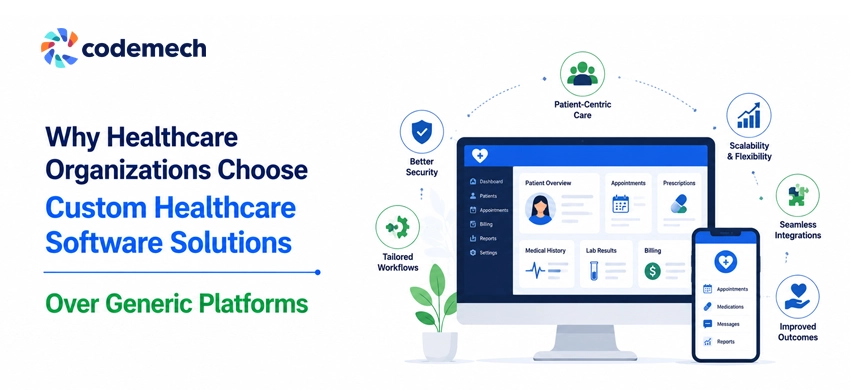
This is one of the primary reasons healthcare providers are investing in custom healthcare software development. Custom solutions offer greater flexibility, scalability, integration capabilities, and security compared to generic software platforms. They enable healthcare organizations to create systems tailored to their operational needs while delivering better patient experiences and improving efficiency.
At Codemech Solutions, we help healthcare organizations build secure, scalable, and future-ready software platforms designed to support patient care, operational excellence, and digital innovation. In this article, we explore why healthcare organizations increasingly choose custom healthcare software solutions over generic platforms.
Understanding Generic Healthcare Software
Generic healthcare software is designed to serve a broad range of healthcare providers using a standardized set of features and functionalities.
These platforms typically offer:
- Basic patient management, scheduling, billing, and reporting capabilities designed to meet common healthcare requirements.
- Standard workflows that may not align with the unique operational processes of individual healthcare organizations.
Although generic solutions can provide a quick starting point, they often create challenges as organizations grow and their requirements become more specialized.
Limitations of Generic Healthcare Software
Many healthcare organizations discover that generic platforms cannot fully support their evolving needs.
Limited Customization
Healthcare providers often operate with unique processes and service models.
Generic software may:
- Restrict workflow customization, making it difficult to adapt systems to specific operational requirements.
- Force organizations to modify their processes to fit the software rather than allowing software to support existing workflows.
This can lead to inefficiencies and reduced productivity.
Scalability Challenges
As healthcare organizations expand, their software requirements become more complex.
Generic systems frequently struggle to:
- Handle increasing patient volumes, additional locations, and growing data requirements.
- Support advanced features and integrations needed for long-term growth.
Scalability limitations can negatively impact operational performance and patient experiences.
Workflow Mismatches
Different healthcare organizations have different operational structures.
For example:
- Hospitals require sophisticated patient management and departmental coordination.
- Telemedicine providers need virtual consultation capabilities and secure communication tools.
- Diagnostic centers require specialized reporting and workflow automation.
Generic software often lacks the flexibility to support these unique requirements effectively.
Benefits of Custom Healthcare Software Solutions
Custom software is designed specifically around the needs of healthcare organizations, providing greater flexibility and long-term value.
Tailored Workflows
One of the biggest advantages of Healthcare Software Solutions is the ability to create workflows that align with actual business operations.
Benefits include:
- Improved efficiency through automation of organization-specific processes.
- Reduced administrative burden and fewer manual tasks for healthcare professionals.
Tailored workflows help organizations operate more effectively while improving service delivery.
Better Integrations
Healthcare providers rely on multiple systems and technologies.
Custom software can integrate seamlessly with:
- Electronic Health Record (EHR) systems.
- Electronic Medical Record (EMR) platforms.
- Laboratory systems.
- Pharmacy systems.
- Insurance verification platforms.
- Payment gateways.
Integrated systems improve data accuracy and reduce operational silos.
Improved Patient Experiences
Modern patients expect convenient and personalized healthcare experiences.
Custom healthcare software can provide:
- Online appointment scheduling.
- Secure patient portals.
- Telemedicine capabilities.
- Automated reminders and notifications.
- Personalized care management tools.
These features improve engagement, satisfaction, and patient retention.
Enhanced Security and Compliance
Healthcare organizations manage highly sensitive patient information.
Custom software allows organizations to implement:
- Advanced access controls.
- Data encryption.
- Audit logging.
- Secure authentication systems.
Strong security measures help protect patient data while supporting regulatory compliance requirements.
Healthcare Systems That Benefit from Custom Development
Custom software development can support a wide range of healthcare applications.
EHR and EMR Systems
Electronic Health Records and Electronic Medical Records are critical components of modern healthcare operations.
Custom development enables organizations to:
- Improve data accessibility.
- Streamline documentation processes.
- Enhance collaboration among healthcare professionals.
Telemedicine Applications
Virtual healthcare services continue to grow rapidly.
Custom telemedicine platforms can include:
- Video consultations.
- Secure messaging.
- Appointment scheduling.
- Remote patient monitoring.
These solutions improve access to healthcare services while enhancing patient convenience.
Patient Management Software
Healthcare providers require efficient systems for managing patient interactions.
Custom patient management solutions support:
- Appointment scheduling.
- Patient registration.
- Medical history management.
- Follow-up communications.
Automation improves efficiency while reducing administrative workloads.
Hospital Management Systems
Hospitals often require highly specialized software.
Custom hospital management systems can manage:
- Department coordination.
- Resource allocation.
- Staff scheduling.
- Inventory management.
- Billing and reporting.
These capabilities improve operational efficiency and decision-making.
Medical Billing Platforms
Billing processes are often complex and time-consuming.
Custom billing solutions help organizations:
- Automate invoicing.
- Process insurance claims.
- Reduce billing errors.
- Improve revenue cycle management.
Efficient billing systems contribute to financial stability and operational performance.
Long-Term ROI of Custom Healthcare Software
Many healthcare organizations initially focus on implementation costs when evaluating software options.
However, long-term value often becomes a more important consideration.
Reduced Operational Costs
Custom software helps organizations:
- Automate repetitive processes.
- Reduce manual workloads.
- Improve resource utilization.
These efficiencies often lead to significant cost savings over time.
Increased Productivity
Healthcare professionals can spend less time on administrative tasks and more time focusing on patient care.
Improved productivity contributes to:
- Better patient outcomes.
- Enhanced staff satisfaction.
- Increased operational efficiency.
Greater Scalability
Custom software grows alongside the organization.
Benefits include:
- Easier expansion to new locations.
- Support for increasing patient volumes.
- Flexibility to introduce new services and technologies.
Scalability protects software investments and supports long-term growth.
Future Trends in Healthcare Technology
Healthcare technology continues to evolve rapidly.
Organizations investing in custom development are better positioned to take advantage of emerging innovations.
Artificial Intelligence
AI-powered healthcare applications can support:
- Predictive analytics.
- Clinical decision support.
- Patient engagement.
- Administrative automation.
Remote Patient Monitoring
Connected devices and wearable technologies enable providers to monitor patients outside traditional healthcare settings.
Benefits include:
- Improved patient outcomes.
- Early intervention opportunities.
- Better chronic disease management.
Cloud-Based Healthcare Platforms
Cloud technologies provide:
- Greater scalability.
- Improved accessibility.
- Enhanced collaboration.
- Reduced infrastructure costs.
Cloud adoption continues to accelerate across the healthcare industry.
Why Healthcare Organizations Choose Custom Development Partners
Developing healthcare software requires specialized expertise.
A trusted Healthcare Software Development Company helps organizations:
Understand Industry Requirements
- Healthcare workflows, compliance requirements, and patient care processes require specialized knowledge.
Reduce Development Risks
- Proven methodologies improve project outcomes and reduce implementation challenges.
Deliver Higher Quality Solutions
- Experienced teams focus on scalability, security, usability, and performance.
The right technology partner plays a critical role in software success.
Why Choose Codemech Solutions for Healthcare Software Development?
At Codemech Solutions, we help healthcare providers build innovative software solutions that improve patient care and operational performance.
Healthcare-Focused Development Expertise
- We understand the unique requirements of hospitals, clinics, telemedicine providers, and healthcare startups.
Scalable and Secure Solutions
- Every solution is designed with scalability, performance, and security in mind.
Customized Software Development
- Our team develops software tailored to your organization's workflows, objectives, and patient care requirements.
End-to-End Development Services
- From planning and design to deployment and ongoing support, we provide complete Healthcare Software Development Services.
Long-Term Technology Partnership
- We help organizations continuously improve their software platforms as technology and business needs evolve.
Conclusion:
Generic healthcare software may provide a convenient starting point, but many healthcare organizations eventually encounter limitations related to customization, scalability, workflow alignment, and integration capabilities.
Custom healthcare software solutions offer greater flexibility, improved patient experiences, stronger security, and long-term scalability. They enable healthcare providers to build systems that align directly with their operational requirements and strategic goals.
As healthcare technology continues to evolve, organizations that invest in custom software are often better positioned to improve patient outcomes, increase efficiency, and adapt to future industry changes.
Codemech Solutions helps healthcare organizations develop secure, scalable, and innovative software solutions that support digital transformation, operational excellence, and long-term growth.