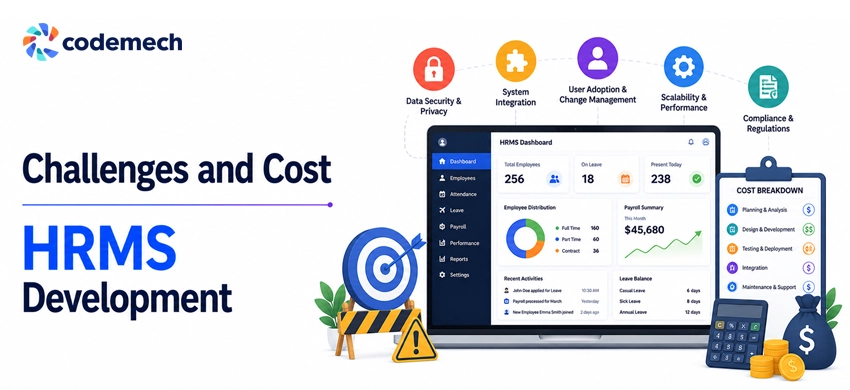
Human Resource Management has evolved significantly over the past decade. Today's HR departments are expected to do much more than hiring employees or processing payroll. They are responsible for recruitment, on-boarding, workforce planning, employee engagement, compliance, performance management, training, analytics, and much more.
Managing all these processes manually becomes increasingly difficult as organizations grow. Businesses require intelligent HR platforms that automate repetitive tasks, improve employee experiences, reduce operational costs, and provide valuable workforce insights.
This growing demand has led many organizations to invest in custom HRM software rather than relying solely on spreadsheets or generic HR platforms. However, building successful HR software is not simply about adding features. Development teams must overcome technical, operational, and business challenges while balancing budget, scalability, security, compliance, and user experience.
Whether you're planning to build an HRMS for internal operations or launching an HR SaaS product, understanding these challenges before development begins can save significant time, cost, and resources.
At Codemech Solutions, we help businesses build secure, scalable, and feature-rich HR platforms that simplify workforce management and support long-term digital transformation. In this guide, we'll explain the biggest HR software development challenges, the factors that influence development costs, and how businesses can make smarter investment decisions.
What is HRMS?
A Human Resource Management System (HRMS) is a centralized software platform that helps organizations manage the complete employee lifecycle from recruitment to retirement.
Instead of using multiple disconnected tools, an HRMS combines essential HR functions into one integrated platform, allowing HR professionals, managers, finance teams, and employees to work more efficiently.
A modern HRMS typically includes:
- Recruitment and Applicant Tracking
- Employee On-boarding
- Employee Database Management
- Leave Management
- Attendance Tracking
- Shift Scheduling
- Payroll Processing
- Benefits Administration
- Performance Management
- Employee Self-Service Portal
- Learning & Development
- HR Analytics
- Compliance Management
- Employee Engagement
A professional HR Software Development Company develops HRMS platforms tailored to an organization's unique workflows, compliance requirements, and long-term business goals rather than forcing businesses to adapt to generic software.
As organizations scale, investing in custom HR Software Solutions provides greater flexibility, stronger security, and better operational efficiency than relying on off-the-shelf applications.
Challenges in HR Software Development:
Building HR software involves much more than creating dashboards and employee records. Developers must solve real business problems while delivering secure, scalable, and user-friendly experiences.
Below are the most common challenges organizations face during HR software development.
1. Unnecessary Tools
One of the biggest mistakes businesses make is trying to include every possible HR feature within a single platform.
Many organizations believe that adding more features automatically increases software value. Unfortunately, the opposite often happens.
An overloaded HR system becomes:
- Difficult to navigate
- Harder to maintain
- More expensive to develop
- Slower to use
- Confusing for employees
Instead of improving productivity, unnecessary tools create additional complexity.
Best Practice
Successful HR software focuses on solving actual business problems.
Before development begins, organizations should identify:
- Which HR processes need automation?
- Which departments will use the software?
- Which features provide measurable business value?
A phased development approach often produces better results than attempting to build every module simultaneously.
2. Absence of Employee Involvement
Many HR software projects fail because only HR managers participate during requirement gathering.
Employees are the largest user group within most HR platforms.
If they are not involved during planning, businesses often develop systems that employees dislike using.
Common problems include:
- Difficult navigation
- Poor workflows
- Confusing interfaces
- Missing employee self-service features
- Low adoption rates
Without employee feedback, organizations risk investing in software that delivers little practical value.
Best Practice
Collect feedback from:
- HR Managers
- Employees
- Team Leaders
- Finance Teams
- IT Departments
- Senior Management
Understanding how each department interacts with HR software helps create a better user experience.
3. Clunky User Interfaces
A powerful HR platform is useless if employees struggle to use it.
One of the biggest complaints about older HRMS platforms is poor usability.
Examples include:
- Too many menus
- Complex workflows
- Outdated design
- Slow navigation
- Difficult forms
- Poor mobile experience
When software becomes frustrating, employees avoid using it whenever possible.
This increases HR workload because routine tasks return to manual processes.
Best Practice
Modern HR software should emphasize:
- Clean dashboard design
- Minimal clicks
- Self-service capabilities
- Responsive design
- Personalized dashboards
- Role-based interfaces
Good UI/UX design significantly increases employee adoption and satisfaction.
4. Lack of Scalability
Businesses rarely remain the same size forever.
A startup with 30 employees today may have 500 employees within a few years.
Unfortunately, many HR systems are built only for current requirements rather than future growth.
Scalability issues include:
- Performance degradation
- Database limitations
- Increased loading times
- Difficult feature expansion
- Poor cloud architecture
Replacing an HRMS after only a few years is expensive and disruptive.
Best Practice
An experienced HRMS Software Development Company designs scalable architectures that support:
- More employees
- Multiple offices
- Multiple countries
- Additional HR modules
- Third-party integrations
- Cloud infrastructure
Planning for scalability from day one significantly reduces future redevelopment costs.
5. Limitations and Lack of Integrations in HR Software
Modern businesses use dozens of business applications.
Examples include:
- Payroll software
- Accounting software
- ERP
- CRM
- Slack
- Microsoft Teams
- Google Workspace
- Email Platforms
- Biometric Devices
- Identity Providers
If HR software cannot integrate with these systems, employees spend valuable time manually transferring data.
Poor integrations often create:
- Duplicate records
- Data inconsistencies
- Reporting errors
- Lower productivity
Best Practice
Modern HR platforms should support:
- REST APIs
- Webhooks
- Single Sign-On (SSO)
- Payroll Integrations
- Accounting Software
- Attendance Devices
- Cloud Storage
- Business Intelligence Tools
Strong integration capabilities significantly increase software value.
6. Insufficient Budget
Many organizations underestimate the investment required to build enterprise-grade HR software.
Development costs extend beyond coding.
Businesses must also consider:
- Product Discovery
- UI/UX Design
- Architecture
- Development
- Testing
- Security
- Infrastructure
- Deployment
- Maintenance
- Feature Enhancements
Choosing the lowest-cost vendor often leads to poor architecture, security issues, and technical debt.
Best Practice
Instead of focusing solely on initial cost, businesses should evaluate long-term return on investment.
Quality software reduces manual work, improves employee productivity, and lowers operational costs over many years.
7. Data Capture but No Reports
Collecting HR data is only valuable if organizations can transform that information into meaningful insights.
Many HR platforms capture enormous amounts of employee data but provide limited reporting capabilities.
Without analytics, businesses struggle to answer questions such as:
- Which departments have the highest turnover?
- Which recruitment channels produce the best candidates?
- How productive are different teams?
- What is the average hiring time?
- Which training programs improve performance?
Best Practice
Modern HR software should include advanced reporting features such as:
- Workforce Analytics
- Recruitment Dashboards
- Payroll Reports
- Attendance Trends
- Employee Retention Reports
- Performance Metrics
- Executive Dashboards
Analytics help HR leaders make informed strategic decisions rather than relying on assumptions.
8. Employee Satisfaction Issues
HR software should improve employee experiences - not create additional frustration.
Employees expect digital experiences similar to the apps they use every day.
Poor HR platforms often suffer from:
- Slow performance
- Difficult navigation
- Poor mobile usability
- Long approval processes
- Limited self-service options
These issues reduce employee engagement and satisfaction.
Best Practice
Employee-centric HR software should provide:
- Self-service portals
- Mobile accessibility
- Quick leave requests
- Real-time notifications
- Personalized dashboards
- Digital document management
- Simple workflows
When employees enjoy using HR software, adoption rates increase, HR teams become more efficient, and overall workplace satisfaction improves.
9. Lack of Mobile Application
Today's workforce is no longer confined to traditional office environments. Employees increasingly work remotely, travel for business, or operate from multiple locations. HR software that only functions on desktop computers creates unnecessary barriers for employees and managers alike.
A lack of mobile accessibility often results in:
- Delayed leave approvals.
- Missed attendance updates.
- Difficulty accessing payslips and employee documents.
- Poor communication between HR and employees.
- Reduced employee engagement.
Modern employees expect to complete HR-related tasks from their smartphones just as easily as they use banking or shopping applications.
Best Practice
An effective HRMS should offer mobile-friendly capabilities such as:
- Employee self-service portal
- Attendance with GPS location
- Leave requests and approvals
- Payroll and payslip access
- Company announcements
- Performance reviews
- Push notifications
- Document management
A mobile-first approach improves employee satisfaction while enabling HR teams to respond more quickly to workforce needs.
10. Poor Implementation
Even the most feature-rich HR software can fail if implementation is poorly planned.
Organizations often underestimate the importance of change management during deployment. Employees may resist adopting a new system if they are not properly informed or trained.
Common implementation mistakes include:
- Lack of implementation planning.
- Insufficient employee training.
- Migrating inaccurate or incomplete data.
- No pilot testing before launch.
- Lack of stakeholder involvement.
These issues can delay adoption and reduce the software's overall effectiveness.
Best Practice
Successful implementation should include:
- Detailed project planning.
- Pilot deployment.
- Data validation.
- User acceptance testing (UAT).
- Employee training sessions.
- Dedicated implementation support.
A phased rollout often minimizes disruption while improving adoption across departments.
11. Customer Support
HR software requires continuous maintenance, updates, and troubleshooting. Unfortunately, many organizations overlook the importance of long-term support when selecting a development partner.
Without reliable support, businesses may experience:
- Extended system downtime.
- Slow issue resolution.
- Delayed feature updates.
- Security vulnerabilities.
- Frustrated HR teams.
Best Practice
Businesses should work with development partners that provide:
- Dedicated support teams.
- SLA-based response times.
- Technical documentation.
- Regular software updates.
- Performance monitoring.
- Security patches.
Reliable support ensures HR operations continue without interruption.
12. Multiple Vendors to Manage
Many organizations purchase separate software for:
- Payroll
- Attendance
- Recruitment
- Performance Management
- Learning Management
- Employee Engagement
Managing multiple vendors often leads to:
- Higher software costs.
- Duplicate employee records.
- Data inconsistencies.
- Integration challenges.
- Increased administrative effort.
Best Practice
Instead of managing multiple disconnected systems, businesses should consider a unified HR platform that consolidates essential HR functions into one centralized solution.
Benefits include:
- Single employee database.
- Simplified reporting.
- Lower operational costs.
- Better user experience.
- Easier software management.
13. Compliance Issues
HR departments handle sensitive employee information and must comply with labor laws, tax regulations, and data privacy requirements.
Failure to comply can result in:
- Financial penalties.
- Legal disputes.
- Reputational damage.
- Employee trust issues.
Compliance requirements vary across industries and countries, making flexibility an essential feature of modern HR software.
Best Practice
Professional HR Software Development Services should include:
- Role-based access control.
- Audit logs.
- Data retention policies.
- Consent management.
- Automated compliance reporting.
- Regulatory updates.
Compliance should be integrated into software architecture from the beginning rather than added later.
14. Insecure Data Storage or Transfer
HR systems store highly confidential employee information, including:
- Personal identification details.
- Salary information.
- Tax records.
- Medical information.
- Bank account details.
- Employment contracts.
Cyber attacks targeting HR systems continue to increase each year.
Weak security can lead to:
- Data breaches.
- Identity theft.
- Financial losses.
- Legal liabilities.
Best Practice
Security should be a core component of HR software development.
Recommended security measures include:
- End-to-end encryption.
- Multi-factor authentication.
- Secure API architecture.
- Role-based permissions.
- Data backup strategies.
- Regular vulnerability assessments.
- Security audits.
Organizations should treat employee data with the same level of protection as financial information.
15. Post-Implementation Support
Software development does not end after deployment.
Business requirements continue evolving, and HR platforms must adapt accordingly.
Without ongoing improvements, software may become outdated within a few years.
Post-launch support typically includes:
- Bug fixes.
- Performance optimization.
- Feature enhancements.
- Security updates.
- API upgrades.
- Infrastructure monitoring.
- Scalability improvements.
Best Practice
Choose a development partner committed to continuous improvement rather than simply delivering software and ending the engagement.
Long-term support helps maximize software lifespan and return on investment.
Factors Affecting the Cost of Developing HR Software
One of the most common questions businesses ask is:
"How much does HR software development cost?"
The answer depends on several technical and business factors.
Rather than focusing only on the final price, organizations should understand what drives development costs.
Factor 1: Type of HR Software
The type of HR platform significantly influences development complexity.
Examples include:
Basic HR Management System
Typically includes:
- Employee records.
- Attendance.
- Leave management.
Lower development complexity.
Enterprise HRMS
Includes:
- Recruitment.
- Payroll.
- Performance Management.
- Learning Management.
- Analytics.
- Employee Engagement.
Requires significantly more development effort.
SaaS HR Platform
Designed for multiple organizations using subscription-based access.
Requires:
- Multi-tenancy.
- Subscription billing.
- Tenant isolation.
- Advanced security.
- Scalability.
This is generally the most complex type of HR software to build.
Factor 2: Number and Types of Users
Different user roles require different interfaces and permissions.
Examples include:
- Employees
- HR Managers
- Recruiters
- Department Managers
- Payroll Teams
- Finance
- Administrators
- Super Admins
The more user roles involved, the more workflows, dashboards, and permission structures need to be developed.
Factor 3: Implementation Requirements
Implementation involves much more than simply deploying software.
Activities include:
- Infrastructure setup.
- Cloud deployment.
- Data migration.
- User training.
- Testing.
- Documentation.
- Change management.
Organizations with legacy HR systems often require complex migration strategies that increase project scope.
Factor 4: Customization and Features
Feature complexity has one of the largest impacts on development costs.
Examples include:
Basic Features
- Employee profiles
- Attendance
- Leave Management
Advanced Features
- AI recruitment
- Resume parsing
- Face recognition attendance
- Payroll automation
- Performance dashboards
- Employee engagement tools
- Predictive analytics
- Workforce planning
The more intelligent and automated the platform becomes, the greater the investment required.
Factor 5: Hardware and Maintenance
Infrastructure costs depend on deployment strategy.
Organizations may choose:
- Cloud Hosting
- Private Cloud
- Hybrid Infrastructure
- On-Premise Servers
Businesses should also budget for:
- Server monitoring.
- Backups.
- Security updates.
- Performance optimization.
- Disaster recovery.
Infrastructure planning is essential for long-term reliability.
Factor 6: Training and Support
Many businesses overlook the cost of user adoption.
Training may include:
- HR Team Workshops.
- Employee Tutorials.
- Administrator Training.
- Documentation.
- Video Guides.
- Knowledge Base.
Well-trained employees adopt software faster and generate higher long-term value.
Support costs may include:
- Technical support.
- Feature enhancements.
- Bug fixing.
- System monitoring.
- Security maintenance.
These services should be considered part of the overall software investment rather than optional expenses.
How Much Does HR Software Development Cost?
There is no universal price for HR software development because every organization has different requirements.
Typical pricing depends on:
- Number of HR modules.
- User roles.
- Mobile application requirements.
- Third-party integrations.
- AI-powered features.
- Cloud infrastructure.
- Security requirements.
- Compliance requirements.
- Deployment model.
- Ongoing maintenance.
Instead of choosing the lowest-cost solution, businesses should evaluate the total long-term value.
A professionally developed HR platform often delivers returns through:
- Reduced administrative work.
- Improved employee productivity.
- Better hiring efficiency.
- Faster payroll processing.
- Higher employee satisfaction.
- Reduced operational costs.
- Better business insights.
- Increased scalability.
Working with an experienced HRMS Software Development Company helps organizations build software that continues delivering value for many years rather than requiring frequent redevelopment.
Why Choose Codemech Solutions for HR Software Development
Choosing the right technology partner is one of the most important decisions when building HR software. Beyond technical expertise, your development partner should understand HR processes, employee lifecycle management, compliance requirements, and modern workforce expectations.
At Codemech Solutions, we combine technical excellence with business understanding to develop scalable, secure, and user-friendly HR platforms that support long-term business growth.
End-to-End HR Software Development
We manage every stage of the product lifecycle, ensuring a smooth development journey from concept to deployment.
Our end-to-end services include:
- Business requirement analysis
- Product discovery and consulting
- UI/UX design
- Software architecture planning
- HRMS application development
- Mobile app development
- API and third-party integrations
- Quality assurance and testing
- Cloud deployment
- Ongoing maintenance and support
This comprehensive approach helps businesses reduce development risks while accelerating time-to-market.
Custom HR Software Built Around Your Business
Every organization has unique HR processes. Generic HR software often forces businesses to adapt their workflows to fit the software.
We take the opposite approach.
Our HR Software Solutions are designed around your:
- HR workflows
- Business processes
- Organizational structure
- Industry regulations
- Growth objectives
Whether you need an HR platform for 100 employees or 100,000 employees, we build software that grows with your business.
Modern, Scalable Architecture
As businesses expand, HR software must support:
- More employees
- Multiple office locations
- Remote teams
- International operations
- New HR modules
- Third-party integrations
Our scalable architecture ensures your software remains reliable and high-performing as your organization evolves.
Secure and Compliance-Ready Development
Employee information is one of the most sensitive business assets.
As an experienced HR Software Development Company, security is integrated into every stage of development.
Our solutions include:
- Role-based access control
- Multi-factor authentication
- Data encryption
- Secure APIs
- Audit logs
- Backup and disaster recovery
- Compliance-ready architecture
This helps organizations protect employee information while meeting evolving regulatory requirements.
AI-Powered HR Capabilities
Modern HR platforms are becoming smarter through artificial intelligence and automation.
We help businesses integrate features such as:
- AI-powered resume screening
- Intelligent recruitment workflows
- Employee performance insights
- Predictive workforce analytics
- Automated attendance validation
- Chatbots for HR support
- Smart notifications and reminders
These capabilities reduce manual work while improving HR efficiency.
Seamless Third-Party Integrations
Modern HR ecosystems rely on multiple business applications.
Our HR platforms integrate with:
- Payroll software
- ERP systems
- Accounting software
- CRM platforms
- Biometric attendance devices
- Email platforms
- Microsoft 365
- Google Workspace
- Slack
- Microsoft Teams
- Payment gateways
- Identity providers
A connected HR ecosystem improves productivity while eliminating duplicate data entry.
Long-Term Technology Partnership
Launching HR software is only the beginning.
We continue supporting our clients through:
- Software maintenance
- Security updates
- Feature enhancements
- Performance optimization
- Cloud monitoring
- Infrastructure scaling
- Technical support
Our goal is to become your long-term technology partner rather than simply delivering a software project.
Conclusion
Human Resource Management has become increasingly complex as organizations expand, adopt hybrid work models, and embrace digital transformation. Managing recruitment, onboarding, payroll, attendance, compliance, employee engagement, and workforce analytics using disconnected systems is no longer sustainable.
Modern HR software enables businesses to automate repetitive processes, improve employee experiences, increase operational efficiency, and make better business decisions through real-time analytics.
However, building successful HR software requires more than technical development. Organizations must carefully consider user experience, scalability, integrations, compliance, security, implementation strategy, and long-term maintenance. Addressing these challenges early helps reduce project risks and creates software that continues delivering value for years.
Development costs can vary depending on project scope, required features, integrations, deployment model, and organizational complexity. Rather than focusing solely on initial investment, businesses should evaluate the long-term return generated through automation, productivity improvements, and operational efficiency.
Whether you're planning to build an internal HRMS, launch a cloud-based HR SaaS platform, or modernize an existing workforce management system, partnering with an experienced HRM Software Development Company is essential for long-term success.
At Codemech Solutions, we specialize in delivering secure, scalable, and future-ready HR Software Development Services tailored to the unique needs of startups, SMEs, and enterprises. From product strategy and UI/UX design to development, deployment, and ongoing support, we help organizations build innovative HR platforms that drive employee engagement, streamline HR operations, and support sustainable business growth.