What Is HR Software Development?
Modern businesses manage hundreds or even thousands of employee-related activities every day. Recruiting candidates, onboarding new hires, managing attendance, processing payroll, conducting performance reviews, and maintaining employee records can become increasingly complex as organizations grow.
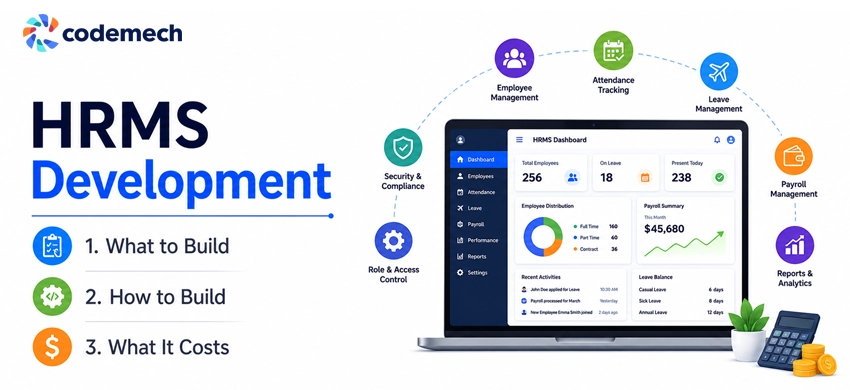
HR software development is the process of designing and building digital platforms that automate and simplify Human Resource operations. Instead of relying on spreadsheets or disconnected tools, businesses can manage their workforce from a centralized platform.
A professional HR Software Development Company creates customized HR solutions that match an organization's workflows, compliance requirements, and long-term business goals.
Unlike generic HR platforms, custom HR software allows businesses to:
- Automate repetitive HR processes.
- Improve employee experiences.
- Reduce administrative workloads.
- Increase operational efficiency.
- Scale as the organization grows.
At Codemech Solutions, we help businesses develop scalable HR platforms that streamline workforce management while supporting future growth.
Key Takeaways
Before investing in HR software, here are the most important points every business should know:
- HR software centralizes employee data, recruitment, payroll, attendance, performance, and reporting in one platform.
- Custom HR software offers greater flexibility, scalability, and integration compared to off-the-shelf solutions.
- Essential modules include ATS, onboarding, employee management, attendance, payroll, analytics, and employee engagement.
- Development costs depend on features, integrations, security requirements, and deployment model.
- Choosing an experienced development partner reduces project risks and accelerates time-to-market.
- A scalable HR platform becomes a long-term business asset that improves employee experience and operational efficiency.
The 8 Core Modules to Include in Your HR Software
A successful HR platform is much more than an employee database. It should automate the complete employee lifecycle—from hiring to retirement.
1. Recruiting and ATS (Applicant Tracking System)
Recruitment is often the first interaction candidates have with an organization. A modern ATS helps businesses hire faster while improving candidate experiences.
Core features include:
- Job posting management
- Resume parsing
- Candidate tracking
- Interview scheduling
- Hiring pipeline management
- Candidate communication
- Recruitment analytics
Benefits:
- Faster hiring process
- Better candidate management
- Reduced recruitment costs
- Improved hiring decisions
2. Onboarding
Employee onboarding plays a critical role in employee retention and productivity.
A digital onboarding module can automate:
- Document collection
- Digital signatures
- Welcome workflows
- Policy acknowledgements
- IT asset assignments
- Training schedules
- Orientation checklists
Benefits:
- Faster employee productivity
- Reduced HR paperwork
- Better employee experience
- Consistent onboarding process
3. Employee Data Management
This module acts as the central repository for employee information.
It stores:
- Personal information
- Employment history
- Organizational hierarchy
- Documents
- Leave balances
- Certifications
- Emergency contacts
Benefits:
- Centralized employee records
- Better data accuracy
- Easy access to employee information
- Improved compliance
4. Time and Attendance
Accurate attendance tracking is essential for payroll and workforce planning.
Features include:
- Biometric integration
- GPS attendance
- Remote clock-in/out
- Shift scheduling
- Leave management
- Overtime tracking
- Holiday management
Benefits:
- Reduced attendance errors
- Improved workforce planning
- Better payroll accuracy
- Enhanced employee accountability
5. Performance Management
Modern businesses focus on continuous employee development instead of annual reviews alone.
Performance management features include:
- Goal setting
- KPI tracking
- 360-degree feedback
- Performance reviews
- Skill assessments
- Career development plans
Benefits:
- Better employee engagement
- Increased productivity
- Transparent evaluation process
- Improved talent retention
6. Payroll and Benefits
Payroll processing is one of the most critical HR functions.
The payroll module should support:
- Salary calculations
- Tax deductions
- Benefits management
- Bonus processing
- Payslip generation
- Compliance reporting
- Bank integrations
Benefits:
- Payroll accuracy
- Reduced manual calculations
- Regulatory compliance
- Employee satisfaction
7. Analytics and Reporting
HR decisions should be driven by data rather than assumptions.
A reporting module provides insights into:
- Employee turnover
- Recruitment performance
- Attendance trends
- Payroll costs
- Employee productivity
- Training effectiveness
- Workforce demographics
Benefits:
- Better decision-making
- Improved HR planning
- Performance measurement
- Executive reporting
8. Employee Engagement
Employee engagement directly impacts retention and business performance.
Common engagement features include:
- Surveys
- Announcements
- Recognition programs
- Internal communication
- Employee feedback
- Rewards systems
- Wellness initiatives
Benefits:
- Higher employee satisfaction
- Better workplace culture
- Improved retention
- Increased collaboration
SaaS vs Custom HR Software – Which Should You Build?
Choosing between SaaS and custom HR software depends on your organization's goals, budget, and growth plans.
SaaS HR Software
Advantages:
- Faster implementation
- Lower upfront investment
- Automatic updates
- Vendor-managed infrastructure
Limitations:
- Limited customization
- Recurring subscription costs
- Vendor dependency
- Restricted integrations
- Feature limitations
Custom HR Software
Advantages:
- Tailored workflows
- Complete ownership
- Better scalability
- Advanced integrations
- Higher security
- Personalized user experience
Limitations:
- Higher initial investment
- Longer development timeline
For growing businesses, enterprises, and organizations with unique HR processes, custom HR software often delivers significantly greater long-term value.
What Does HR Software Development Cost?
One of the most common questions businesses ask is:
"How much does HR software cost?"
The answer depends on several factors.
Major Cost Factors
Number of Modules
A platform with recruitment, payroll, performance management, analytics, and employee engagement will naturally cost more than a basic HRMS.
User Roles
Different roles require different dashboards.
Examples:
- HR Managers
- Employees
- Recruiters
- Department Heads
- Finance Teams
- Administrators
Integrations
Costs increase when integrating with:
- Payroll systems
- Biometric devices
- Accounting software
- ERP
- CRM
- Third-party APIs
- Email platforms
Security Requirements
Enterprise HR software typically includes:
- Role-based access
- Multi-factor authentication
- Data encryption
- Audit logs
- Compliance management
Deployment
Options include:
- Cloud-based SaaS
- Private Cloud
- On-premise
- Hybrid deployment
Each deployment model has different infrastructure costs.
Typical Development Stages
A successful HR software project generally follows these phases:
- Discovery & Planning
- UI/UX Design
- Software Architecture
- Development
- Testing
- Deployment
- Maintenance & Enhancements
Businesses should view HR software as a long-term investment rather than simply a development expense.
How to Choose the Right Development Partner for HR Software
Choosing the right development partner can determine the success of your HR platform.
Look for a company that offers:
Industry Experience
They should understand HR workflows, employee lifecycle management, compliance, and workforce challenges.
Product Development Expertise
A reliable HRMS Software Development Company should have experience developing scalable SaaS products, enterprise software, and cloud-based HR platforms.
Strong UI/UX Design
HR software should be easy to use for:
- HR Teams
- Managers
- Employees
- Recruiters
Modern Technology Stack
Look for expertise in:
- Cloud infrastructure
- API integrations
- AI-powered automation
- Analytics
- Mobile applications
Long-Term Support
Your development partner should provide:
- Maintenance
- Feature enhancements
- Performance optimization
- Security updates
- Technical support
Why Choose Codemech Solutions?
Building HR software requires more than technical knowledge. It requires understanding HR operations, employee workflows, compliance requirements, and future business scalability.
At Codemech Solutions, we develop secure, scalable, and user-friendly HR Software Solutions tailored to each client's business objectives.
Why businesses partner with us:
- End-to-end product development
- Custom HRMS development
- Cloud-based HR platforms
- Enterprise-grade security
- Scalable architecture
- API and third-party integrations
- Agile development methodology
- Ongoing maintenance and support
Whether you're building an HRMS from scratch, modernizing legacy software, or launching a SaaS HR platform, our team helps transform your vision into a reliable, future-ready solution.
Let's Sum Up!
HR software is no longer a luxury—it's a strategic investment that enables businesses to improve workforce management, automate routine tasks, enhance employee experiences, and make data-driven decisions.
Whether you're developing an HR platform for internal use or launching a commercial HR SaaS product, choosing the right architecture, modules, and development partner is essential for long-term success.
From recruitment and onboarding to payroll, analytics, and employee engagement, every feature should align with your business goals and support future growth.
Partnering with an experienced HR Software Development Company ensures your platform is scalable, secure, and ready to evolve with your organization. At Codemech Solutions, we help businesses build innovative HR software solutions that improve operational efficiency, simplify HR processes, and deliver lasting business value.