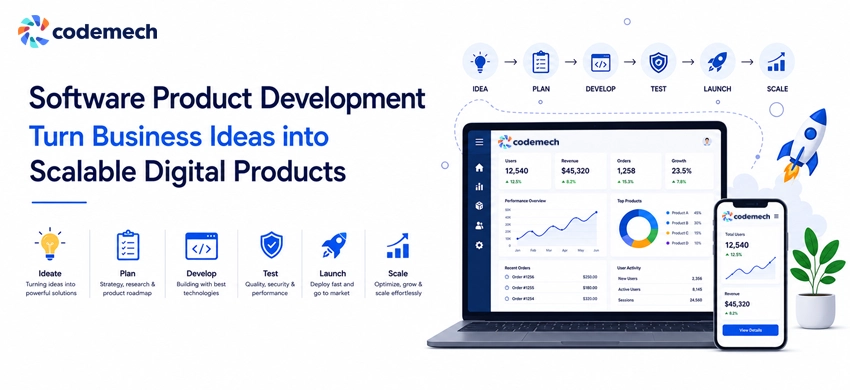
Every successful digital product begins with an idea. Whether it is a SaaS platform, enterprise application, mobile app, online marketplace, customer portal, or industry-specific software solution, the journey from concept to market-ready product requires strategic planning, technical expertise, and continuous innovation.
Many startups, entrepreneurs, and enterprises have promising software ideas but struggle with turning those concepts into scalable and profitable digital products. Common challenges include validating market demand, selecting the right technology stack, designing intuitive user experiences, ensuring scalability, managing development costs, and launching successfully in competitive markets.
This is where a professional Software Product Development Company becomes a critical business partner. By combining product strategy, design thinking, agile development methodologies, cloud technologies, and ongoing innovation, software development experts help businesses transform ideas into scalable digital solutions capable of supporting long-term growth.
At Codemech Solutions, we help organizations build future-ready software products that deliver measurable business value. In this guide, we explore how software product development companies transform innovative ideas into successful digital products and why businesses increasingly invest in custom software product development.
What is Software Product Development?
Software product development is the process of designing, building, testing, launching, and maintaining a software solution intended to solve specific business or consumer challenges.
Unlike traditional software projects that may focus on internal business operations, software products are typically designed for broader user adoption and market success.
Examples include:
- SaaS applications
- Enterprise platforms
- Customer portals
- Mobile applications
- Marketplaces
- Healthcare systems
- Fintech products
- Travel booking platforms
- eCommerce solutions
The objective is not simply to build software but to create a scalable product that delivers value to users while supporting business growth.
Idea Validation and Market Research
One of the most important phases of software product development is validating the idea before investing significant resources.
Understanding Market Demand
Successful products solve real problems.
Development teams conduct research to:
- Identify customer pain points, market gaps, industry trends, and competitive opportunities that help determine whether a product concept has genuine demand.
- Validate assumptions through customer interviews, surveys, competitor analysis, and market intelligence to reduce development risks.
Proper validation increases the likelihood of product success.
Defining Target Users
Understanding users is essential for product planning.
This process involves:
- Creating user personas that represent potential customers and their needs.
- Mapping user journeys to identify expectations, challenges, and opportunities for product improvement.
Customer-focused development results in stronger user adoption and engagement.
MVP Development Strategy
Many successful products begin with a Minimum Viable Product (MVP).
What is an MVP?
An MVP includes the core functionality necessary to solve a specific problem while minimizing development time and costs.
Benefits include:
- Faster time-to-market that allows businesses to gather real-world user feedback early in the development process.
- Reduced investment risks because organizations can validate concepts before committing to full-scale development.
MVPs help businesses make informed decisions based on actual user behavior.
Iterative Product Improvement
After launch, businesses can:
- Analyze user feedback and product performance.
- Prioritize new features based on customer needs and market demand.
This iterative approach supports sustainable product growth.
Organizations often seek Software Product Development Services to create MVP strategies that balance speed, quality, and scalability.
UI/UX Design for Software Products
User experience plays a significant role in product adoption and long-term success.
User-Centered Design
Modern software products focus on usability and accessibility.
Key principles include:
- Creating intuitive navigation structures that simplify interactions and reduce user frustration.
- Designing interfaces that align with user expectations and business objectives.
Well-designed products improve customer satisfaction and retention.
Wireframing and Prototyping
Before development begins, product teams often create:
- Interactive prototypes that simulate user experiences.
- Wireframes that define page layouts, workflows, and functionality.
These activities help identify improvements early in the process.
Agile Product Development Process
Agile development has become the preferred methodology for modern software product development.
Flexible Development Cycles
Agile frameworks divide projects into smaller iterations called sprints.
Advantages include:
- Faster delivery of functional product features.
- Continuous feedback loops that improve development quality and responsiveness.
Agile methodologies support rapid innovation and adaptation.
Improved Collaboration
Agile teams encourage communication among:
- Product managers
- Designers
- Developers
- Quality assurance specialists
- Stakeholders
Collaborative environments improve project outcomes and reduce risks.
Scalability and Cloud Architecture
Building a product that supports future growth is critical.
Scalable Infrastructure
Modern software products must accommodate:
- Increasing user volumes.
- Growing data requirements.
- Expanding functionality.
Scalable architecture helps ensure consistent performance during growth.
Cloud-Native Development
Cloud technologies provide businesses with:
- Flexible infrastructure that can scale based on demand.
- Reduced operational complexity and infrastructure costs.
Many organizations rely on Software Development Solutions built on cloud platforms to support long-term scalability and business expansion.
Product Testing and Quality Assurance
Product quality directly impacts customer trust and business reputation.
Functional Testing
Testing ensures that:
- Features perform as expected.
- Workflows operate correctly across different devices and environments.
Thorough testing helps minimize defects before launch.
Performance Testing
Software products must perform reliably under various conditions.
Testing activities evaluate:
- Speed
- Stability
- Scalability
- Security
Performance testing helps ensure a positive user experience.
Security Testing
Security is essential for protecting users and business operations.
Testing includes:
- Vulnerability assessments.
- Authentication verification.
- Data protection reviews.
Strong security practices improve trust and compliance.
Product Launch Strategies
A successful launch requires more than completing development.
Go-To-Market Planning
Launch preparation often includes:
- Defining target audiences and messaging.
- Developing marketing and customer acquisition strategies.
Strong planning helps maximize launch impact.
Soft Launch Approach
Many businesses choose to:
- Release products to a limited audience initially.
- Gather feedback and address issues before wider deployment.
This strategy helps reduce risks while improving product quality.
Post-Launch Maintenance and Upgrades
Product development continues after launch.
Continuous Monitoring
Successful products require:
- Performance monitoring.
- User behavior analysis.
- System health tracking.
Continuous monitoring helps identify improvement opportunities.
Feature Enhancements
As markets evolve, businesses must:
- Introduce new functionality.
- Improve user experiences.
- Adapt to changing customer expectations.
Regular updates help maintain competitiveness.
Long-Term Product Growth and Innovation
The most successful software products continuously evolve.
Data-Driven Decision Making
Analytics help organizations:
- Understand user behavior.
- Measure feature adoption.
- Identify opportunities for improvement.
Data-driven strategies support sustainable growth.
Emerging Technologies
Modern software products increasingly leverage:
- Artificial Intelligence
- Machine Learning
- AI Automation
- Predictive Analytics
- Cloud Computing
Innovation helps businesses remain competitive in rapidly changing markets.
Why Businesses Partner with Software Product Development Companies
Building successful software products requires expertise across multiple disciplines.
Access to Specialized Expertise
Development partners provide:
- Product strategy
- UI/UX design
- Software engineering
- Cloud architecture
- Quality assurance
This expertise helps reduce project risks and accelerate development.
Faster Time-to-Market
Experienced development teams help businesses:
- Streamline product planning.
- Accelerate development cycles.
- Launch products more efficiently.
Speed often provides significant competitive advantages.
Organizations frequently work with a trusted Software Development Company to gain access to specialized skills and proven development processes.
Why Choose Codemech Solutions?
At Codemech Solutions, we help startups, enterprises, and entrepreneurs transform innovative ideas into scalable digital products.
Our expertise includes:
- Product strategy and consulting.
- MVP development.
- Custom software development.
- Cloud-native architecture.
- UI/UX design.
- Product modernization.
- Ongoing support and innovation.
We focus on building software products that align with business goals while delivering exceptional user experiences and long-term scalability.
Conclusion:
Transforming a business idea into a scalable digital product requires far more than coding. It involves market validation, product strategy, user-centered design, agile development, cloud architecture, rigorous testing, and continuous innovation.
By partnering with an experienced Software Product Development Company, businesses can reduce development risks, accelerate time-to-market, improve product quality, and create solutions capable of supporting long-term growth.
Whether you are launching a SaaS platform, enterprise application, marketplace, or industry-specific solution, the right development strategy can significantly influence your success. With the support of Codemech Solutions, organizations can confidently transform ideas into powerful digital products that drive business growth and customer value.