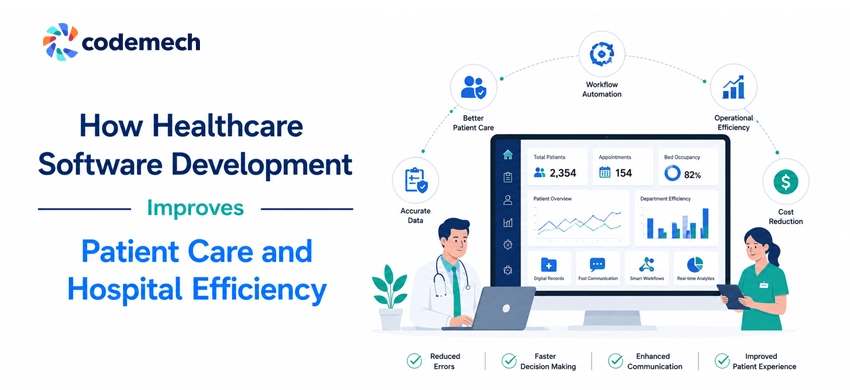
The healthcare industry is evolving rapidly as hospitals, clinics, diagnostic laboratories, specialty care centers, and healthcare startups embrace digital transformation to deliver better patient outcomes and improve operational efficiency. Growing patient expectations, increasing administrative workloads, stricter regulatory requirements, and rising healthcare costs have made technology a strategic investment rather than an optional enhancement.
Traditional software often struggles to support the unique workflows of modern healthcare organizations. Generic applications may offer standard functionality, but they rarely address specialized clinical processes, department-specific requirements, or seamless interoperability between multiple healthcare systems.
This is why healthcare providers worldwide are increasingly investing in custom healthcare software development to build secure, scalable, and intelligent digital solutions tailored to their operational needs.
Whether it's automating patient registration, simplifying appointment scheduling, improving clinical documentation, enabling telemedicine, or integrating AI-powered analytics, custom healthcare software helps organizations streamline operations while delivering a superior patient experience.
At Codemech Solutions, we specialize in delivering custom healthcare software development services that empower healthcare organizations to modernize their operations, improve efficiency, and support long-term digital transformation.
In this guide, we'll explore how custom healthcare software improves patient care, enhances hospital efficiency, and creates measurable business value for healthcare providers.
Why Healthcare Organizations Need Custom Software
Healthcare organizations operate in highly complex environments where multiple departments, healthcare professionals, patients, insurance providers, laboratories, pharmacies, and medical devices must work together efficiently.
Some common operational challenges include:
- Long patient waiting times
- Manual documentation
- Disconnected healthcare systems
- Appointment scheduling conflicts
- Billing errors
- Limited patient engagement
- Poor communication between departments
- Data duplication
- Administrative inefficiencies
- Increasing compliance requirements
While off-the-shelf software may solve individual problems, it often lacks the flexibility to support an organization's complete workflow.
Custom software for healthcare addresses these challenges by creating solutions designed specifically around the organization's processes, goals, and future growth.
How Custom Healthcare Software Improves Patient Care
Patient care remains the highest priority for every healthcare organization. Modern software helps clinicians spend less time managing paperwork and more time delivering quality care.
Centralized Patient Records
One of the biggest advantages of healthcare software is providing healthcare professionals with instant access to complete patient information.
Doctors can quickly review:
- Medical history
- Previous diagnoses
- Laboratory reports
- Imaging results
- Prescriptions
- Allergies
- Treatment plans
- Insurance information
Having accurate information readily available supports faster and better-informed clinical decisions.
Faster Appointment Scheduling
Patients increasingly expect convenient digital appointment booking.
Custom software enables:
- Online appointment scheduling
- Real-time doctor availability
- Automated confirmations
- Appointment reminders
- Rescheduling
- Waitlist management
This reduces missed appointments while improving patient satisfaction.
Improved Doctor-Patient Communication
Effective communication strengthens patient engagement and treatment adherence.
Healthcare software allows secure communication through:
- Patient portals
- Mobile applications
- Secure messaging
- Video consultations
- Digital prescriptions
- Follow-up reminders
Patients stay informed throughout their healthcare journey while healthcare providers maintain continuous communication.
Telemedicine and Remote Care
Virtual healthcare has become an essential part of modern medical services.
Healthcare organizations can offer:
- Video consultations
- Online prescriptions
- Virtual follow-ups
- Chronic disease monitoring
- Remote patient assessments
Telemedicine improves healthcare accessibility, particularly for patients in remote or underserved locations.
Personalized Patient Experiences
Custom software enables organizations to deliver personalized healthcare services by analyzing patient preferences, treatment history, and engagement patterns.
Examples include:
- Personalized health recommendations
- Medication reminders
- Preventive care alerts
- Wellness programs
- Customized treatment plans
Personalized experiences improve patient satisfaction and long-term outcomes.
Improving Hospital Efficiency Through Automation
Operational efficiency directly impacts the quality of healthcare services. Automating repetitive administrative tasks allows healthcare professionals to focus on delivering patient care.
Patient Registration Automation
Digital registration systems eliminate manual paperwork by allowing patients to submit information online before arriving at the healthcare facility.
Benefits include:
- Faster check-in
- Reduced paperwork
- Fewer data entry errors
- Improved patient flow
Electronic Medical Documentation
Healthcare providers can create, update, and access medical records digitally rather than relying on paper documentation.
Advantages include:
- Faster documentation
- Better collaboration
- Improved accuracy
- Easier record retrieval
- Reduced storage costs
Hospital Resource Management
Custom healthcare software helps hospitals optimize the use of resources such as:
- Operation theatres
- Hospital beds
- Medical equipment
- Diagnostic facilities
- Healthcare staff
Real-time visibility improves scheduling and resource utilization.
Inventory and Pharmacy Management
Hospitals manage thousands of medicines and medical supplies.
Automated inventory systems help:
- Track stock levels
- Monitor expiry dates
- Generate purchase requests
- Reduce wastage
- Prevent stock shortages
This improves operational efficiency while reducing unnecessary costs.
Billing and Insurance Processing
Healthcare billing is often time-consuming and prone to errors.
Custom software automates:
- Invoice generation
- Insurance claim processing
- Payment tracking
- Revenue reporting
- Financial reconciliation
Automation accelerates payment cycles and reduces administrative workload.
Healthcare Workflow Automation
Workflow automation is one of the most valuable outcomes of healthcare software development services.
Automated workflows reduce delays and eliminate repetitive manual processes.
Healthcare organizations can automate:
- Patient registration
- Appointment scheduling
- Laboratory requests
- Prescription management
- Diagnostic reporting
- Insurance verification
- Billing
- Staff scheduling
- Patient discharge
- Follow-up notifications
Automation increases productivity while minimizing human errors.
AI Is Transforming Healthcare Software
Artificial Intelligence is helping healthcare organizations deliver smarter and more proactive care.
AI Clinical Decision Support
AI analyzes patient records and medical research to assist healthcare professionals in identifying potential diagnoses and treatment options.
Predictive Healthcare Analytics
Healthcare organizations can identify high-risk patients earlier by analyzing:
- Medical history
- Lifestyle factors
- Vital signs
- Chronic disease patterns
Early intervention improves patient outcomes while reducing healthcare costs.
AI Chatbots
Healthcare chatbots provide:
- Appointment scheduling
- Frequently asked questions
- Medication reminders
- Patient education
- Follow-up assistance
AI-powered support improves patient engagement while reducing administrative workload.
Medical Image Analysis
AI supports radiologists by identifying abnormalities in:
- X-rays
- MRI scans
- CT scans
- Mammograms
This improves diagnostic efficiency while assisting clinical decision-making.
Benefits of Custom Healthcare Software for Hospitals
Healthcare organizations investing in custom healthcare software solutions experience measurable improvements across multiple areas.
Better Patient Experience
Patients receive faster, more convenient, and personalized healthcare services.
Increased Operational Efficiency
Automation reduces repetitive administrative work while improving productivity.
Improved Clinical Decision-Making
Healthcare professionals access accurate patient information in real time.
Stronger Data Security
Advanced encryption, role-based access controls, and secure cloud infrastructure protect sensitive patient information.
Seamless System Integration
Custom applications integrate with:
- EHR systems
- EMR platforms
- Laboratory systems
- Pharmacy software
- Insurance providers
- Medical devices
- Payment gateways
Connected healthcare systems improve collaboration across departments.
Scalability
Custom healthcare software grows alongside the organization, supporting additional facilities, users, departments, and services.
Types of Custom Healthcare Software Solutions
Healthcare organizations invest in different digital solutions depending on operational requirements.
Common examples include:
- Hospital Management Systems
- Electronic Health Records (EHR)
- Electronic Medical Records (EMR)
- Telemedicine Platforms
- Patient Portals
- Healthcare CRM Systems
- Laboratory Information Systems
- Pharmacy Management Software
- Healthcare Mobile Applications
- Remote Patient Monitoring Platforms
- Healthcare Analytics Dashboards
- AI-Based Diagnostic Solutions
Each solution can be tailored to specific business needs.
Choosing the Right Healthcare Software Development Partner
Building healthcare software requires technical expertise, healthcare domain knowledge, and a deep understanding of security, compliance, and interoperability.
Before selecting a development partner, evaluate:
- Healthcare industry experience
- Technical capabilities
- Cloud expertise
- Security-first development approach
- API integration experience
- AI and automation capabilities
- UI/UX design expertise
- Long-term support services
Choosing the right technology partner significantly impacts project success.
Why Choose Codemech Solutions?
Healthcare software should do more than digitize existing processes - it should help organizations improve patient care, increase efficiency, and prepare for future growth.
At Codemech Solutions, we develop secure, scalable, and intelligent healthcare applications tailored to the needs of hospitals, clinics, healthcare startups, diagnostic centers, and enterprise healthcare providers.
Our Healthcare Expertise Includes
- Custom Healthcare Software Development
- Hospital Management Systems
- Healthcare Mobile Applications
- Patient Portal Development
- EHR & EMR Solutions
- Telemedicine Platforms
- Healthcare CRM Systems
- AI-Powered Healthcare Applications
- API Integration & Healthcare Interoperability
- Cloud-Based Healthcare Platforms
Why Healthcare Organizations Trust Codemech Solutions
- Deep healthcare domain expertise
- Secure and scalable software architecture
- Modern cloud-native development
- AI-powered healthcare innovation
- Seamless third-party integrations
- End-to-end development and ongoing support
- Long-term technology partnership focused on measurable business outcomes
Whether you're modernizing existing healthcare systems or building a new digital healthcare platform, Codemech Solutions delivers customized software solutions designed to improve patient care and operational performance.
Conclusion:
The future of healthcare depends on intelligent digital solutions that improve both patient outcomes and operational efficiency. Custom healthcare software enables organizations to automate workflows, strengthen collaboration, streamline hospital management, enhance patient engagement, and make better clinical decisions through connected, data-driven systems.
Unlike generic software, custom-built solutions adapt to your organization's unique processes and support long-term growth. Investing in custom healthcare software development is not just a technology decision—it is a strategic investment in better healthcare delivery.
With extensive experience in custom software for healthcare, AI integration, cloud-native development, and secure application architecture, Codemech Solutions helps healthcare organizations build future-ready digital platforms that deliver measurable value for patients, healthcare professionals, and businesses alike.