Modern businesses rely on scalable, fast, and secure web applications to stay competitive in today’s digital landscape. As frontend technologies continue evolving, many companies are now upgrading legacy applications to modern Angular frameworks for better performance, maintainability, and long-term scalability. Whether you are using an outdated Angular version or still operating on AngularJS, migrating to the latest Angular ecosystem has become essential in Future.
At Codemech Solutions, we provide advanced Angular Development Services that help businesses modernize legacy applications, improve performance, and build future-ready digital solutions. As an experienced Angular Development Company, our team specializes in smooth and secure Angular migration strategies for startups, enterprises, and growing organizations worldwide.
What is Angular Migration?
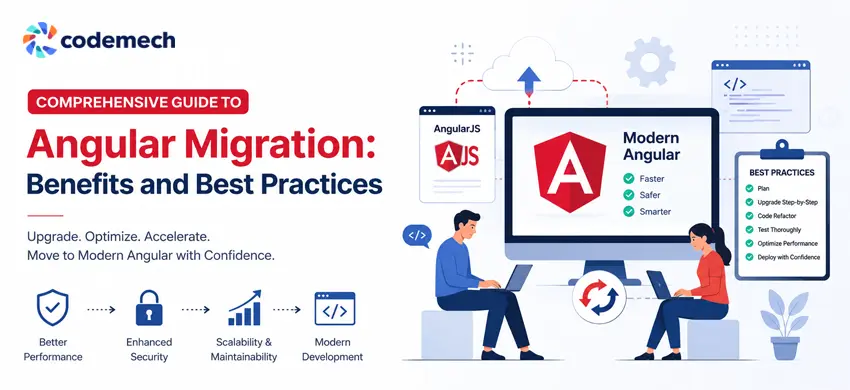
Angular migration refers to the process of upgrading an existing Angular application to a newer Angular version or migrating from AngularJS to the modern Angular framework. The purpose of migration is to improve application performance, security, scalability, code maintainability, and compatibility with modern development standards.
Angular has evolved significantly over the years. Modern Angular frameworks offer powerful Features such as:
- Component-based architecture
- Improved rendering performance
- TypeScript support
- Better dependency injection
- Standalone components
- Server-side rendering (SSR)
- Enhanced security updates
- Better developer tooling
Businesses using outdated Angular applications often experience slow performance, compatibility issues, security risks, and difficulties maintaining old codebases. Migration solves these challenges and ensures long-term business growth.
Why Businesses Are Migrating to Modern Angular:
Technology evolves rapidly, and outdated applications can negatively impact both customer experience and operational efficiency. Businesses are increasingly investing in Angular Development Solutions to modernize their web applications and stay ahead of competitors.
• Improved Application Performance: Modern Angular versions offer faster rendering, optimized bundle sizes, lazy loading, hydration support, and improved runtime performance. These enhancements directly improve website speed and user experience. Faster applications also help improve SEO rankings, reduce bounce rates, and increase customer engagement.
• Better Security and Stability: Older Angular versions may no longer receive security updates or official support. Migrating to the latest Angular version helps protect applications from vulnerabilities, outdated dependencies, and compatibility issues. Security is especially important for enterprise applications handling customer data, transactions, and sensitive information.
• Enhanced Scalability: Modern Angular architecture supports scalable application development. Businesses can efficiently expand their applications as user traffic and feature requirements grow. An experienced Angular Development Company can help design scalable frontend architectures that support long-term business expansion.
• Easier Maintenance: Legacy AngularJS applications often become difficult to maintain over time. Modern Angular frameworks simplify code management through reusable components, modular architecture, and improved tooling. This reduces development complexity and helps teams deliver updates faster.
• Better Developer Productivity: Angular CLI, TypeScript support, modern testing frameworks, and automated build tools improve development speed and collaboration between teams. Modern development environments reduce debugging time and improve overall productivity.
AngularJS vs Modern Angular
Many businesses still confuse AngularJS with modern Angular frameworks. However, both technologies differ significantly in architecture and capabilities.
|
AngularJS |
Modern Angular |
|
JavaScript-based |
TypeScript-based |
|
MVC architecture |
Component-based architecture |
|
Limited scalability |
Highly scalable |
|
Slower performance |
Faster rendering |
|
Limited mobile optimization |
Mobile-friendly framework |
|
Outdated support |
Active Google support |
|
Difficult maintenance |
Easier maintenance |
Modern Angular offers a much stronger ecosystem for enterprise-grade applications, making migration a smart investment for businesses planning long-term digital growth.
Signs Your Application Needs Angular Migration
Businesses should consider Angular migration if they experience the following issues:
- Slow application performance
- Increasing maintenance costs
- Outdated UI and user experience
- Compatibility issues with modern browsers
- Unsupported AngularJS dependencies
- Security vulnerabilities
- Difficulty scaling the application
- Frequent development bottlenecks
- Poor mobile responsiveness
Ignoring these problems can eventually affect customer experience, revenue generation, and operational efficiency.
Complete Angular Migration Process
A successful migration requires proper planning, testing, and execution. At Codemech Solutions, our Angular Development Services follow a structured migration strategy to minimize downtime and business risks.
Application Audit and Assessment
The first step involves analyzing the existing application architecture, dependencies, third-party libraries, and performance bottlenecks.
This helps identify:
- Deprecated APIs
- Legacy components
- Security issues
- Code complexity
- Compatibility concerns
A detailed assessment ensures a smoother migration roadmap.
Migration planning
After the audit, developers prepare a migration strategy based on project size, business goals, and technical requirements.
Migration planning includes:
- Timeline estimation
- Feature prioritization
- Risk analysis
- Rollback strategy
- Testing requirements
Proper planning helps reduce unexpected issues during migration.
3. Upgrading Angular Versions
For applications already using Angular, developers gradually upgrade versions step-by-step instead of directly jumping to the latest release.
This approach helps maintain stability and minimizes dependency conflicts.
4. Migrating from AngularJS to Angular
Migrating from AngularJS is more complex because both frameworks have different architectures.
Developers may use:
- Hybrid migration approaches
- Incremental module migration
- Full application rewrites
- Component-based modernization
The best strategy depends on application complexity and business requirements.
5. Code Refactoring and Optimization
Legacy code often requires restructuring to align with modern Angular standards.
This process includes:
- Converting controllers into components
- Optimizing services and APIs
- Improving routing architecture
- Implementing lazy loading
- Reducing technical debt
Refactoring improves maintainability and long-term scalability.
6. Testing and Quality Assurance
Comprehensive testing ensures the migrated application functions correctly across all devices and browsers.
Testing may include:
- Unit testing
- Integration testing
- Performance testing
- Security testing
- User acceptance testing
Proper QA helps avoid deployment issues and ensures application reliability.
7. Deployment and Monitoring
After testing, the migrated application is deployed to production environments. Continuous monitoring helps identify performance issues and optimize the application after launch.
Popular Angular Migration Strategies
Different businesses require different migration approaches. Common strategies include:
• Incremental Migration: This strategy upgrades applications module-by-module instead of rebuilding the entire application at once.
Benefits include:
- Lower risk
- Reduced downtime
- Easier testing
- Faster implementation
This is often the preferred approach for enterprise applications.
- Complete Rewrite: Some outdated applications require full redevelopment using modern Angular architecture.
This approach is suitable when:
- The legacy codebase is extremely outdated
- Application architecture is unstable
- Scalability limitations exist
Although more time-consuming, it offers complete modernization benefits.
- Hybrid Migration: Hybrid migration combines AngularJS and Angular components within the same application during transition phases.
This allows businesses to continue operations while gradually modernizing the system.
Common Challenges during Angular Migration
Angular migration can involve technical and operational challenges, including:
• Third-Party Dependency Issues: Older libraries may not support newer Angular versions, requiring replacements or custom solutions.
• Large Legacy Codebases: Enterprise applications often contain thousands of lines of legacy code that need careful restructuring.
• Performance Bottlenecks: Improper migration strategies can negatively impact application speed and responsiveness.
• Team Learning Curve: Development teams may need training to adapt to modern Angular features and TypeScript based workflows.
• Downtime Risks: Poor migration planning may disrupt business operations during deployment. Working with a professional Angular Development Company helps reduce these risks significantly.
Best Practices for Successful Angular Migration
Businesses should follow proven best practices for successful migration projects.
• Use Step-by-Step Upgrades: Avoid skipping multiple Angular versions during migration. Incremental upgrades help maintain application stability.
• Maintain Proper Documentation: Documentation helps developers track architecture changes, dependencies, and migration progress.
• Focus on Performance Optimization: Optimize bundle sizes, lazy loading, caching, and API calls during migration.
• Implement Automated Testing: Automated testing improves deployment reliability and reduces manual testing efforts.
• Keep Dependencies Updated: Regularly updating libraries and packages prevents compatibility issues in the future.
SEO and Business Benefits of Angular Migration
Modern Angular applications can significantly improve business performance and search visibility.
Benefits include:
- Faster page loading speed
- Better Core Web Vitals
- Improved mobile experience
- Enhanced user engagement
- Lower bounce rates
- Improved scalability
- Better search engine crawling with SSR
These advantages help businesses improve both customer experience and organic search rankings.
Why Choose Codemech Solutions for Angular Migration?
Choosing the right Angular Development Company is critical for successful migration projects. At Codemech Solutions, we deliver scalable and future-ready Angular Development Solutions tailored to business requirements.
Our expertise includes:
- AngularJS to Angular migration
- Enterprise Angular application development
- Frontend modernization
- Performance optimization
- API integration
- Responsive UI development
- Long-term maintenance and support
Our experienced developers follow modern development standards, SEO best practices, and Google EEAT guidelines to build secure and scalable web applications.
Future of Angular Development
Angular continues evolving with powerful features focused on performance, developer experience, and scalability. Emerging trends include:
- Standalone components
- Server-side rendering improvements
- AI-powered web experiences
- Enhanced hydration support
- Better state management
- Faster build systems
- Improved micro frontend architecture
Businesses investing in Angular modernization today will be better prepared for future digital transformation opportunities.
Conclusion:
Angular migration is no longer just a technical upgrade; it is a strategic business investment. Modern Angular applications provide improved performance; scalability, security, and long-term maintainability that businesses need to remain competitive in Future.
Whether you are migrating from AngularJS or upgrading an outdated Angular application, partnering with an experienced Angular Development Company can help ensure a smooth and successful transition.
At Codemech Solutions, offers dedicated Angular expert who specialize in Angular migration, enterprise web development, frontend modernization, and custom Angular Development Solutions tailored to your business needs.
If your business is planning an Angular migration project, now is the perfect time to upgrade your application for better performance, improved user experience, and future-ready scalability.