Modern SaaS businesses are growing faster than ever, but many companies still struggle with one critical problem: their application architecture cannot handle long-term growth. What starts as a simple web application for a few hundred users often becomes unstable once traffic increases, integrations grow, teams expand, and customer expectations rise. Slow APIs, database bottlenecks, deployment failures, security risks, and scaling limitations begin affecting both business performance and user experience. This is exactly why scalable architecture has become one of the most important foundations for SaaS success in 2026.
Whether you are a startup founder building a SaaS MVP, a CTO modernizing a legacy platform, or an enterprise launching a cloud-native solution, investing in professional enterprise web application development services can directly impact your product scalability, operational efficiency, and long-term profitability. In this guide, we will explain how to build a scalable enterprise web application architecture for SaaS products, including real-world examples, practical implementation strategies, architecture decisions, scalability considerations, cloud infrastructure planning, and future-ready development approaches businesses are using globally.
Why Scalability Matters More Than Ever in 2026
A few years ago, many SaaS businesses focused primarily on launching products quickly. Today, the market is different.
Users now expect:
- real-time performance
- uninterrupted uptime
- fast loading speed
- enterprise-grade security
- seamless integrations
- AI-powered automation
- multi-device accessibility
At the same time, SaaS products are becoming increasingly complex.
A modern enterprise SaaS platform may include:
- customer dashboards
- analytics systems
- AI integrations
- payment gateways
- mobile applications
- third-party APIs
- workflow automation
- cloud infrastructure
- role-based permissions
- microservices architecture
Without scalable architecture, these systems eventually fail under pressure.
Many businesses experience:
- rising infrastructure costs
- slower deployment cycles
- technical debt
- system crashes during traffic spikes
- security vulnerabilities
- frustrated users
- reduced customer retention
This is why businesses worldwide are investing heavily in enterprise web application development services, software architecture consulting services, and modern cloud engineering solutions to future-proof their SaaS platforms.
What Is a Scalable Enterprise Web Application Architecture?
In simple terms, scalable architecture means building your SaaS application in a way that can handle increasing users, traffic, features, and business operations without breaking performance.
A scalable enterprise architecture allows businesses to:
- grow users without downtime
- launch features faster
- integrate external systems easily
- improve application security
- reduce operational risks
- optimize infrastructure costs
- support long-term digital transformation
- Think of scalability like building a city.
A small town may work with a few roads and basic infrastructure. But once millions of people move in, poor planning creates traffic congestion, utility failures, and operational chaos. Enterprise SaaS applications work the same way. If architecture planning is weak, scaling becomes expensive and risky.
Core Components of Scalable SaaS Architecture
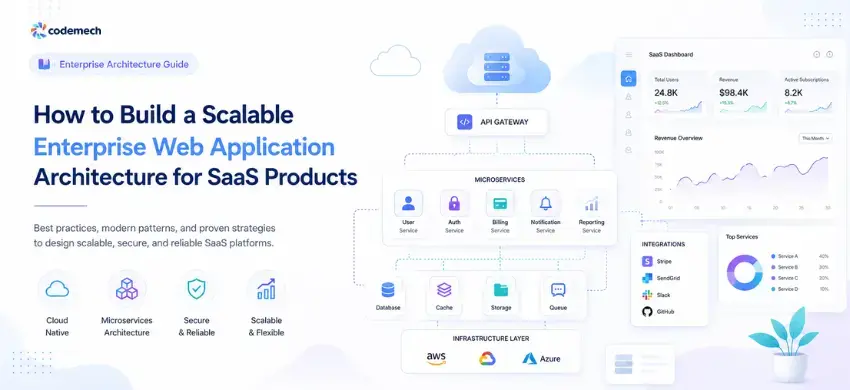
1. Cloud-Native Infrastructure
Modern SaaS applications are increasingly built using cloud application development services because cloud-native systems offer:
- flexibility
- scalability
- global accessibility
- automated infrastructure management
Cloud platforms like AWS, Azure, and Google Cloud enable businesses to scale resources dynamically based on demand.
For example:
An eCommerce SaaS platform may receive 5x more traffic during holiday sales. A cloud-native infrastructure can automatically scale servers without affecting customer experience. This flexibility is one reason why cloud-based SaaS adoption continues growing rapidly in the USA, Canada, Australia, South Africa, and India.
2. Microservices Architecture
One of the biggest architecture shifts in recent years has been the move from monolithic applications to microservices development services.
In a monolithic system:
- all components are tightly connected
In microservices architecture:
- features operate independently
For example:
A SaaS CRM platform may separate:
- authentication service
- payment service
- analytics engine
- notification service
- customer management system
- Each service can scale independently.
Benefits include:
- faster deployments
- easier maintenance
- better fault isolation
- improved scalability
- independent development teams
Large SaaS companies rely heavily on microservices because they support continuous innovation without disrupting the entire platform.
3. API-First Development
Modern SaaS products rely heavily on API development services.
APIs connect:
- frontend applications
- mobile apps
- payment gateways
- AI systems
- external business tools
- analytics platforms
- An API-first approach ensures future flexibility.
For example:
A logistics SaaS platform may integrate with:
- GPS providers
- inventory management systems
- accounting software
- warehouse management platforms
Without scalable APIs, integration becomes difficult and expensive.
Businesses building enterprise SaaS products today increasingly prioritize:
- REST APIs
- GraphQL APIs
- event-driven architecture
- secure API gateways
- to support scalable digital ecosystems.
4. Scalable Database Architecture
Many SaaS products fail because their database architecture cannot handle growth.As applications scale, businesses face:
- slow queries
- data duplication
- performance bottlenecks
- synchronization issues
Scalable enterprise applications typically use:
- distributed databases
- database replication
- caching layers
- optimized indexing
- read/write separation
For example:
A healthcare SaaS platform handling millions of patient records requires highly optimized data architecture to maintain speed and security simultaneously.
5. DevOps and CI/CD Pipelines
Fast-growing SaaS businesses cannot rely on manual deployment processes.
Modern teams at a trusted enterprise software development company use:
- DevOps automation
- CI/CD pipelines
- infrastructure as code
- automated testing
- container orchestration
to accelerate deployments while reducing operational risks.
This enables:
- faster feature releases
- improved stability
- rollback protection
- automated monitoring
In 2026, DevOps has become essential for scalable SaaS operations.
Real Business Challenges Companies Face
Many businesses approach scalable architecture only after facing serious problems.
Startup Growth Problems
A startup launches quickly using basic architecture.
Within 12 months:
- user traffic increases
- mobile users grow
- integrations expand
- server costs rise
- deployments become unstable The original system becomes difficult to maintain.
Enterprise Modernization Challenges
Large enterprises often operate on legacy systems built years ago.
Common issues include:
- outdated frameworks
- security vulnerabilities
- poor scalability
- slow development cycles
- integration limitations
This is where custom enterprise software development services become critical for modernization.
SaaS Multi-Tenant Complexity
Enterprise SaaS platforms must support multiple customers securely on shared infrastructure.
This requires:
- tenant isolation
- role-based access
- scalable permissions
- data segmentation
- advanced security architecture
Poor planning in these areas can create serious compliance and performance risks.
How to Build a Scalable SaaS Architecture Step by Step
Step 1: Define Business Scalability Goals
Before selecting technologies, businesses must define:
- expected user growth
- future features
- geographic expansion
- compliance requirements
- integration needs
Architecture decisions should align with long-term business goals.
Step 2: Choose the Right Tech Stack
Technology selection directly affects scalability.
Modern SaaS platforms commonly use:
- React or Angular for frontend
- Node.js, Java, or .NET for backend
- Kubernetes for orchestration
- PostgreSQL or MongoDB databases
- Redis caching
- Docker containerization
A professional SaaS development company helps businesses choose technologies based on:
- scalability
- security
- development speed
- operational cost
- future flexibility
Step 3: Implement Modular Architecture
Scalable SaaS products should separate:
- frontend
- backend
- APIs
- databases
- authentication
- analytics
- notifications
This improves maintainability and scalability.
Step 4: Optimize Infrastructure for Growth
Businesses should design infrastructure with:
- auto-scaling
- load balancing
- CDN integration
- disaster recovery
- monitoring systems
- from the beginning.
Waiting until traffic spikes happen often creates avoidable downtime.
Step 5: Prioritize Security Early
Security should never be added later.
Enterprise SaaS architecture should include:
- data encryption
- secure authentication
- API protection
- access management
- audit logs
- compliance standards
especially for:
- fintech
- healthcare
- logistics
- enterprise systems
Real-World Example: SaaS Scaling Scenario
Imagine a project management SaaS startup serving 2,000 users. Initially, a simple monolithic architecture may work.
But after securing enterprise clients:
- users grow to 200,000
- integrations increase
- AI features are added
- mobile traffic rises
- reporting systems expand
Without scalable architecture:
- application performance slows
- deployments fail frequently
- customer complaints increase
The company eventually migrates to:
- cloud-native infrastructure
- microservices
- Kubernetes
- scalable APIs
- distributed databases
Result:
- 70% faster deployment cycles
- improved uptime
- lower infrastructure risks
- better enterprise client retention This transition is now extremely common among growing SaaS businesses.
Sample Case Study Example
A mid-sized logistics company approached Codemech Solutions, a leading software product development company, to modernize their legacy shipment management platform.
Their challenges included:
- slow application performance
- failed API integrations
- poor scalability during peak seasons
- manual deployment issues
- increasing infrastructure costs
The engineering team at Codemech Solutions redesigned the platform using:
- microservices architecture
- cloud-native infrastructure
- containerized deployments
- scalable API integrations
- CI/CD automation
Results after implementation:
- application response time improved by 60%
- deployment time reduced from hours to minutes
- infrastructure scalability improved significantly
- downtime during peak traffic was eliminated
- customer satisfaction improved noticeably
This is a common example of how scalable architecture directly impacts operational efficiency and business growth.
Industry-Specific Applications
FinTech SaaS Platforms
Require:
- high security
- real-time processing
- fraud detection
- scalable transaction systems
Healthcare SaaS Applications
Need:
- HIPAA-compliant architecture
- encrypted patient data
- secure APIs
- scalable cloud infrastructure
eCommerce SaaS Systems
Require:
- inventory synchronization
- payment gateway integration
- scalable checkout systems
- real-time analytics
Logistics Platforms
Need:
- GPS integrations
- fleet tracking
- warehouse synchronization
- route optimization systems
AI-Powered SaaS Products
Require:
- GPU scalability
- AI model serving
- data pipelines
- high-performance APIs
Cost Considerations for Scalable SaaS Architecture
Many businesses worry that scalable architecture is expensive. In reality, poor architecture becomes far more expensive over time.
Common hidden costs include:
- downtime losses
- emergency infrastructure fixes
- developer inefficiency
- technical debt
- customer churn
- migration expenses
A properly designed architecture helps businesses:
- reduce operational costs
- optimize cloud spending
- improve engineering productivity
- accelerate feature releases
Long-term scalability should always be viewed as a business investment, not just a technical expense.
Common Mistakes Businesses Make
Building Too Fast Without Planning
Many startups prioritize speed while ignoring scalability.
This often creates:
- unstable systems
- architectural limitations
- future migration problems
Ignoring Infrastructure Automation
Manual deployments slow down development and increase operational risk.
Poor API Design
Weak APIs create integration bottlenecks that limit future growth.
Choosing Technologies Without Scalability Planning
Some businesses select frameworks based only on short-term development speed. Long-term scalability often gets ignored.
Delaying Security Implementation
Security vulnerabilities become expensive to fix later.
Best Practices for Scalable Enterprise SaaS Development
Design for Change
Architecture should support future business evolution.
Invest in Observability
Use:
- monitoring
- logging
- analytics
- performance tracking
to proactively identify problems.
Build Modular Systems
Independent services improve flexibility.
Prioritize User Experience
Scalability is not only technical. Fast and reliable user experiences directly affect retention.
Use Experienced Architecture Consultants
Professional software architecture consulting services help businesses avoid costly mistakes early.
Future Trends in Enterprise SaaS Architecture (2026 and Beyond)
Several trends are reshaping enterprise SaaS development globally:
AI-Native SaaS Platforms
AI-powered workflows are becoming standard.
Serverless Infrastructure
Businesses increasingly use serverless systems for scalability and cost optimization.
Edge Computing
Applications are moving closer to users for lower latency.
Event-Driven Architecture
Real-time event processing improves responsiveness.
Multi-Cloud Strategies
Enterprises increasingly avoid relying on a single cloud provider.
Why Businesses Choose Codemech Solutions For Enterprise Web Application Architecture for SaaS Products
Building scalable SaaS platforms requires more than coding expertise. Businesses need:
- strategic architecture planning
- cloud scalability expertise
- API-first engineering
- DevOps automation
- enterprise security understanding
- long-term technical partnership
Codemech Solutions works with startups, SMEs, and enterprises to build scalable enterprise applications that support long-term growth.
As an experienced enterprise software development company, Codemech Solutions helps businesses:
- modernize legacy systems
- build cloud-native SaaS products
- implement microservices architecture
- optimize application scalability
- accelerate product delivery The engineering team focuses on creating scalable, secure, and future-ready digital platforms tailored to modern business needs.
Whether businesses need enterprise web application development services, software architecture consulting services, cloud application development services, or custom enterprise software development services, Codemech Solutions provides scalable technology solutions designed for long-term success.
Conclusion
Scalable architecture is no longer optional for SaaS businesses in 2026. As user expectations, integrations, AI adoption, and cloud infrastructure demands continue growing, businesses must build applications that can evolve without performance limitations.
A well-designed enterprise SaaS architecture helps businesses:
- scale efficiently
- improve system reliability
- accelerate innovation
- reduce operational risks
- enhance customer experience
From cloud-native infrastructure and microservices to API-first development and DevOps automation, every architectural decision directly impacts future scalability. Businesses that invest in scalable architecture early gain a significant competitive advantage in the global SaaS market. Partnering with experienced teams like Codemech Solutions can help businesses build enterprise-grade SaaS platforms designed for long-term growth, operational stability, and future innovation.