By Codemech Solutions — Enterprise Application Engineering Experts
Monolith to Microservices Migration is becoming a critical priority for enterprises aiming to scale applications faster, improve deployment agility, and modernize legacy systems without disrupting business continuity. Most organizations initially build applications using a monolithic architecture, where all business logic, modules, and services exist within a single unified codebase. While this model works efficiently during early development stages, it eventually creates limitations in scalability, flexibility, and deployment independence.
While monolithic applications offer simplicity in the early development stages, they eventually become major roadblocks to:
- Scalability
- Deployment agility
- Development velocity
- System resilience
- Team autonomy
- Continuous innovation
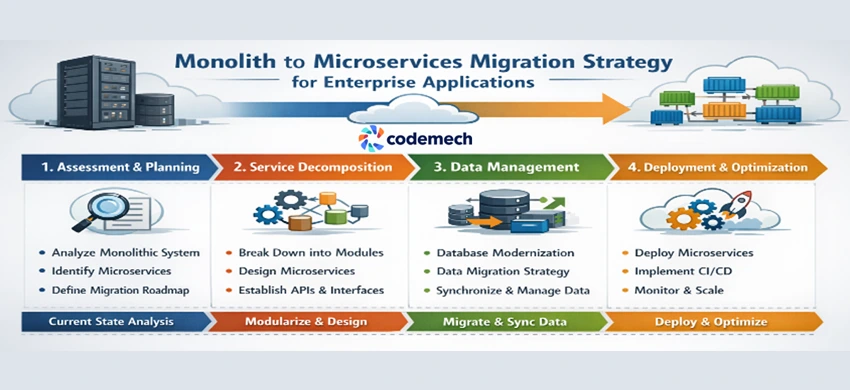
To overcome these challenges, organizations adopt a Microservices Migration Strategy that enables modular scalability, independent deployments, and faster innovation cycles. However, migrating from a monolith to a distributed system architecture without proper planning can introduce operational risks, data inconsistencies, and performance failures. At Codemech Solutions, we approach Monolithic Architecture Modernization through an incremental and rollback-safe decomposition strategy not a risky big-bang rewrite.
Why Full “One-Shot” Monolith Decomposition Fails
Many enterprises attempt a complete rewrite of their legacy monolithic application into microservices in one go. Unfortunately, this approach has a long-documented history of failure. A full rewrite simultaneously introduces risk across multiple layers:
- Application architecture
- Infrastructure environment
- Data consistency
- Deployment pipelines
- Observability stack
- Team ownership boundaries
- Runtime communication
When everything changes at once, identifying production failures becomes extremely difficult. Instead of increasing agility, organizations end up facing:
- Deployment instability
- Performance degradation
- Data synchronization issues
- Service downtime
- Team coordination bottlenecks
Therefore, the objective of a successful monolith to microservices migration strategy should never be speed. The real goal is: Controlled, reversible architectural evolution
Core Principles of Reliable Monolith Decomposition
Before extracting any service from your legacy system, organizations must align on some non-negotiable decomposition principles.
1. Extract Incrementally — One Service at a Time
An Incremental Microservices Migration approach allows enterprises to:
- Reduce deployment risks
- Maintain rollback capabilities
- Validate service boundaries
- Improve system resilience
- Avoid cascading failures
Each extracted service becomes a reusable migration pattern for future domains.
2. Modularize Before Distributing
Before distributing business logic across independent services, ensure proper modularization within the monolith. If domain boundaries cannot function cleanly inside the system, distributing them into cloud-native microservices will only increase:
- Runtime latency
- Dependency conflicts
- Integration complexity
- Service failures
3. Observability Before Extraction
You cannot debug what you cannot observe. Before any microservice deployment, your system must implement:
- Centralized logging
- Distributed tracing
- Runtime metrics
- Performance dashboards
- Automated alerting
Observability must exist before service extraction not after production incidents.
4. Data Migration Is Always the Last Step
Data ownership separation is the least reversible phase in an Enterprise Application Modernization journey. Always stabilize:
- API contracts
- Service interfaces
- Deployment workflows
before performing database separation in containerized deployment environments.
5. Every Service Extraction Must Be Rollback-Ready
If a service migration cannot be undone instantly, it is not production-ready. Implement:
- Feature flags
- Traffic routing controls
- Gateway-based rollback
- Failover routing
This allows immediate fallback to the monolith in case of service instability.
6. Avoid Premature Infrastructure Complexity
Do not introduce:
- Service mesh
- Event sourcing
- Distributed messaging
- Advanced service orchestration
without validated business needs. Premature infrastructure increases operational complexity without immediate ROI.
Monolith to Microservices Migration Strategy for Legacy Applications
A successful Monolith to Microservices Migration Strategy for Legacy Applications requires:
- Incremental service decomposition
- API Gateway migration
- Independent deployment capabilities
- Secure service orchestration
- DevOps automation pipelines
All production traffic should first pass through an API Gateway even if still served by the monolith.
Align Organizational Structure with Architecture
According to Conway’s Law: System design mirrors organizational communication structure. Each microservice must have:
- A dedicated owning team
- Clear operational responsibility
- Independent deployment authority
Shared ownership leads to architectural regression and deployment bottlenecks.
Build the Platform Foundation First
Before beginning service extraction:
- Containerize the monolith
- Implement API Gateway routing
- Establish CI/CD pipelines
- Deploy observability stack
- Configure secrets management
All production traffic should flow through the API Gateway even if still served by the monolith.
Before planning a migration, it’s important to understand the trade‑offs — see our analysis of Monolithic vs. Microservices: Which Architecture is Right for Your Business?.
This service migration sequence must repeat for each domain.
Identify the Right Service Boundary
Use:
- Domain-Driven Design (DDD)
- Bounded Context Mapping
- Event Storming Workshops
Begin with leaf domains:
- Minimal inbound dependencies
- Clear business ownership
- Lower coupling risk
Avoid extracting highly entangled domains early in the migration journey.
Introduce a Seam in the Monolith
Create an internal interface or facade around domain logic. Key rules:
- No functional change
- Internal callers route through facade
- Application behavior remains identical
This seam becomes the official microservice extraction point.
Build the New Microservice Against the Same Contract
The new service must replicate the monolith interface exactly. Avoid redesigning APIs during extraction because simultaneous:
- Contract change
- Architecture change
- Multiplies migration risk. API refactoring can happen later.
Migrate Data in Parallel
Provision a dedicated service database using:
- Change Data Capture (CDC)
- Dual-write synchronization
- Event replication
Validate migration accuracy using:
- Record count comparison
- Checksums
- Business validation queries
Shared databases should only be temporary.
Shadow Testing
Before exposing the new service to production users:
- Mirror live traffic
- Compare service responses
- Identify mismatches
- Fix inconsistencies
End-users remain completely unaware during this stage.
Canary Traffic Rollout
Gradually shift traffic through the API Gateway:
- 1–5% initial routing
- Monitor latency and error rates
- Increase gradually:
5% → 25% → 50% → 100% Each rollout phase must pass a full business cycle. Feature flags allow instant rollback if needed.
Disable the Monolith Code Path
After at least two weeks of service stability:
- Disable legacy logic
- Route all internal callers to service APIs
- Decommission schema only after write cessation
Code deletion is the final step never the first.
Non-Negotiable Production Requirements
Security
Each service boundary is a trust boundary. Implement:
- mTLS communication
- Workload identity
- Default-deny network policies
- Secure secret management
- Zero-trust architecture principles
Observability
Production-ready microservices require:
- Structured logging
- Distributed tracing
- RED metrics (Rate, Errors, Duration)
- Monitoring dashboards
- Automated alerting
Unobservable services create invisible production incidents.
Resilience Engineering
Each service must include:
- Request timeouts
- Retry mechanisms
- Circuit breakers
- Backup strategies
- Disaster recovery plans
- Defined RTO / RPO
API Contracts
Maintain:
- Machine-readable API specifications
- Consumer-driven contract testing
- Versioned APIs
Silent contract drift is unacceptable in distributed systems.
Developer Experience
Each microservice must:
- Run locally with a single command
- Use stubbed dependencies
- Generate mocks from API contracts
Poor developer experience directly increases production defects.
Signs Your Microservices Migration Is on Track
- Monolith codebase reduces every sprint
- Legacy paths are disabled
- Service extraction completes within 8 weeks
- Independent deployments increase
- Failures remain isolated
- New developer onboarding improves
Signs of a Distributed Monolith
- Shared service ownership
- Lock-step deployments
- Shared databases
- Multi-team API coordination
- Deferred observability
These indicate migration failure.
Final Thoughts
Migrating from a monolithic to a microservices architecture is not simply a technical transformation it's a comprehensive journey that encompasses product evolution, platform modernization, and cultural change. A successful migration is not about undertaking a risky, one-time rewrite; rather, it’s a gradual, controlled process that ensures business continuity while paving the way for scalable, agile, and resilient systems. By embracing a step-by-step, incremental approach, organizations can achieve faster deployment cycles, improved system resilience, and more efficient innovation. At Codemech Solutions, we understand that every enterprise modernization journey is unique. Our focus is on providing low-risk, strategic approaches that minimize operational disruption and ensure long-term success. With a well-planned microservices migration, businesses can unlock new levels of scalability, independence, and resilience, ultimately fostering continuous growth and technological advancement. We are committed to guiding enterprises through this complex transition with the right tools, strategies, and expertise to ensure their success in the digital era.