The Need for Transformation: Why Migrate from COBOL to Java?
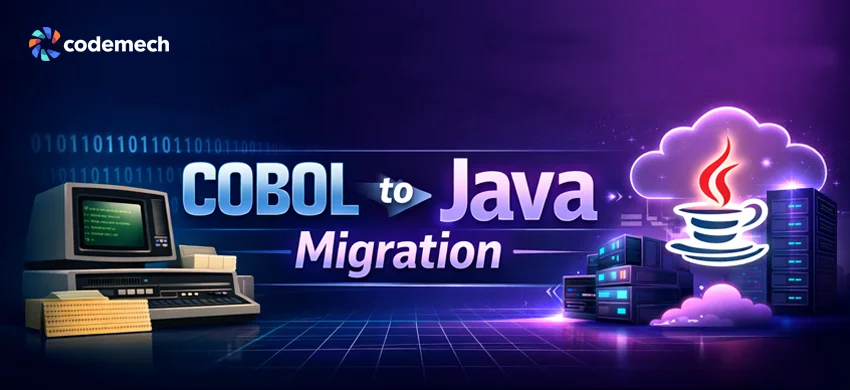
COBOL, short for Common Business-Oriented Language, has been a cornerstone of business computing since its inception in the late 1950s. For decades, it has powered critical applications in sectors such as banking, insurance, and government. Despite its reliability and robustness, COBOL is now seen as an aging technology, primarily due to its dated syntax and lack of support for modern programming paradigms. Organizations are increasingly finding it challenging to maintain and enhance COBOL-based systems, primarily due to the dwindling number of developers proficient in the language.
This growing challenge clearly highlights Why Migrate from COBOL to Java? and why enterprises are actively investing in Application Modernization Services and Legacy Application Modernization Services to transform outdated systems into scalable modern architectures.
On the other hand, Java has emerged as one of the most popular and versatile programming languages. With its object-oriented design, platform independence, and strong community support, Java offers numerous advantages over COBOL. Migrating to Java enables organizations to leverage modern development practices, improve system performance, and facilitate easier integration with contemporary technologies. Additionally, Java's extensive libraries and frameworks significantly streamline application development, making it an attractive choice for modernizing legacy systems through Java Software Development Services and support from a reliable Java Software Development Company.
Therefore, the migration from COBOL to Java is not just a technological upgrade; it represents a strategic move towards future-proofing an organization's IT infrastructure. By transforming COBOL applications to Java, businesses can enhance their agility, reduce operational costs, and ensure the long-term sustainability of their software assets using enterprise-grade Enterprise Software Development Services. This guide on How to Migrate COBOL to Java Step by Step aims to provide a detailed, structured approach to achieving this transformation using multi-agent systems.
Modernization Beyond Code Conversion: What Really Matters
It’s crucial to understand that migrating COBOL to Java is only one aspect of modernization. Simply rewriting code does not guarantee a modern, scalable, or secure system. True modernization involves multiple factors:
Architecture: Building modular, scalable, and maintainable systems using modern design patterns.
Performance: Handling large datasets, jobs, batches, queues, and high-volume transactions efficiently.
Security & Compliance: Ensuring data encryption, role-based access, and meeting legal/industry standards.
Stability & Reliability: Reducing downtime and building fault-tolerant systems.
Maintainability: Clean, documented, and easily upgradable Java code.
Databases & Data Handling: Migrating legacy data to modern relational or NoSQL databases with optimized queries.
Interfaces & Workflows: Updating UI, APIs, and file systems for smooth integration.
Hardware & Scalability: Supporting millions of records in high-load scenarios without performance degradation.
Companies like Codemech Solutions emphasize this holistic approach, combining Application Modernization Services, Enterprise Software Development Services, and DevOps automation to create robust, future-ready IT systems.
Overview of Multi-Agent Systems in Software Migration
Multi-agent systems (MAS) are a subset of AI where intelligent agents interact to achieve specific goals. In software migration, MAS helps streamline tasks such as code analysis, translation, optimization, and validation.
For complex migrations like COBOL to Java, MAS ensures meticulous handling of:
- Parsing COBOL code
- Translating it into Java with frameworks supported by Java Application Development Services
- Optimizing performance and validating functionality This reduces human error and aligns with modern Application Modernization Services practices.
AI can accelerate migration projects — learn more in How to Modernize Legacy Code Using AI.
Preparing for the Migration: Analyzing Existing COBOL Code
The first step in How to Migrate COBOL to Java Step by Step is a thorough analysis of the existing COBOL codebase. This phase involves understanding the application's architecture, identifying key components, and mapping business logic.
Begin by cataloging all COBOL programs, modules, and scripts. This inventory acts as a blueprint for migration. Next, analyze dependencies, workflows, and data handling processes. Pay special attention to file systems and structured data flows, which often require specialized Data Migration Solutions during modernization.
Organizations often partner with a Java Application Development Company or experienced Application Modernization Services providers to perform this analysis effectively.
Using static code analyzers and COBOL parsers helps uncover hidden dependencies and logic structures. Collaboration with stakeholders ensures accurate understanding, which is critical for successful migration.
Designing the Migration Strategy: Key Considerations
A well-defined strategy is essential for successful migration.
- First, clearly define business objectives such as performance improvement, scalability, or UI modernization. These goals align directly with enterprise-level Legacy Application Modernization Services.
- Second, decide whether to follow a phased or full migration approach. Phased migration reduces risk and allows incremental validation.
- Third, allocate resources effectively. A skilled team including COBOL experts, Java developers, QA engineers, and DevOps professionals is essential. Many organizations partner with a DevOps Consulting Company to streamline deployment pipelines and automation.
- Technology selection is equally important. Choose tools, frameworks, and environments that support scalable Java development, such as those used by a professional Java Software Development Company.
Step-by-Step Migration Process: From COBOL to Java
This section explains How to Migrate COBOL to Java Step by Step using a structured approach.
Step 1: Code Analysis and Preparation
Perform detailed analysis using tools and manual review to understand the system architecture.
Step 2: Code Translation
Convert COBOL code into Java using automated tools and manual refinement. This step is often supported by Java Application Development Services and advanced frameworks like those offered by a Spring boot company.
Step 3: Code Optimization
Refactor code for performance, readability, and maintainability. Apply Java best practices and modern architecture patterns.
Step 4: Integration and Testing
Integrate Java modules into the system and validate using Software Testing Services. Ensure seamless interaction between components.
Step 5: Deployment and Monitoring
Deploy the application and monitor performance using DevOps pipelines designed by a DevOps Consulting Company. Technology partners like codemech solutions help organizations execute this entire migration lifecycle with scalable architecture, automation, and performance optimization.
Testing and Validation: Ensuring Code Quality Post-Migration
Testing is critical to ensure system reliability. Unit testing validates individual components. Integration testing ensures system compatibility. Regression testing confirms no functionality is broken. User Acceptance Testing ensures business requirements are met. Performance testing evaluates scalability and responsiveness under load. Organizations often rely on professional Software Testing Services to ensure high-quality outcomes and minimize post-migration risks.
Common Challenges in COBOL to Java Migration and Solutions
Understanding challenges is essential in Why Migrate from COBOL to Java? discussions. Complex business logic requires detailed documentation and expert validation. Legacy data formats require structured Data Migration Solutions. Performance concerns can be resolved using Java concurrency and optimization tools. Dependency management requires careful planning and integration testing. Skill gaps can be addressed by partnering with a Java Software Development Company or leveraging external modernization experts.
Tools and Technologies for Effective Migration
- COBOL analyzers – Understand legacy systems
- Automated translators – Speed up code conversion
- Modern IDEs – Efficient Java development
- Testing frameworks – Ensure quality assurance
- Profiling tools – Optimize performance
- CI/CD pipelines – Automate deployment and testing, managed by DevOps Consulting Companies
Conclusion: The Future of Legacy Systems and Java Development
The journey of How to Migrate COBOL to Java Step by Step represents a strategic transformation toward modern, scalable, and efficient IT systems. Organizations adopting Application Modernization Services can significantly improve agility, reduce costs, and future-proof their infrastructure. By leveraging Java technologies, multi-agent systems, and modern frameworks like Spring Boot, businesses can unlock new innovation opportunities. Technology partners such as codemech solutions play a crucial role in enabling seamless migration, offering expertise in Enterprise Software Development Services, Java Software Development Services, and end-to-end modernization strategies. As digital transformation accelerates, migrating from COBOL to Java is no longer optional it is a necessity for long-term success and competitive advantage.